
Governance hype vs. business reality: Moving toward trust models
4 November 2025 | 8 mins read | Data Culture
by Jessica, Tech writer

There’s a growing disconnect in many organizations: Governance is talked about as indispensable, yet it’s often treated as a checkbox.
Leaders are eager to adopt data and AI strategies, invest in platforms, and hire data governance officers—but often, implementation lags.
In this post, we explore Gartner’s finding that while nearly 89% of data and analytics leaders say governance is essential for innovation, far fewer deliver it consistently. We introduce trust models as a turning point. These governance frameworks are built on accountability, ethics, and stakeholder trust, not just control.
Then, we’ll look at how companies can move beyond hype, implement governance that drives measurable outcomes, and how DataGalaxy is uniquely positioned to enable this transformation.
Gartner’s 2025 Hype Cycle for Data & Analytics Governance
According to the Gartner Chief Data and Analytics Officer (CDAO) Agenda Survey for 2024, 89% of respondents consider effective data and analytics governance essential for fostering business and technology innovation.
Gartner’s 2025 Hype Cycle for Data & Analytics Governance report evaluates the progress of D&A governance innovations across all use cases. The report also includes additional research that helps form a holistic view of D&A.
Download your free copy!The challenge: Governance as a perceived limitation
Traditional data governance can often be perceived as slow, bureaucratic, and restrictive.
Some reasons for this include its:
- Overly rigid frameworks: Having a large set of rules, heavy documentation, and lengthy approval cycles that frustrate business units
- Focus on risks and compliance rather than value: Many data governance programs are launched from a defensive position rather than from a value-creation mindset
- Poor alignment with business context: When governance doesn’t clearly tie to what the business cares about (speed, innovation, cost savings, customer experience), stakeholders feel it’s overhead
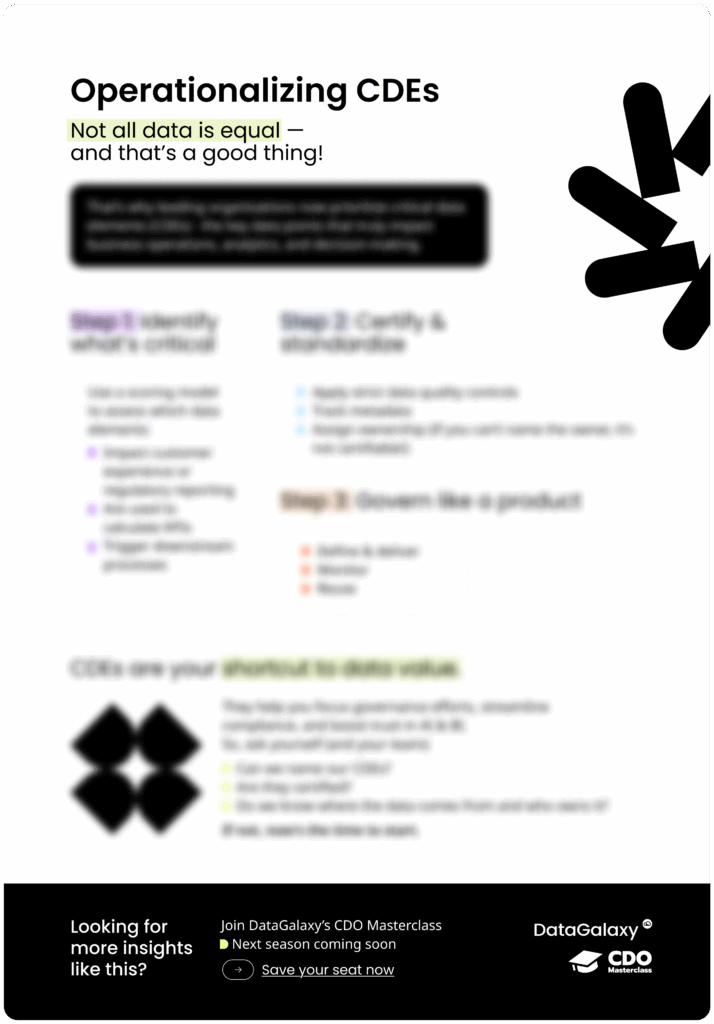
Operationalizing
CDEs
Do you know how to make critical data elements (CDEs) work for your teams?
Get your go-to guide to identifying and governing critical
data elements to accelerate data value.
Consequences of failing to operationalize governance
Here are some common consequences your teams may face if your governance remains theoretical:
- Low adoption: Without proper governance, data teams and business users can ignore or circumvent processes. This can mean that catalogs, glossaries, and policies exist but are rarely used.
- Missed innovation: Enterprises can’t safely scale AI or advanced analytics if data is untrusted, lineage is unknown, or policies conflict
- Regulatory or reputational risk: Without operational governance, incidents of AI bias, privacy breaches, or misuse are more likely
- Wasted investment: Platforms, tools, and people get underutilized when governance is siloed or when efforts don’t connect to clear outcomes
What are trust models in data & analytics?
In data, analytics & AI governance, a trust model is a governance architecture built explicitly around these elements:
- Accountability: Clear roles and decision rights so people know who is responsible for data, metadata, and model outcomes
- Ethical standards & transparency: Making sure data and AI assets are developed, deployed, and maintained with fairness, clarity, and explainability
- Shared understanding: Standardizing elements like your metadata, glossary, lineage, and business context helps visibility & usability across the organization
- Measurable value & outcomes: Governance objectives linked to business goals, not just compliance
Designing data & AI products that deliver business value
To truly derive value from AI, it’s not enough to just have the technology.
- Clear strategy
- Reasonable rules for managing data
- Focus on building useful data products

Gartner’s stance on trust models in 2025
Gartner has identified trust-based governance as a critical shift in data and analytics governance.
For example, in Gartner’s 2025 Hype Cycle for Data & Analytics Governance, their research shows that 89% of respondents consider effective data & analytics governance essential for business and tech innovation.
Gartner’s trend prediction is clear: Governance programs are getting reevaluated, redesigned, or relaunched to emphasize trust, usability, alignment, and business outcomes.
How trust models create accountability, ethical standards, and value
A trust-based governance model makes governance a strategic asset.
Some of the concrete ways it delivers measurable value include:
- Faster analytic & AI deployment: When metadata, lineage, and policies are established and visible, teams spend less time chasing definitions or chasing approvals
- Clearer risk reduction: Ethical violations, bias, and misuse risk are lowered with built-in accountability and monitoring
- Better stakeholder buy-in and usage: When business users see the relevance of governance (For example, glossaries they understand and a catalog that helps them find data they need), they use it
- Stronger regulatory compliance: If governance is operational (not just policy), compliance with regulations can be demonstrable and auditable
How DataGalaxy enables trust-based governance
To make trust models possible, organizations need governance solutions that are usable, visible, aligned with business, and that embed governance into workflows. Here’s how DataGalaxy is built to enable trust-based governance in practice:
One collaborative platform for stewardship, policy enforcement, and metadata management
DataGalaxy’s product architecture supports cross-team collaboration with its:
- Value governance platform: Combining metadata management, strategy alignment, governance policies, and tracking of business impact. It’s not just about documenting assets; it ties them to business objectives.
- Governance hub: Lets you define rules, policies, and enforce them directly on assets. Stewards, owners, business users, and IT can see compliance, lineage, and usage.
- The metadata catalog: Serves as a single source of truth to ensure consistency and clarity.
Operationalizing trust: A user-friendly, integrated governance ecosystem
Some of DataGalaxy’s features that help make trust models real include:
- Business-friendly catalog & marketplace: DataGalaxy provides a marketplace of certified data & AI products so business users can browse, understand, and request data assets that are governed (with definitions, quality, policies) already in place.
- Strategy cockpit & value tracking: DataGalaxy includes a dashboard or cockpit to map data & AI initiatives to strategic goals, monitor key metrics, and see impact. This ensures governance isn’t just about restriction but about enabling measurable business outcomes.
- Strong adoption focus: DataGalaxy prioritizes user adoption. It emphasizes ease of use, fast ramp-up, intuitive UI, and integration into daily workflows. Together, that helps reduce resistance and friction.
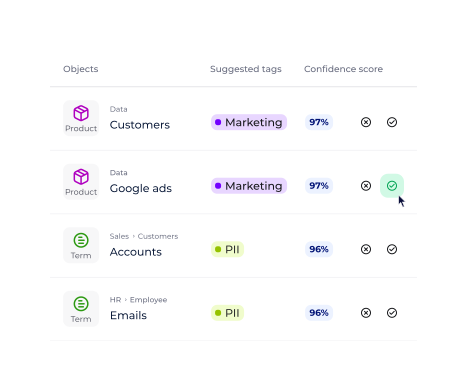
Blink, your AI Copilot
Ask questions. Get answers. Drive action.
Blink helps every user explore, understand, and use data in their daily work. No tickets, no filters, no delays. Ask anything in your native language and get trusted, contextual answers and recommendations.
Meet Blink!Trust models: Practical steps for organizations
Here are a few steps any organization can take now to move from the hype toward trust-based governance that delivers real value:
1. Adopt a future vision
- Define what trust means in your organization: What ethical standards, what accountability, and what transparency?
- Set the business outcomes you want, like increasing speed, data confidence, and regulatory compliance
- Map your current state: Where are your gaps in metadata, lineage, ownership, policies, or usage?
2. Prioritize metadata management, governance platforms, and stewardship
- Metadata is foundational. It makes up your glossaries, lineage, and classification so that trust is possible
- Invest in a governance platform that supports strategic alignment, policy enforcement, and stewardship workflows
- Assign or train stewards and business owners who can own governance in different domains.
3. Align technology with business culture
- Promote data literacy so business users understand what is governed, why, and how to participate
- Embed governance into workflows so that using governed data is easier for everyone
- Celebrate wins early. These can include lower risk, faster insights, or improved decision-making. Use these wins to build momentum.
4. Measure & monitor outcomes
- Define KPIs: ex. time to access governed data and the number of data products certified, governance workflows completed, or incidents prevented
- Use dashboards to monitor usage and adherence to policies
- Use feedback loops: Business users should be able to flag issues, proposals for policies, or suggest improvements.
Bringing it all together: Trust models vs. hype
Governance doesn’t have to stop innovation or be a burden.
When built around trust models with clear accountability, ethical guardrails, stakeholder engagement, and measurable outcomes, it becomes a strategic enabler.
DataGalaxy offers the tools, platform, and mindset to help organizations make that shift.
From value governance, metadata catalogs, stewardship workflows, to aligned business goals and measurable impact, DataGalaxy empowers teams to make governance a driver of value, not merely a compliance measure.
If you’re ready to move from hype to high performance, download Gartner’s complete 2025 Hype Cycle for Data & Analytics Governance today.
Discover where trust models are applicable, which technologies are maturing, and how to operationalize governance to achieve outcomes in your own organization.
FAQ
- What is data governance?
-
Data governance ensures data is accurate, secure, and responsibly used by defining rules, roles, and processes. It includes setting policies, assigning ownership, and establishing standards for managing data throughout its lifecycle.
- How do I implement data governance?
-
To implement data governance, start by defining clear goals and scope. Assign roles like data owners and stewards, and create policies for access, privacy, and quality. Use tools like data catalogs and metadata platforms to automate enforcement, track lineage, and ensure visibility and control across your data assets.
- How does a data catalog work?
-
It connects to your data sources and tools, ingests metadata automatically, and creates a centralized, searchable inventory of your assets. Advanced catalogs like DataGalaxy also provide lineage, collaboration, and governance capabilities.
👉 Want to go deeper? Check out:
https://www.datagalaxy.com/en/blog/utilizing-the-semantic-layer/ - Is your data governance actually collaborative?
-
Top-down governance doesn’t work if the people on the ground aren’t engaged.
Without collaboration, policies go unread, data remains undocumented, and stewardship becomes a checkbox exercise.
DataGalaxy transforms governance into a team sport — empowering domain owners, stewards, and business users to contribute directly to data knowledge and accountability.
– Assign clear roles and ownership for every asset
– Foster contributions via contextual editing and collaborative workflows
– Track changes and governance maturity over timeFacing this challenge? Explore the solution
Want to see it live? Book a tailored demo
- What does it mean to have AI-ready data?
-
AI-ready data is data that’s trustworthy, well-governed, and contextualized — so it can be safely and effectively used to power machine learning models and AI systems. That means:
– The source, lineage, and ownership of the data are clear
– Policies and usage rights are in place to ensure compliance
– The data is accurate, timely, and relevant for the intended AI use case
– It’s connected to a shared business vocabulary, so decisions made by AI can be explained and trustedWithout these foundations, AI models are more likely to produce biased, incorrect, or non-compliant results.
At a glance
- Traditional governance often stalls as rigid, compliance-focused, and disconnected from business value, but trust models shift the focus to accountability, ethics, and measurable outcomes.
- Trust-based governance fosters adoption by aligning policies, metadata, and lineage with business needs, enabling faster AI deployment, risk reduction, and stronger compliance.
- DataGalaxy operationalizes trust models with a collaborative governance hub, business-friendly catalog, strategy tracking, and adoption-focused features that turn governance into a driver of innovation and value.
About the author

With a passion for turning data complexity into clarity, Jessica Sandifer is an experienced content manager who crafts stories that resonate across technical and business audiences. At DataGalaxy, she creates content and product marketing messages that demystify data governance and make AI-readiness actionable.
Related posts