
Modern data catalogs explained: The 7 must-have features for data & AI governance
17 October 2025 | 8 mins read | Data Governance
by Jessica, Tech writer

Organizations are dealing with more data than ever, and it’s scattered across cloud platforms, SaaS systems, pipelines, APIs, and legacy environments.
The result? Massive complexity, duplicated effort, compliance risks, and a lack of shared understanding.
TL;DR summary
A modern data catalog is a centralized system that organizes, governs, and activates your organization’s data knowledge. It provides searchable visibility into data assets, metadata, lineage, quality, and usage context — helping teams trust, understand, and confidently use data for analytics and AI.
With today’s shift toward data & AI product governance, the data catalog has evolved into a foundational capability for scaling responsible AI and ensuring business-wide data literacy.
This guide breaks down the seven most important features to look for when choosing a data catalog.
A modern data catalog solves these challenges by providing a unified, intelligent inventory of an organization’s data products and metadata assets.
More than a glossary or index, today’s data catalogs incorporate automation, governance workflows, AI-powered discovery, and collaborative features that help teams build trust in data.
As part of a broader Data & AI Product Governance Platform, like DataGalaxy, a data catalog becomes the connective tissue across business, IT, and AI stakeholders.
This article explores what a data catalog is and the seven most important features you should expect from a best-in-class solution today.
What is a data catalog?
A data catalog tool is software that organizes, classifies, and makes data assets easily discoverable across an organization.
It acts as a centralized metadata repository that stores essential context, such as:
- Data source and schema
- Business definitions and glossary terms
- Data lineage across pipelines and transformations
- Data quality scores and profiling results
- Ownership and stewardship information
- Usage history and popularity signals
- Regulatory classifications and sensitivity levels
A data catalog integrates with data warehouses, data lakes, BI tools, ELT/ETL systems, machine learning platforms, and governance workflows.
By offering powerful search, tagging, lineage visualization, collaboration capabilities, and automated metadata extraction, a catalog gives all users — business, technical, and AI — a shared understanding of data.
Operationalizing
CDEs
Do you know how to make critical data elements (CDEs) work for your teams?
Get your go-to guide to identifying and governing critical
data elements to accelerate data value.
Why data catalogs matter more today than ever before
As organizations move toward AI-driven decision-making, generative AI assistants, and data product operating models, the catalog becomes the authority for:
- Trust and explainability (e.g., “Where did this data come from?”)
- Reducing duplication and shadow datasets
- Improving data quality and data observability
- Regulatory compliance (GDPR, CCPA, HIPAA, DORA, etc.)
- Ensuring responsible use of data in AI models
- Building cross-team alignment through a shared glossary
The growing need for a data catalog
Data today is distributed across dozens or even hundreds of sources: cloud warehouses, operational databases, SaaS apps, streaming systems, internal APIs, spreadsheets, and AI pipelines.
Without a unified view:
- Teams spend hours searching for the right data
- Definitions become inconsistent
- Data becomes duplicated or misused
- Compliance risks grow
- AI models generate unreliable outputs due to poor input quality
A data catalog solves these challenges by providing a single source of truth for data understanding.
It enhances data literacy, accelerates onboarding, supports governance, and ensures stakeholders are always aware of what data means, who owns it, and how it should be utilized.
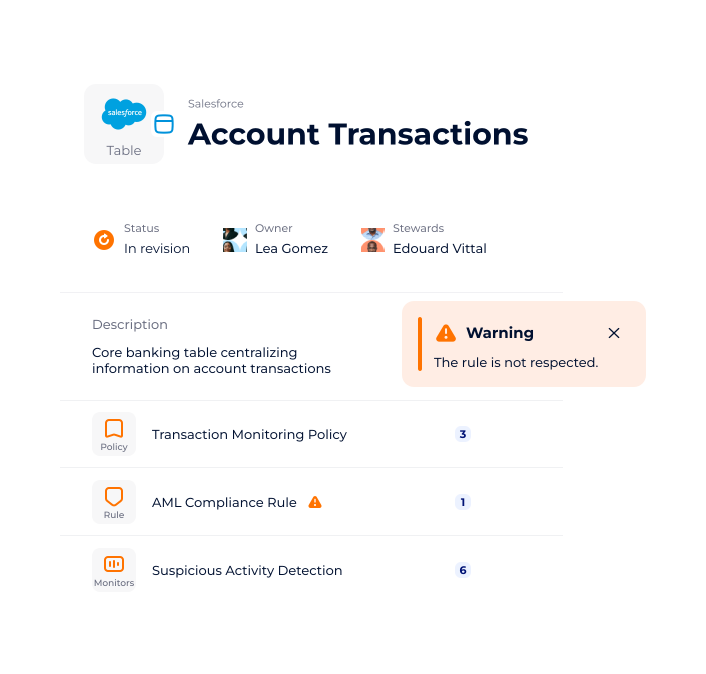
Trace issues down to the column level
Visualize how data quality issues impact tables, queries, and downstream assets. With lineage, diagrams, and column-level visibility, teams can assess risk and resolve problems faster.
Visualize data impact7 important data catalog features you should know
Below are the seven core capabilities every modern data catalog should deliver:
1. Data discovery & inventory
One of the foundational capabilities of a data catalog is the automated indexing of data assets across your ecosystem.
This includes:
- Databases
- Data lakes & lakehouses
- Data warehouses
- BI dashboards
- Metrics layers
- ML feature stores
- SaaS connectors
- APIs and files
A best-in-class catalog should:
- Continuously sync and update assets in near-real time
- Automatically detect new tables, schemas, and fields
- Offer a “Google-like” semantic search experience
- Surface popularity metrics, last updated timestamps, and usage patterns
Practitioners emphasize that a catalog must be easy to maintain and not become stale, which means automation is essential. Manual inventorying is a guaranteed path to decay.
2. Metadata management
Metadata is “data about data,” and it’s at the core of every data catalog. Effective metadata management includes:
- Technical metadata (schemas, field types, storage)
- Business metadata (definitions, owners, domains, KPIs)
- Operational metadata (frequency, SLAs, upstream/downstream jobs)
- Behavioral metadata (query patterns, popularity, data usage)
A modern catalog uses automation and sometimes AI to enrich metadata with:
- Data profiling results
- Relationship detection
- Domain inference
- Business glossary binding
Strong metadata management drives data literacy and reduces reliance on tribal knowledge.
3. Data lineage tracking
Data lineage shows how data flows across the organization — from ingestion to transformation to consumption.
A robust lineage feature enables users to:
- Visualize end-to-end pipeline flows
- Understand dependencies and impact
- Trace errors to their upstream sources
- Support regulatory transparency
- Validate AI training data inputs
Lineage is crucial for compliance with regulations like GDPR, CCPA, DORA, and emerging AI governance laws requiring explainability.
Engineers repeatedly note that lineage is one of the most valuable and “non-negotiable” features for troubleshooting and trust.
DataGalaxy’s Campaigns
DataGalaxy’s Campaigns ensure rapid deployment, expert management, and enhanced collaboration through customized workflows
Learn more
4. Data classification & tagging
Automatic and customizable classification helps organizations govern their data more effectively. Modern catalogs classify data by:
- Sensitivity (PII, PHI, financial, confidential)
- Domain (marketing, finance, operations, product)
- Business value
- Data type
- Compliance relevance (GDPR data subject fields, etc.)
AI-assisted tagging further accelerates organization by learning from user behavior and patterns.
Custom tags allow organizations to adapt the data catalog to their specific internal vocabulary, which increases adoption significantly.
5. Data quality indicators
Data quality indicators help users quickly assess whether a dataset is trustworthy. These indicators may include:
- Freshness
- Completeness
- Validity
- Uniqueness
- Volume changes
- Schema drift detection
More advanced solutions include data profiling and observability metrics.
Practitioners stress that a catalog without true quality insights becomes “a pretty UI with no value.” Users expect quality, profiling, and alerts directly inside the catalog.
6. Collaboration & user feedback tools
A data catalog thrives when it becomes a collaborative knowledge hub. Look for features like:
- Ratings & endorsements
- Comments, discussions, and annotations
- Shared business glossary
- Ownership fields & stewardship workflows
- Domain-based governance structures
- Suggested definitions or automated glossary linking
Collaboration turns the catalog from a technical repository into a shared organizational brain.
7. Security, Privacy, and Compliance
As data regulations expand, a catalog must support strong governance controls:
- Role-based access control (RBAC)
- Attribute-based access control (ABAC)
- Audit logs and access histories
- PII detection
- Retention policy management
- Data-sharing controls
- Integration with compliance frameworks
A modern data catalog should fit into a broader data & AI product governance strategy to ensure responsible use of data across analytics and AI.
What modern data users expect from a data catalog today
Today’s data professionals share clear expectations for what a modern data catalog must deliver.
These expectations come not just from theory, but from real operational pain points experienced across organizations.
1. Automation is non-negotiable
Users expect a catalog to stay continuously up to date without manual intervention.
If metadata collection, lineage extraction, or classification requires human upkeep, the catalog quickly becomes stale. Automation isn’t a feature; it’s table stakes.
2. Seamless integrations across the ecosystem
Modern teams rely on a diverse stack: Snowflake, Databricks, BigQuery, dbt, Airflow, Power BI, Tableau, Looker, and hundreds of SaaS tools.
A catalog must plug into this ecosystem easily and deeply to discover metadata, lineage, and usage patterns automatically.
The 3 KPIs for driving real data governance value
KPIs only matter if you track them. Move from governance in theory to governance that delivers.
Download the free guide3. A single, trustworthy place to find the truth
Data users want one place to search for authoritative, complete information about datasets, metrics, pipelines, and definitions.
If the catalog is incomplete or inconsistent, users revert to tribal knowledge or private spreadsheets — defeating the purpose.
4. Clear ownership & accountability
Modern organizations expect every data asset to have a known owner or steward.
This supports governance, accelerates issue resolution, and ensures accountability for data quality and definition alignment.
5. Practical, actionable lineage and quality signals
Lineage isn’t just a diagram — it’s a troubleshooting tool.
Users want real insight into upstream sources, downstream impacts, and data quality indicators (freshness, anomalies, schema drift) to understand whether they can trust the data.
6. Easy adoption, especially for non-technical roles
If a catalog requires deep technical knowledge or heavy ongoing maintenance, adoption suffers.
Users expect intuitive navigation, strong search, business-friendly context, and a clear glossary — making the tool accessible beyond engineering teams.
FAQ
- How does a data catalog work?
-
It connects to your data sources and tools, ingests metadata automatically, and creates a centralized, searchable inventory of your assets. Advanced catalogs like DataGalaxy also provide lineage, collaboration, and governance capabilities.
👉 Want to go deeper? Check out:
https://www.datagalaxy.com/en/blog/utilizing-the-semantic-layer/ - Do I need a data catalog?
-
If your teams are struggling to find data, understand its meaning, or trust its source — then yes. A data catalog helps you centralize, document, and connect data assets across your ecosystem. It’s the foundation of any data-driven organization.
👉 Want to go deeper? Check out:
https://www.datagalaxy.com/en/blog/what-is-a-data-catalog/ - How does a data catalog help with AI risk management?
-
A modern data catalog helps identify and track sensitive data, document lineage, and ensure data quality — all of which reduce AI-related risks. It also improves traceability across AI pipelines and enables proactive monitoring.
- How does the catalog support governance and compliance?
-
It includes lineage, impact analysis, ownership tracking, and policy management — all mapped to your data assets. That means better traceability, audit readiness, and confidence in data-driven decisions.
- What does a data catalog actually do?
-
If your teams are struggling to find data, understand its meaning, or trust its source — then yes. A data catalog helps you centralize, document, and connect data assets across your ecosystem. It’s the foundation of any data-driven organization.
👉 Want to go deeper? Check out:
https://www.datagalaxy.com/en/blog/what-is-a-data-catalog/
In summary
- A modern data catalog is foundational for analytics and AI.
- Automation, lineage, and metadata enrichment are must-have capabilities.
- Collaboration and governance workflows drive adoption and trust.
- Catalogs must integrate seamlessly across the full data ecosystem.
- Data quality and compliance features are essential for AI reliability.
About the author

With a passion for turning data complexity into clarity, Jessica Sandifer is an experienced content manager who crafts stories that resonate across technical and business audiences. At DataGalaxy, she creates content and product marketing messages that demystify data governance and make AI-readiness actionable.
Related posts