
Data intelligence meets value governance: Inside DataGalaxy’s next-gen platform
12 November 2025 | 9 mins read | Data Governance
by Jessica, Tech writer

Enterprises expect more than simply knowing what data assets exist. Today, they demand clear insight into how those assets are being used and what value they deliver.
Therefore, organisations that treat data merely as a technical asset risk leaving business value on the table.
Summary
Data is no longer just a technical enabler. For forward-looking organisations, it is a business discipline that requires strategic alignment, governance, and measurement of value. The move from traditional data cataloging to value governance is not optional. It is essential if you want your data and AI initiatives to deliver measurable business impact.
With DataGalaxy’s unified platform that combines a strategy cockpit, an automated catalog, and a governance/value tracking hub, you gain the means to bridge the gap between what data you have and what value you extract from it.
The question now is: will your organisation treat data as a business discipline and measure what matters?
In this blog post, we’ll explore how you can elevate your data initiatives by shifting from a metadata-centric mindset to one built around value governance. We’ll also show how DataGalaxy enables precisely that.
Note: The article references an external opinion piece, “DataGalaxy Addresses the Governance and Value of Data,” originally written by Matt Aslett. View the article here.
Data usage & value, not just discovery
A modern data intelligence catalog helps business leaders understand where and how data is used across an enterprise.
Therefore, treating data as a business discipline (not merely an IT domain) is essential to align data projects with strategic business objectives.
Yet even with these insights, many organizations still struggle with a critical gap. They may know what data they have and who owns it, but they struggle to track how it is being used and what value is being generated by data and AI initiatives.
For example, the recent analysis by ISG highlighted that more than two-fifths of respondents cite measuring ROI as a key data challenge.
Similarly, many organisations still treat data operations as an IT problem: although 49 % agree data operations should be managed separately from other parts of IT, 47 % report that IT is responsible for most data activity.
ISG
When data strategy is defined by IT platforms rather than business outcomes, initiatives risk becoming detached from business value.
In short: the next frontier is not simply cataloging data, it’s governing it for business value.
Why the shift from metadata to value governance matters
Modern enterprises have been investing in cataloging, lineage, glossaries, and governance for good reason.
However, as the complexity of data landscapes, analytics, and AI grows, so must our view of what a data governance and catalog ecosystem should deliver.
Operationalizing
CDEs
Do you know how to make critical data elements (CDEs) work for your teams?
Get your go-to guide to identifying and governing critical
data elements to accelerate data value.
When you shift your mindset to value governance, you:
- Connect strategy to execution: Aligning data initiatives with business domains, objectives, and programs
- Embed governance and product-discipline into data & AI just like any other business product
- Prioritize, monitor, and measure data initiative value in terms of usage, cost, risk, and realized benefit
- Ensure that the data catalogue isn’t just a repository of assets, but becomes the cockpit from which business, analytics, and data teams collaborate, deliver, and assess value
This shift matters because metrics around usage and value increasingly separate “good” from “great” data intelligence solutions.
For example, in the 2025 Buyers Guide for Data Management: while ~63 % of software vendors were graded A- or above for usage and scorecards, fewer than ~45 % were graded so for metrics around value and ROI.
ISG
If your organisation aspires to drive measurable business impact from data and AI — not just tactical wins — you need a platform that bridges catalog, governance, and value measurement.
DataGalaxy for unifying catalog, governance, and value
DataGalaxy connects two powerful products, the DataGalaxy Catalog and DataGalaxy Portfolio, into an end-to-end governance platform designed to organize, govern, and track the business impact of your data and AI initiatives, all in one place.
Unlike legacy catalogs that focus on technical documentation or rigid enforcement, DataGalaxy empowers every stakeholder, from C-suite to business user, to contribute to and benefit from metadata knowledge that is tied directly to measurable business value.
Why focus on value?
There are three compelling reasons:
- In the AI era, your choice is value creation or value destruction: Without a clear strategy, governance, and sequencing plan, AI investments can squander time and money
- DataGalaxy is the only governance tool that includes built-in portfolio management to prove and maximise the connection between data, metadata, and business value
- DataGalaxy rejects governance tools that lock down data and only focus on compliance: Governance must enable, not disable. DataGalaxy turns control into opportunity.
The DataGalaxy difference
- Persona-driven experience: DataGalaxy delivers role-based views, aligning all stakeholders in one collaborative environment
- Visual Knowledge Studio (VKS): A fast, visual workspace that turns siloed data into clear stories, enabling technical and business users alike to understand and act
- Business value mapping: DataGalaxy connects metadata to measurable business outcomes. With built-in portfolio management, you see how trusted data becomes AI-ready, productised, and impactful.
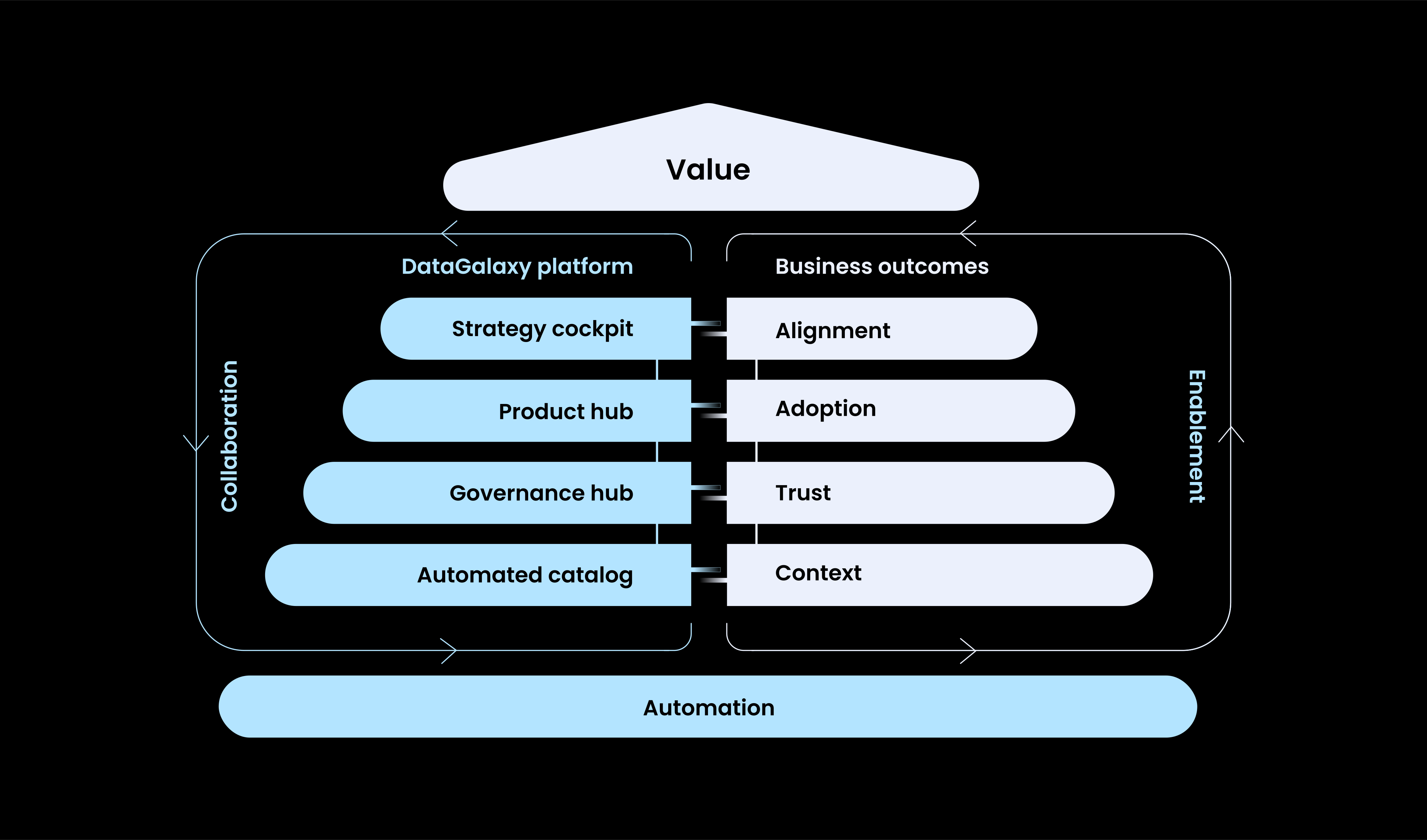
Here’s how the platform delivers across three interlocking layers:
1. Strategy Cockpit & Product Hub
The Strategy Cockpit allows enterprises to capture ideas across the business, organize them into domains or strategic programs, and assess them according to key attributes: strategic alignment, value, effort, and risk.
This means data initiatives don’t live in a vacuum. They are linked directly to business priorities, and you gain a portfolio-based view of your data & AI investment.
Through the Product Hub, datasets, analytics, and AI models become managed “data products”: discoverable, reusable, documented.
2. Automated Data Catalog
The platform’s catalog layer enables you to centralise all data assets, build lineage automatically, enrich metadata with business context, and deliver a “Google-style” search for users across the business.
Features include:
- Smart search to find tables, KPIs, dashboards, definitions, owners, and certifications
- Automated glossary generation (including multilingual support)
- Column-level lineage across tools, browser extension for context in BI dashboards
- 70+ connectors to modern data platforms (Snowflake, Databricks, Power BI, BigQuery, etc.)
3. Governance Hub & Value Tracking
Governance in DataGalaxy is designed for real-world impact, not just documentation.
You can define policies, assign roles, launch governance campaigns, run impact analysis, monitor compliance, and connect usage/cost/value metrics back to your data initiatives.
Together, these three layers provide a unified value governance platform, enabling organizations to move from “What data do we have?” to “How are we using it?” to finally, “What business value are we realizing?”.
Designing data & AI products that deliver business value
To truly derive value from AI, it’s not enough to just have the technology.
- Clear strategy
- Reasonable rules for managing data
- Focus on building useful data products

The need for value governance now
There are multiple compelling reasons why organisations should be investing in tools like DataGalaxy today:
Complexity & scale of data and AI initiatives are growing
With increasing cloud adoption, analytics and AI initiatives proliferate across departments.
Traditional catalog or governance tools struggle to keep up. The era of “just a data catalog” is over — organisations need full-service data & analytics governance platforms.
Business scrutiny over data ROI is intensifying
Executives increasingly expect data and analytics initiatives to tie back to business value.
The fact that almost half the survey respondents cited ROI measurement as a key issue underlines the gap. Without visible, measured value, data initiatives risk being deprioritised or dismissed.
ISG
IT-only data strategies are no longer sufficient
When data is treated purely as an IT problem, it risks misalignment with business objectives.
The ISG study showed a nearly even split between the view that data operations should be separate from IT, and the reality that they often remain within IT’s domain.
A platform that enables business and IT-stakeholder collaboration across strategy, governance, and value delivery is essential.
Innovation & compliance demands are rising together
With regulatory mandates (GDPR, CPRA, AI Act, etc.) and business demands for speed and innovation, organisations need a governance platform that supports both control and agility, enabling trusted data use for analytics and AI.
DataGalaxy’s governance hub addresses this balance: control and enablement.
Real-world benefits: What organisations can expect
By shifting your data governance approach to one of value governance and using a platform such as DataGalaxy, you can expect to unlock benefits that map directly to business impact:
- Better prioritisation of data & AI initiatives: With a portfolio view and evaluation scoring (value/effort/risk), you deploy resources where they matter most
- Improved data discovery, trust & collaboration: Self-service access to data with business context, lineage, and ownership breaks down silos and speeds decision-making
- Stronger alignment of data projects with business KPIs: Initiatives are directly connected to business domains and strategic objectives, not isolated IT projects
- Measurable tracking of value and usage: Initiatives move from vague “data projects” to business-governed products with cost, usage, benefit, and risk metrics
- Governance that scales with adoption: By embedding policies, roles, and workflows into the everyday experience of users (via the catalog, browser extension, campaign workflows), governance becomes part of the business flow rather than a hindrance
Centralize all your data assets in one unified platform, automatically build and maintain lineage across systems, and enrich every asset with AI-powered context. With DataGalaxy, teams can quickly search, discover, and understand the data they need, while ensuring full traceability and trust.
Discover the DataGalaxy differenceA call to action for data leaders
If you’ve already done the work of cataloging data assets and embedding governance fundamentals, the next step is to ask, “Are we capturing and measuring business value from our data and AI initiatives?”
As you evaluate the landscape of data intelligence and governance providers, here are key questions to ask — and where DataGalaxy stands out:
- Do we have a strategy cockpit for data and AI initiatives that links to business domains and objectives?
- Can we assess initiatives by value, risk, effort, and track progress over time?
- Does our data catalog integrate both business users and technical users, with lineage, glossary, and metadata enriched with business context?
- Are governance, data products, collaboration, and compliance provided in one platform rather than disparate tools?
- Do we have metrics for usage, cost, and realised value per initiative — not just counts of assets cataloged?
FAQ
- What is DataGalaxy?
-
DataGalaxy is a modern data & AI governance platform that centralizes metadata, data lineage, and business definitions to create a shared understanding of data across the organization. Designed for collaboration, we empower teams to find, trust, and use data confidently. Learn how DataGalaxy accelerates data-driven decision-making at www.datagalaxy.com.
- What makes DataGalaxy different from other data catalog solutions?
-
DataGalaxy stands out with our user-friendly, collaborative data governance platform that empowers everyone—from data stewards to business users—to understand, trust, and use data confidently. Unlike complex legacy tools, DataGalaxy offers intuitive metadata management, real-time lineage, and a business glossary in one centralized hub.
- How does DataGalaxy help manage data products?
-
You can define, own, govern, and evolve each data product across its lifecycle — with clear responsibilities, lineage, and performance tracking
- How does DataGalaxy help with regulatory compliance?
-
The platform includes role-based access (RBAC), SSO, audit trails, and admin control over every object and user permission.
- What types of systems can DataGalaxy integrate with?
-
DataGalaxy connects with a wide range of systems including data warehouses, BI tools, data lakes, ETL platforms, and governance frameworks. Supported platforms include Snowflake, BigQuery, Tableau, Power BI, dbt, Talend, Collibra, and many more. Whether your ecosystem is cloud-based or hybrid, DataGalaxy provides flexible integration paths.
Key takeaways
- DataGalaxy is redefining data intelligence through value governance. The platform moves beyond traditional catalogs by connecting data governance directly to measurable business outcomes and strategic value.
- As the first true Value Governance Platform, DataGalaxy unites catalog and portfolio management. It provides an end-to-end solution to organize, govern, and track the business impact of all data and AI initiatives from a single workspace.
About the author

With a passion for turning data complexity into clarity, Jessica Sandifer is an experienced content manager who crafts stories that resonate across technical and business audiences. At DataGalaxy, she creates content and product marketing messages that demystify data governance and make AI-readiness actionable.
Related posts