About the author: Max Faivre
Product Marketing Manager
When a number looks wrong in a dashboard, the first question is where it came from. Answering it means tracing the data back through every system it crossed, and that gets slow once you have more than a couple of sources.
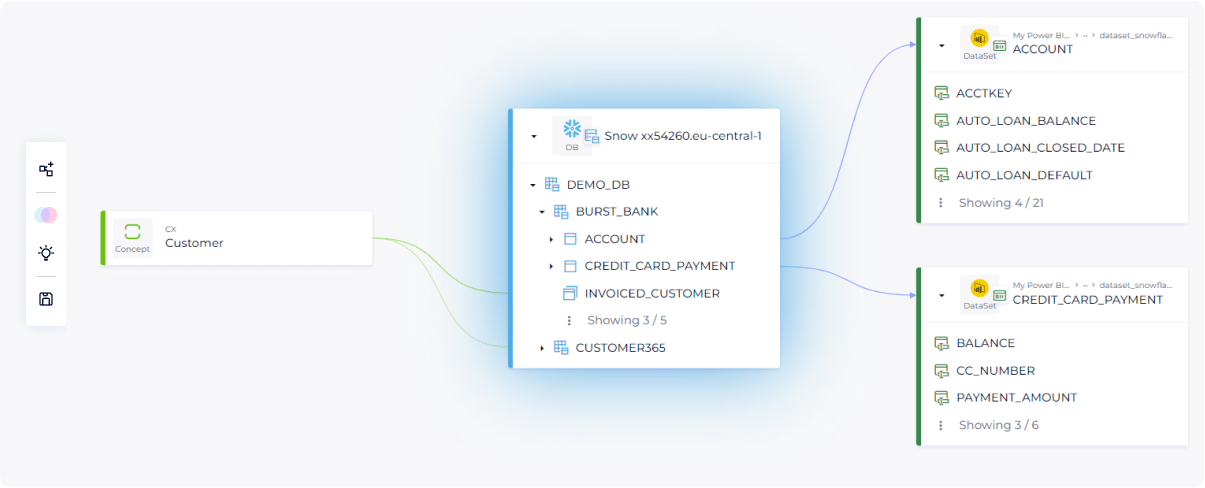
DataGalaxy now builds cross-technology, column-level data lineage automatically for the Snowflake cloud data platform. You can follow a single column from its source through each transformation, across Snowflake and the other tools you’ve connected to DataGalaxy.
Lineage shows you where data comes from, what happens to it along the way, and where it ends up. Column-level means you can follow one field, say customer_id, from a source table to the report that uses it.
Automated data lineage draws that map for you. It’s what you rely on for regulatory compliance, migration planning, root cause analysis and impact analysis.
Getting there is harder than it sounds:
To trust data, business and technical users need the same view of how it flows, how datasets relate, and whether they’re healthy. A detailed lineage view you can explore gives them that, so decisions rest on data people actually understand.
Here’s what DataGalaxy adds for Snowflake.
Every object connected from Snowflake gets a unique URN, a bit like a URL for a table or a column. It works as a fingerprint: each asset can be identified and traced without ambiguity, which makes checking and adding information simpler.
New API support lets DataGalaxy connectors share information with each other, so lineage keeps going when data leaves one tool for another.
Lineage is tracked the same way across your stack, so teams share data and work from the same picture. When everyone understands how data flows, it’s easier to fix processes and agree on decisions.
Column-level lineage across Snowflake and the rest of your stack answers the question every data team keeps getting: where does this number come from? DataGalaxy builds it automatically, with URNs to identify each asset and connectors that pass lineage from one tool to the next.
Want to see it on your own data? Take a look at the DataGalaxy Snowflake connector or book a demo.
DataGalaxy is a modern data & AI governance platform that centralizes metadata, data lineage, and business definitions to create a shared understanding of data across the organization. Designed for collaboration, we empower teams to find, trust, and use data confidently. Learn how DataGalaxy accelerates data-driven decision-making at www.datagalaxy.com.
DataGalaxy stands out with our user-friendly, collaborative data governance platform that empowers everyone—from data stewards to business users—to understand, trust, and use data confidently. Unlike complex legacy tools, DataGalaxy offers intuitive metadata management, real-time lineage, and a business glossary in one centralized hub. Discover how we drive agile, value-first data strategies at www.datagalaxy.com.
Data mesh decentralizes data ownership to domain teams, letting them manage and serve data as products. It fosters collaboration and accountability, supported by shared standards, self-serve tools, and governance to ensure data is interoperable and trustworthy across the organization.
Data mesh architecture treats data as a product, giving ownership to domain teams. It replaces centralized control with shared standards and empowers experts to manage and share data, making it more scalable, discoverable, and useful across the organization.
Data intelligence transforms raw data into meaningful insights by analyzing how it flows and where it adds value. It uncovers patterns and connections, helping teams make confident, strategic decisions that drive real business outcomes.
Product Marketing Manager