
The complete guide to metadata management in 2026: Definition, benefits, challenges, & why it’s now a business imperative
In the age of big data, sound metadata and data management are essential for organizations. But what does metadata management exactly entail?
- How is it done?
- What are the benefits of managing metadata?
This lack of data visibility creates costly consequences: users lose 30–40% of their time simply trying to find and identify useful information.
The problem is no longer data scarcity, but the inability to understand, govern, and exploit the data that already exists. This is where metadata becomes essential. Metadata transforms chaotic data landscapes into clear, trustworthy, usable information ecosystems.
This guide covers everything you need to know about metadata and metadata management—from definitions and key concepts to benefits, strategy, roles, and how DataGalaxy helps you operationalize metadata at scale.
TL;DR summary
Metadata is data about data: it provides the context needed to understand, locate, and trust your data across systems. Without metadata, organizations create data swamps: redundant, unknown, or non-compliant data that nobody can safely use.
Effective metadata management underpins data governance, AI product governance, regulatory compliance, and self-service analytics. A modern approach includes a data catalog, business glossary, and clear roles (CDO, data stewards, product owners) aligned around shared metadata standards.
DataGalaxy helps organizations document, govern, and activate metadata so data products are discoverable, compliant, and trusted.
What is metadata?
The term metadata refers to the primary properties that describe data.
Metadata provides the full context needed to understand, classify, locate, govern, and use data effectively. In an enterprise context, metadata typically includes:
- Descriptive metadata
- Name, description, business definitions
- Domain or subject area (e.g. “Customer,” “Product,” “Revenue”)
- Structural metadata
- Data models, tables, fields, schemas
- Relationships between entities (e.g. Customer → Orders)
- Administrative metadata
- Ownership and stewardship
- Access rights and permissions
- Lifecycle status (draft, active, deprecated, archived)
- Security & compliance metadata
- Classification (public, internal, confidential, restricted)
- Data sensitivity (personal data, special categories, financial, health)
- Regulatory tags (GDPR, HIPAA, SOX, PCI DSS, etc.)
- Technical metadata
- Data formats and types
- ETL/ELT rules and transformations
- Lineage (where data comes from and where it goes)
- Usage & operational metadata
- Who created and modified the data
- Frequency of use, last access
- Linked dashboards, reports, and AI models
- Governance metadata
- Business rules and validation rules
- Standardized terms from the business glossary
- Data quality indicators and certifications
A practical example: Metadata for a photo vs. enterprise data
When you export a photo from your phone, its metadata can include:
- Camera model
- Location (GPS coordinates)
- Time and date
- Resolution and file format
- Editing history
This allows both humans and software to organize and interpret the photo.
For enterprise data, the idea is similar. The difference is that the stakes are higher, and the description must be far richer. A “Customer” dataset, for example, should answer:
- What does “customer” mean in this context?
- Which systems does this data come from?
- Which fields contain personal data?
- Who is accountable if there’s an issue?
- Which reports, dashboards, and AI models rely on it?
That “extra” information is metadata, and it’s the difference between raw data and governed data products.
Operationalizing
CDEs
Do you know how to make critical data elements (CDEs) work for your teams?
Get your go-to guide to identifying and governing critical
data elements to accelerate data value.
The role of metadata: Providing enterprise-grade context
Modern organizations need metadata to answer essential questions about every data asset. A useful way to frame this is through the 5W + H:
Who?
- Who created this data?
- Who owns it (data owner)?
- Who uses it regularly (data consumers)?
- Who maintains it (data steward, data engineer)?
What?
- What is the business definition?
- What business rules apply?
- What quality level is expected?
- What is its sensitivity and classification level?
Where?
- Where is the data stored (cloud, on-prem, data warehouse, data lake)?
- Where did it originate (source systems)?
- Where is it used or replicated (downstream systems, BI tools, AI models)?
When?
- When was it created, updated, or archived?
- When is it scheduled for deletion (retention policy)?
Why?
- Why does this data exist, and what business value does it provide?
- Why is it needed for specific use cases (reporting, AI models, regulatory reporting)?
How?
- How does the data flow across systems (data lineage)?
- How is it transformed, aggregated, or anonymized?
- How many databases, sources, or APIs expose this data?
When these questions go unanswered, organizations end up with:
- Shadow IT: critical data in spreadsheets and local databases nobody knows about
- Data swamps: unlabeled data lakes where nobody can tell what’s trustworthy
- Compliance risks: personal data and sensitive information are scattered and unmanaged
Metadata provides the visibility and structure to prevent that.
Types of metadata in modern data ecosystems
To align with today’s Data & AI landscape, it’s useful to distinguish several metadata domains:
- Business metadata: Terms, definitions, KPIs, ownership, criticality
- Technical metadata: Schemas, tables, columns, file formats, APIs
- Operational metadata: Runtime statistics, job status, pipeline performance
- Social/usage metadata: Ratings, comments, favorites, popularity indicators
- AI/ML metadata (Model metadata): Features, training datasets, model versions, experiment runs
What we do
Since day one, DataGalaxy has been guided by a simple conviction: data creates value when people align on it, adopt it, and turn it into outcomes.
Metadata is not the destination. It is the foundation that makes this possible. That’s why we built the value governance platform, a business-first approach that connects strategy to execution, IT to business, and data to results.
Discover DataGalaxyWhat is metadata management?
Metadata management is the practice of collecting, organizing, governing, and activating metadata so that data becomes:
- Discoverable (easy to find)
- Understandable (clear definitions and context)
- Trustworthy (quality, lineage, ownership visible)
- Compliant (aligned with regulations and internal policies)
- Reusable (shared across use cases and teams)
Historically, metadata management existed long before digital transformation: library card catalogs were an early analog example.
Today, with multi-cloud architectures, SaaS sprawl, data lakes, and AI models, metadata management is no longer “nice to have”—it’s the foundation of a mature data strategy and of AI product governance.
Key building blocks typically include:
- A central data catalog
- A governed business glossary
- Standardized classifications and taxonomies
- Automated metadata harvesting from data platforms, BI tools, and SaaS apps
- Clear roles & responsibilities for metadata ownership
Why metadata management matters: 15 critical benefits
The growing volume, variety, and complexity of enterprise data make metadata indispensable.
Below are 15 key benefits of investing in metadata management, grouped into themes.
1. Better organization & productivity
Enhanced data organization
Metadata categorizes and labels data, making it easy to locate, understand, and reuse. This reduces searching time, speeds up workflows, and boosts productivity.
Reduced time wasted searching for data
With a centralized metadata layer and a data catalog, users spend their time using data—not hunting for it in emails, shared drives, or old dashboards.
Streamlined data archiving & retrieval
Metadata explains what data is, where it lives, why it matters, and how long it should be kept—simplifying retention and accelerating retrieval.
2. Stronger governance, compliance, and security
Better data management & data quality
Metadata provides visibility into data lineage, transformations, owners, and dependencies. This improves accuracy and reliability, and reduces the risk of using “the wrong number” in critical reports.
Stronger compliance & security
Metadata supports tracking sensitive data, aligning with regulations like GDPR and HIPAA, managing permissions, and documenting processing activities. It becomes a pillar of risk management and privacy-by-design.
Stronger protection of personal & sensitive data
By tagging personal data, special categories, and other sensitive attributes, organizations can enforce encryption, masking, and access controls and automate reporting to regulators when needed.
Increased trust, traceability & collaboration
Metadata shows who touched the data, what processes affected it, and which downstream assets depend on it. This transparency builds trust and supports collaboration between IT, data, and business teams.
Unlock the playbook of 220+ data & AI leaders
Learn the secrets shared over 10 seasons of CDO Masterclass, DataGalaxy’s premier online and in-person learning experience.
Download the white paper
3. Smarter decisions & better analytics
Better data context for all business users
Metadata makes data understandable even for non-technical users. This democratizes access and supports a self-service analytics culture.
Faster, more accurate decision-making
When data is clearly defined, certified, and traceable, decisions are made on trusted, consistent information, instead of conflicting spreadsheets.
Enrichment for advanced analytics & innovation
Metadata fuels analytics, AI, and machine learning by adding clarity and context. The richer the metadata, the easier it is to build robust models, monitor them, and reuse features and datasets across use cases.
Discovery of hidden or forgotten data
Many organizations have valuable data in mainframes, legacy ERP systems, or departmental databases. Metadata mapping surfaces these assets so they can be evaluated, governed, and reused.
4. Technical efficiency & resilience
Efficient data integration across systems
Metadata explains formats, origins, and relationships, enabling seamless integration across warehouses, lakes, SaaS tools, and AI platforms.
Simplified data migration
Whether migrating to a new cloud platform or consolidating tools, metadata acts as a map that reduces errors, duplication, and data loss.
Essential for disaster recovery
If data is lost or corrupted, metadata provides the blueprint needed to rebuild structures, restore relationships, and minimize downtime.
Better SEO performance for digital content
For websites and digital products, metadata (meta tags, descriptions, structured data) enhances search engine ranking, click-through rates, and content discoverability.
The cost of poor metadata: Data waste, shadow IT, and operational blind spots
Without strong metadata management, organizations experience:
- Redundant, trivial, or unknown data (ROT) piling up in storage
- Shadow IT: critical spreadsheets and access databases outside governance
- Conflicting numbers in reports and dashboards
- Regulatory risk, especially around personal and sensitive data
- Low trust in data, leading to decisions made on instinct instead of evidence
- Productivity loss, as users constantly re-create existing datasets and reports
The result? Organizations collect more data but use less of it, and data becomes a liability instead of an asset.
Metadata management reverses this trend by making data structured, discoverable, compliant, and reusable.
The 3 KPIs for driving real data governance value
KPIs only matter if you track them. Move from governance in theory to governance that delivers.
Download the free guideCore components of a modern metadata management strategy
To move beyond theory, organizations need a clear strategy and operating model.
A modern metadata management program typically includes four core components.
1. Centralized metadata storage: The data catalog
A data catalog is the central repository where metadata is stored, searched, and governed.
It should:
- Connect to your data sources, BI tools, and SaaS platforms
- Automatically harvest technical metadata
- Allow business users to add context (definitions, tags, comments)
- Provide search, filters, and data product views
2. Continuous metadata integration
Metadata cannot be a one-off documentation exercise.
It must be kept in sync with your evolving data landscape:
- Automate ingestion from databases, lakes, warehouses, SaaS, and ETL tools
- Track data lineage from source to report or AI model
- Update classifications, rules, and ownership as systems change
3. Governance: Standards, roles, and processes
Metadata management is a core part of your data governance framework.
It requires:
- Standards & policies
- Naming conventions
- Classification frameworks
- Quality rules and certifications
- Roles & responsibilities
- Chief Data Officer (CDO): sponsors strategy and governance
- Data Owners: accountable for data assets and their fitness for purpose
- Data Stewards: maintain metadata, quality, and compliance
- Data Engineers: implement pipelines, manage technical metadata
- Data Product Owners: manage data products as long-lived assets
- Processes
- Onboarding new data sources
- Approving new terms in the business glossary
- Handling data access requests
- Reviewing data quality issues and remediation
4. Activation: Make metadata actionable
Metadata creates value when it is used:
- Power self-service search in your catalog
- Support AI & analytics teams with certified datasets and features
- Integrate with access management, masking, and encryption tools
- Surface lineage directly in BI and AI tools to increase trust
How DataGalaxy helps: The data & AI product governance platform
DataGalaxy is designed to help organizations move from ad-hoc documentation to living, governed, and actionable metadata.
With DataGalaxy, you can:
- Centralize all metadata in a collaborative Data Knowledge Catalog
- Build a shared business glossary that aligns business and IT
- Map data products and their relationships across domains (data products)
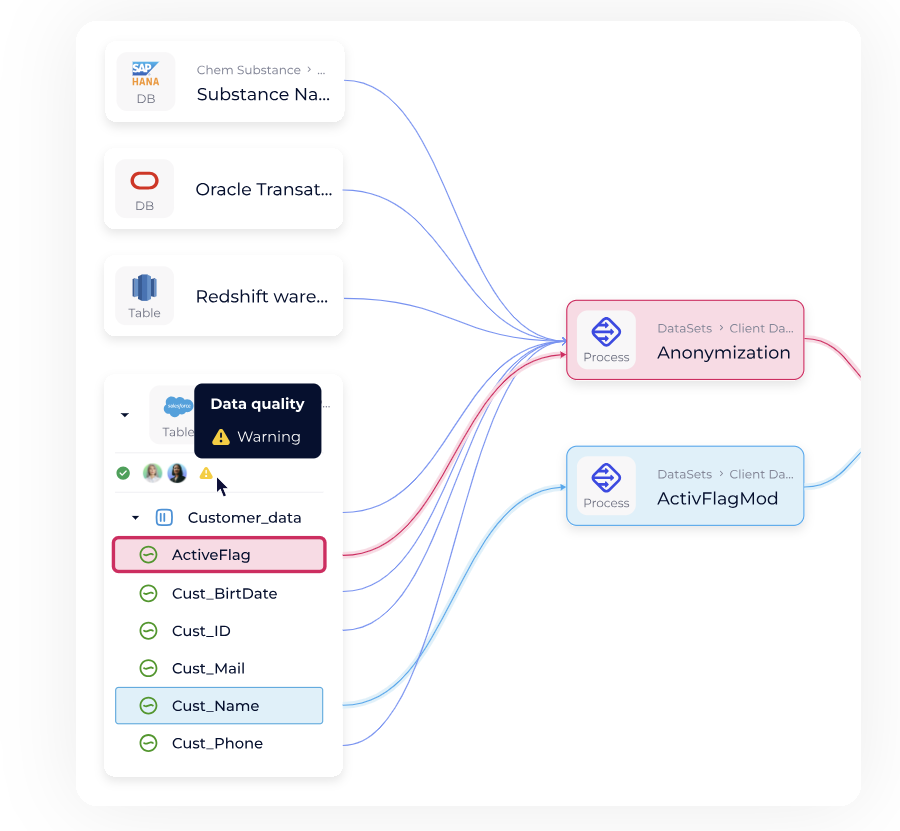
- Visualize data lineage from source systems to BI dashboards and AI models
- Classify sensitive data and support GDPR and other regulatory requirements
- Enable self-service discovery for data analysts, product teams, and business users
- Use AI-assisted features to accelerate documentation and relationship discovery
In short, DataGalaxy provides the metadata backbone for modern Data & AI Product Governance—ensuring that your data products are discoverable, compliant, and trusted.
Getting started: Practical steps for your organization
If you’re at the beginning of your metadata journey, here’s a simple starting roadmap:
- Assess your current state
- Where is metadata stored today (if anywhere)?
- Which teams are struggling the most to find and trust data?
- Define your priority domains
- Start with high-value areas: finance, customer, product, regulatory reporting, and AI models
- Select and implement a data catalog platform
- Choose a solution like DataGalaxy that supports both technical and business metadata and integrates with your existing stack
- Establish governance and roles
- Appoint data owners and stewards for your priority domains
- Define simple processes for approving definitions and curating metadata
- Automate metadata harvesting & lineage
- Connect to key data sources, BI tools, and pipelines
- Start visualizing lineage for critical reports and AI products
- Promote adoption through use cases
- Showcase quick wins: faster report creation, easier compliance checks, reduced data duplication
- Iterate and expand
- Gradually onboard new domains, systems, and teams
- Continuously refine your glossary, classifications, and governance
Organizations cannot afford to ignore the vital insights brought by metadata in 2026.
While starting a data management project from scratch might seem intimidating, luckily, there is a wealth of tools available to make the process as snag-free and scalable as possible.
FAQ
- Why is metadata important?
-
Metadata explains what data means, where it comes from, and how to use it. It simplifies finding, organizing, and managing data, boosting trust, compliance, and decision-making. Like a roadmap, metadata gives teams clarity and confidence to work efficiently.
- Is metadata discovery automatic or manual?
-
DataGalaxy connects to your data ecosystem and ingests metadata automatically. You can also enrich it manually with business context, ownership, and policies — making the catalog both comprehensive and collaborative.
- What metadata is needed for responsible AI?
-
To support responsible AI, you need metadata that captures model lineage, training data sources, versioning, performance metrics, and ethical audit trails. This transparency is key to monitoring and governing AI at scale.
- What is DataGalaxy?
-
DataGalaxy is a modern data & AI governance platform that centralizes metadata, data lineage, and business definitions to create a shared understanding of data across the organization. Designed for collaboration, we empower teams to find, trust, and use data confidently. Learn how DataGalaxy accelerates data-driven decision-making at www.datagalaxy.com.
- What makes DataGalaxy different from other data catalog solutions?
-
DataGalaxy stands out with our user-friendly, collaborative data governance platform that empowers everyone—from data stewards to business users—to understand, trust, and use data confidently. Unlike complex legacy tools, DataGalaxy offers intuitive metadata management, real-time lineage, and a business glossary in one centralized hub.
Key takeaways
- Metadata is the contextual layer that makes data understandable, governable, and reusable.
- Without metadata management, organizations face data waste, shadow IT, and regulatory risk.
- A modern metadata strategy combines a data catalog, business glossary, clear roles, and automation.
- Metadata management is central to Data & AI Product Governance and to building trusted data products.
- DataGalaxy provides a collaborative, AI-powered platform to operationalize metadata at scale and turn data into a strategic asset.
About the author


With a passion for turning data complexity into clarity, Jessica Sandifer is an experienced content manager who crafts stories that resonate across technical and business audiences. At DataGalaxy, she creates content and product marketing messages that demystify data governance and make AI-readiness actionable.
Related posts