Data is everywhere, but for all its potential, data is only as useful as it is trustworthy, organized, and secure.
That’s where data governance comes in. It’s not just a checklist or IT function—it’s the foundation for making sure your data is accurate, accessible, and actually helps your business move forward.
Whether you’re trying to improve decision-making, stay on top of regulations, or simply get everyone on the same page, data governance is what makes it all possible.
In this article, we’ll break down what data governance really means, why it matters, and how it can help your business turn data into real value.
Data governance defined
Data governance is the process of managing the availability, usability, integrity, and security of the data in enterprise systems.
Simply put, data governance is an organizational framework that sets out how businesses manage, maintain, and utilize their data. It focuses on data quality, consistency, and accessibility, aiming to ensure that every piece of information is trustworthy and valuable.
With the volume of business data growing exponentially each day, the importance of data governance has become increasingly more pronounced. It is the backbone of efficient decision-making, helping companies transform raw data into actionable insights. Organizations often use a data maturity model to assess where they currently stand and define a clear roadmap for strengthening their governance capabilities over time.
Enhancing data quality
At the heart of data governance is a commitment to enhancing data quality.
A sound governance strategy ensures that the data employed in business operations and decision-making processes is clean, consistent, and accurate.
This involves establishing stringent data validation, cleansing, and enrichment protocols to maintain the integrity of the data. High-quality data is a critical asset in the era of analytics and big data, where every piece of information can be analyzed for insights and trends. Complementing these controls with data governance and observability practices allows teams to monitor data freshness, accuracy, and completeness in real time, closing the loop between policy and execution.
Without proper data governance, data can become fragmented, outdated, or erroneous, leading to skewed insights and potentially costly mistakes.
Designing data & AI products that deliver business value
To truly derive value from AI, it’s not enough to just have the technology.
- Clear strategy
- Reasonable rules for managing data
- Focus on building useful data products

Therefore, one key reason for understanding the importance of data governance is understanding data quality and integrity, which paves the way for insightful and effective business strategies.
Ensuring regulatory compliance
Data governance is crucial for organizations looking to stay ahead in the ever-evolving regulatory landscape.
It assists businesses by maintaining compliance with a range of regulations, not only those specific to their industry (such as HIPAA for healthcare or GDPR for European businesses), but also broader data privacy and security regulations.
Effective data governance involves establishing policies and processes that align with regulatory standards, reducing the risk of costly fines and reputational damage linked to non-compliance.
It also promotes an understanding of regulatory changes, helping businesses to adapt and ensure ongoing compliance. Understanding the importance of data governance extends beyond mere data management – It’s also about safeguarding the business against regulatory pitfalls and maintaining the trust of customers and stakeholders.
Promoting business efficiency
Effective data governance promotes efficiency in business operations.
By creating a unified view of a company’s data assets, data governance helps eliminate redundancy and inconsistency, streamline processes, and reduce costs.
This operational efficiency arises from consistent data definitions, clear data owner responsibilities, and established data handling processes, all of which are key aspects of data governance.
Businesses that fully understand the importance of data governance are better able to align their data strategy with their overall business objectives, resulting in more coherent, goal-oriented actions.
Moreover, by eliminating data silos and ensuring the easy availability of accurate data, data governance can reduce time spent searching for and validating data, freeing up resources for more value-added tasks.
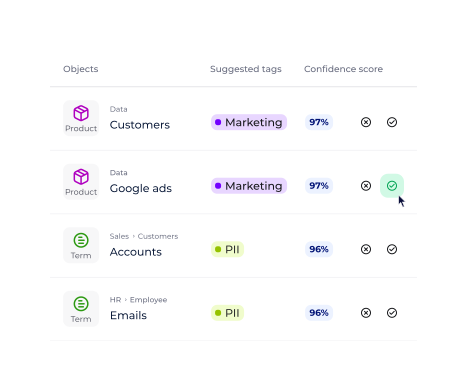
Blink, your AI Copilot
Ask questions. Get answers. Drive action.
Blink helps every user explore, understand, and use data in their daily work. No tickets, no filters, no delays. Ask anything in your native language and get trusted, contextual answers and recommendations.
Data privacy & security
Data privacy and security are central to the importance of data governance.
With rising concerns about data breaches and unauthorized data usage, ensuring data privacy and security has become paramount for businesses. This involves defining who can access specific data, how it can be used, and what levels of security are required to protect it.
Data governance policies and procedures provide clear guidelines to prevent unauthorized data access and misuse.
In addition, they ensure that the business meets legal and ethical standards for data protection. By ensuring data privacy and security, businesses not only prevent costly breaches and penalties but also build trust with their customers and stakeholders.
Data governance: A strategic asset
Seeing data governance as a strategic asset is key to understanding its importance.
Data governance enables businesses to establish a single version of truth for their data, minimizing conflicts and confusion about data accuracy. This cohesive approach fosters trust in the data, elevating its strategic value. Businesses can therefore leverage data more confidently in their strategic planning and decision-making processes.
Furthermore, with accurate and reliable data at their disposal, businesses can uncover valuable insights, predict trends, and make informed decisions that drive growth and competitive advantage. As AI adoption accelerates, this trusted data foundation also becomes the prerequisite for building a sound AI governance framework, ensuring that models are trained on consistent, compliant, and well-documented data.
Risk management with data governance
Data governance plays a pivotal role in risk management.
By setting clear protocols and procedures for data handling, data governance can significantly mitigate the risk of data breaches and misuse. Strong data governance ensures data traceability, crucial for swiftly identifying and rectifying any potential issues, thereby minimizing risk and fallout. Additionally, it aids in regulatory compliance, another significant risk factor for businesses.
By keeping data in check and ensuring it meets all necessary standards and regulations, businesses can avoid hefty penalties and reputational damage associated with non-compliance.
Data governance’s importance extends into the realm of risk management, safeguarding businesses from potential data-related pitfalls.
Facilitating data integration
Data integration is a complex challenge for businesses operating across multiple systems and platforms.
Data governance plays a crucial role in facilitating data integration by establishing standard data definitions, formats, and protocols. A data dictionary is one of the foundational tools that captures these definitions centrally, ensuring that every team refers to the same attributes, types, and relationships. This shared reference eliminates inconsistencies and enables a comprehensive view of the organization’s operations.
The 3 KPIs for driving real data governance value
KPIs only matter if you track them.
Move from governance in theory to governance that delivers.
By harmonizing data across different systems, data governance enhances the accuracy and reliability of integrated data, enabling more accurate reporting, analysis, and decision-making.
Data governance for enabling data transparency
Data governance promotes transparency in business operations by defining and managing access to data. It establishes clear guidelines on who can access specific data, how it can be used, and under what conditions.
By ensuring data transparency, businesses can maintain control over their information assets, prevent unauthorized data access, and protect sensitive information.
This transparency not only enhances internal operations but also helps build trust with customers and stakeholders. It demonstrates a commitment to data privacy and security, fostering confidence that data is being handled responsibly.
Data transparency is increasingly important in today’s data-driven landscape, where individuals and regulatory bodies are demanding more transparency around data collection, usage, and privacy practices.
By embracing data governance, businesses can facilitate data integration, promote transparency, and address key risk management concerns. These aspects of data governance contribute to the overall success and resilience of a business in an increasingly data-centric world.
Fostering an organizational data-driven culture
Finally, effective data governance helps to foster a data-driven culture within an organization: It empowers employees at all levels to use data in their decision-making processes, promoting efficiency and innovation.
This culture shift towards data-driven decision-making can be a game-changer, giving businesses the edge in a competitive market.
The future of data governance
In the end, data governance isn’t just a nice-to-have—it’s a must-have for any organization that wants to use data responsibly and effectively.
From improving data quality and ensuring compliance to boosting efficiency and enabling smarter decisions, a solid data governance strategy touches every part of the business.
It helps teams trust their data, reduces risk, and creates a clear path toward becoming a truly data-driven organization.
As data continues to shape the future of business, investing in strong governance today is what sets the foundation for long-term success tomorrow.
FAQ
-
How does a data catalog work?
-
It connects to your data sources and tools, ingests metadata automatically, and creates a centralized, searchable inventory of your assets. Advanced catalogs like DataGalaxy also provide lineage, collaboration, and governance capabilities.
? Want to go deeper? Check out:
https://www.datagalaxy.com/en/blog/utilizing-the-semantic-layer/ -
How does a data catalog integrate with my existing tools?
-
Modern catalogs integrate with your full data ecosystem — from Snowflake to Power BI. DataGalaxy includes prebuilt connectors, APIs, and automation tools that make syncing metadata seamless and scalable.
? See supported integrations -
How does DataGalaxy create value for the business?
-
By turning data into a searchable, shared knowledge base, DataGalaxy helps teams spend less time chasing answers — and more time delivering impact. It improves data discoverability, reduces duplication, and accelerates decision-making. And with built-in governance, you reduce risk while increasing trust in every report, model, and initiative.
-
How does DataGalaxy enhance self-service analytics in Looker?
-
DataGalaxy empowers self-service by providing contextual metadata—like field descriptions, owners, and certified status—right within Looker. Users no longer need to rely on Slack threads or data teams to interpret metrics; they can explore with built-in governance and confidence.
-
How does DataGalaxy help manage data products?
-
You can define, own, govern, and evolve each data product across its lifecycle — with clear responsibilities, lineage, and performance tracking