It’s no secret that organizations rely on data to drive decisions, but managing and securing that data is just as important as accessing it.
A data catalog helps structure and locate information, but its value is only partially realized without a strong governance framework. Data governance platforms provide the necessary oversight, enforce policies, ensure accuracy, and protect sensitive information.
This article breaks down six essential features of an effective data governance platform, showing how they improve data management, strengthen security, and support better decision-making.
Data governance platforms: The ultimate solution for data-driven success
While a data catalog tool provides a structured way to organize and search for data, it becomes significantly more powerful when combined with a comprehensive data governance platform.
Data governance is the process of managing the availability, usability, integrity, and security of the data in enterprise systems. Simply put, data governance covers all the rules and processes that ensure organizational data’s structure, protection, and management.
Data governance platforms are essential for data management organizations as they facilitate standardized data policies, access controls, and metadata management, enabling organizations to maintain data accuracy and consistency across various systems.
By implementing a robust data governance strategy, organizations can enhance data quality, reduce risks associated with data breaches or misuse, and improve decision-making processes. Assessing where your organization stands today, using a data maturity model, is often the first step toward building that strategy with confidence. These platforms also promote collaboration by defining clear roles and responsibilities, ensuring that data is utilized effectively while aligning with business objectives. A governance-first approach ensures that organizations can:
- Enforce data compliance: Stay ahead of regulatory requirements and audits
- Improve data trust: Ensure data accuracy, security, and reliability
- Enhance collaboration: Provide a unified data access experience for business users and data professionals
- Maximize data value: Turn raw data into actionable insights with high-quality governance frameworks
1. Data lineage tracking: Understanding data’s journey
Data lineage is an integral process that outlines the entire data life cycle.
It’s a critical tool that enables businesses to undertake system migrations with confidence, implement process changes with minimal risk, track data-related errors, and integrate data discovery with a metadata overview to establish a robust data mapping framework. It provides a clear visualization of where data originates, how it transforms, and where it is used.
Data is perpetually being processed and transformed in a continuously evolving data system. Maintaining a record of each transformation while establishing a data lineage system includes mapping data elements at every stage; tracking columns, views, and tables; and reporting extractions and transformations in databases.
Why data lineage tracking matters
Enhances data trust and accuracy by showing the complete lifecycle of data
Supports compliance efforts by maintaining records of data movement and transformations
Helps troubleshoot data issues by identifying errors at their source
Improves collaboration by providing a shared understanding of data across teams
A robust data governance platform integrates data lineage tracking to ensure auditability and regulatory compliance, making it an essential feature in modern data management.
2. Natural language search: Democratizing data access
Natural language processing powered search allows users to find datasets using everyday language rather than complex queries. Self-service search engines are key to an efficient, data-driven organization: They empower teams to quickly find the data they need to derive valuable insights and drive informed decision-making.
Why natural language search matters
Makes data discovery intuitive, even for non-technical users
Reduces dependency on data engineers and IT teams
Encourages a data-driven culture by making data more accessible
Saves time by quickly retrieving relevant data insights
By incorporating natural language search capabilities, a data catalog tool enables a self-service data environment, allowing business users, analysts, and engineers to find and utilize data effortlessly.
3. Metadata management: Structuring data for better insights
Metadata, often described as data about data, is vital for businesses to help organize, find, and understand data, enhancing the efficiency of data management and facilitating informed decision-making. Metadata management involves collecting, organizing, and maintaining detailed information about data, including its structure, source, format, and usage. A well-maintained data dictionary is often the foundation of effective metadata management, giving teams a centralized reference for data definitions, attributes, and relationships.
Designing data & AI products that deliver business value
To truly derive value from AI, it’s not enough to just have the technology.
Data professionals today also need a clear strategy, reasonable rules for managing data, and a focus on building useful data products.

Why metadata management matters
Facilitates data classification, ensuring sensitive data is properly labeled and handled
Enables data standardization across multiple sources
Supports data discovery by providing descriptive attributes and contextual information
Ensures data quality by tracking key metrics and attributes
An enterprise-level data governance platform with strong metadata management capabilities ensures that organizations maintain data consistency and integrity, leading to more informed decision-making.
4. Data quality monitoring: Ensuring integrity
Data quality and profiling tools assess datasets for completeness, accuracy, consistency, and validity before use. Data quality management is an intricate blend of processes, methodologies, and tools that strives to ensure the integrity and accuracy of data throughout its lifecycle. From its inception, when data is first generated or captured, to its eventual consumption in decision-making processes, data quality monitoring oversees every stage to guarantee data is free from errors, inconsistencies, and redundancies. In essence, data quality management is the guardian of an organization’s data reservoir. It acts as the filter, ensuring that only the most valuable, actionable, and reliable data reaches the decision-makers, analysts, and other stakeholders. In a world inundated with vast volumes of data, data quality management shines the spotlight on “quality over quantity,” ensuring that businesses base their decisions on a solid foundation.
Why data quality monitoring matters
Prevents poor-quality data from impacting business decisions
Identifies data anomalies and inconsistencies early
Helps regulatory compliance by ensuring data accuracy
Reduces operational risks associated with faulty data
5. Role-Based Access Control (RBAC) & security: Protecting sensitive data
Data breaches can have catastrophic implications, from financial repercussions to reputational damage. Thus, ensuring robust data security is non-negotiable. Steps to fortify data security include:
- Access controls: Ensure that only authorized personnel access specific data sets. Implement roles and permissions that define who can view, modify, or delete data
- Data encryption: Encrypt data at rest and in transit to safeguard it from unauthorized access and breaches
- Regular audits: Conduct regular security audits to identify potential vulnerabilities and address them proactively
- Backup & recovery: Establish a robust backup strategy, ensuring data is regularly backed up in secure locations. Additionally, a recovery plan should be implemented for scenarios where data restoration is necessary.
Role-Based Access Control ensures that users can access only the data they are authorized to use based on their role within the organization. Defining data owner responsibilities upfront is key to making RBAC work in practice: data owners set the access policies, determine who can view or modify specific datasets, and ensure accountability for data quality and security across the board.
Why access control matters
Strengthens data security by preventing unauthorized access
Helps in meeting compliance requirements like GDPR, HIPAA, and CCPA
Reduces insider threats by limiting data exposure
Improves audibility with clear logs of who accessed what data and when
When a data governance platform integrates RBAC, encryption, and auditing features to ensure that data remains secure while being accessible to authorized personnel.
Smart browser extensions
Our browser extension doesn’t just supply knowledge – It also gives users an easy way to capture knowledge and share it with their team members.
6. Automated data tagging & classification: Simplifying data management
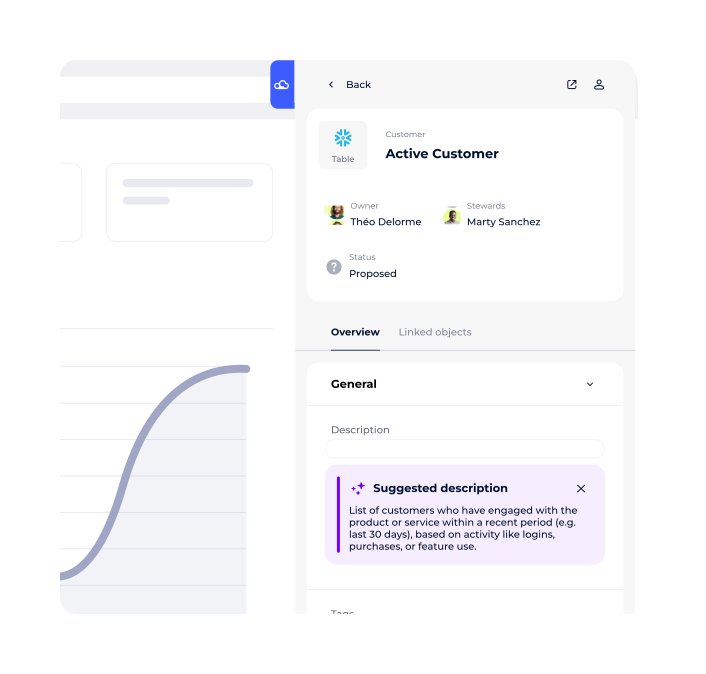
Automated tagging and classification use AI and machine learning to label data based on content, context, and usage patterns. As AI capabilities become more deeply embedded in data operations, organizations are increasingly expected to pair these tools with a structured AI governance framework to ensure responsible, compliant use of automated decisions. Over the last three years, DataGalaxy has worked to master machine learning and artificial intelligence, staying ahead of the curve and shaping future trends in the data management sphere. This forward-thinking approach has resulted in a set of powerful, user-friendly tools that make data management a breeze for businesses everywhere using DataGalaxy. Automate your catalog with Metabot, DataGalaxy’s suggestion assistant – Metabot is an AI-based advanced software revolutionizing object catalog management. As your organization’s ultimate suggestion assistant, Metabot offers personalized suggestions based on customer behavior, streamlines object categorization and tagging, and provides valuable analytics to improve catalog performance.
Why automation matters
Accelerates data cataloging without manual effort
Improves searchability by categorizing data based on relevance
Helps data governance policies by classifying sensitive data automatically
Enables better compliance tracking by ensuring data is handled according to regulatory requirements
A data governance platform with automated classification tools helps organizations maintain a well-organized, secure, and easily searchable data repository without manual intervention.
Conclusion
A data catalog tool is essential for organizations looking to unlock the full value of their data assets. However, not all catalogs are created equal.
A data governance platform that integrates these features ensures that organizations maintain control, compliance, and accessibility over their data, ultimately transforming raw data into a strategic business asset.
By investing in the right data catalog tools and governance frameworks, organizations can secure their data value and drive business success in a rapidly evolving digital world.
FAQ
-
If data is everyone’s job, why does it still feel like no one knows where to start?
-
Most teams still rely on a few experts to translate the data jungle. As a result, adoption lags, reporting is inconsistent, and decisions get bottlenecked.
DataGalaxy boosts data literacy by making business terms, definitions, and trusted data assets easy to explore for every user — not just the experts.
👉 – Empower teams with a shared vocabulary through a centralized business glossary
👉 – Make trusted data assets easily discoverable via natural language search
👉 – Provide guided lineage and visual context to foster real understanding
👉 Facing this challenge? Explore the solution
👉 Want to see it live? Book a tailored demo -
Is a data catalog easy to use for non-technical teams?
-
Yes — the best data catalogs are built for collaboration. With intuitive interfaces, searchable business terms, and visual lineage, DataGalaxy empowers business users, analysts, and stewards to work with data confidently.
-
How long does it take to implement a data catalog?
-
Implementation time varies by organization size and complexity, but modern data catalogs like DataGalaxy can be operational in weeks — not months. Out-of-the-box connectors, guided onboarding, and automated metadata ingestion reduce ramp-up time dramatically.
👉 ? Contact us to scope your ideal timeline -
How is AI governance different from data governance?
-
While data governance focuses on managing data quality, access, and compliance, AI governance extends those principles to models and algorithms. It includes monitoring for bias, ensuring explainability, and managing the lifecycle of machine learning models.
-
How is a data catalog different from a data glossary?
-
A business glossary defines terms and ensures shared understanding. A data catalog documents the technical assets (tables, fields, reports) and connects them to the glossary. Both are essential — and should be linked.
? Want to go deeper? Check out:
https://www.datagalaxy.com/en/blog/data-catalog-vs-glossary-dictionary
At a glance
- Governance amplifies catalog value: A data catalog is most powerful when paired with a governance platform that enforces policies, ensures data quality, and secures sensitive information.
- Six core features drive success: Data lineage, natural language search, metadata management, quality monitoring, access control, and automated tagging are essential for scalable, secure data use.
- Smart tools unlock strategic impact: With the right governance platform, organizations turn raw data into trustworthy, compliant, and business-ready insights that fuel innovation and growth.