According to Gartner, more than 84% of organizations say less than half of their employees understand how to use the data tools provided.
What happens when the people using those tools aren’t confident or equipped to work with data? Teams get underused technology, unrealized potential, and decisions made on instinct rather than insight. Thankfully, data literacy can solve the majority of these issues in your teams.
Here’s the catch: Data literacy training often misses the mark because it starts too late and targets the wrong audience.
Before rolling out complex training programs or granting access to new analytics software, organizations must first understand the true value of data and why empowering every employee with the right data skills is essential for long-term success.
Why tackle data literacy at a lower level?
It’s tempting to think that data literacy should be confined to analysts or technical roles. However, organizations that take this approach often face low adoption of their data tools and platforms. As a result, the business value they expect from data initiatives falls short.
There are two core reasons to prioritize data literacy at a foundational level:
CDO Masterclass: Upgrade your data leadership in just 3 days
Join DataGalaxy’s CDO Masterclass to gain actionable strategies, learn from global leaders like Airbus and LVMH, and earn an industry-recognized certification.
Low adoption means unrealized potential: If only a small subset of your workforce can confidently work with data, the broader organization won’t benefit from data-driven thinking. That leads to underutilized tools and missed opportunities.
Unresolved obstacles diminish business value: Misunderstandings about data, mistrust in data outputs, and lack of confidence to use tools independently all limit the impact of even the most advanced data programs.
Before any training can begin, your business must understand and appreciate the value of data.
Who drives data literacy?
Chief Data and Analytics Officers (CDAOs) and Chief Data Officers (CDOs) typically lead the data literacy charge supported by a team of technical professionals. Their mission is to lead the organization toward becoming truly data literate.
This requires:
Demonstrating impact
Show real metrics, business outcomes, and case studies to prove the value of investing in data skills.
Delegation with consistency
While the CDAO owns the strategy, different teams must help deliver training with a unified message.
Designing data & AI products that deliver business value
To truly derive value from AI, it’s not enough to just have the technology.
Becoming a data-literate organization is a journey, and like any journey, it requires a clear roadmap. Here’s a phased approach to building a successful data literacy program:
1. Sell the value of data literacy
Start by creating compelling value propositions that resonate across departments.
2. Assess the current state
Understand your baseline: Who is confident with data, who isn’t, and what barriers exist?
Your HR staff and data scientists don’t need the same training.
Don’t deliver information just once
Reinforcement is key.
Don’t forget to celebrate and communicate successes
Here are the best practices for encouraging a data literacy program:
Tailor training to data personas
Not everyone needs to be a data scientist – Focus on what each role truly needs to know
Use multiple delivery methods
Combine classroom sessions, webinars, gamified platforms, lunch-and-learns, social learning, and real-world exercises
Identify skill gaps per persona
Start with what people need in their day-to-day work.
Embed data learning in day-to-day tasks
On-the-job application cements learning more than theory alone
Tools that support data literacy
Your data literacy training will be far more effective if it integrates with the tools employees already use. Consider these complementary tools:
Data catalogs: Help employees discover data sources and understand their context
Semantic layers: Translate technical data into business language
Knowledge graphs: Visualize relationships between data entities
Analytics platforms: Give learners hands-on experience with real tools
Using these tools can help take data literacy from a mere concept to a concrete foundation for your teams’ daily operations.
Blink, your AI Copilot
Ask questions. Get answers. Drive action.
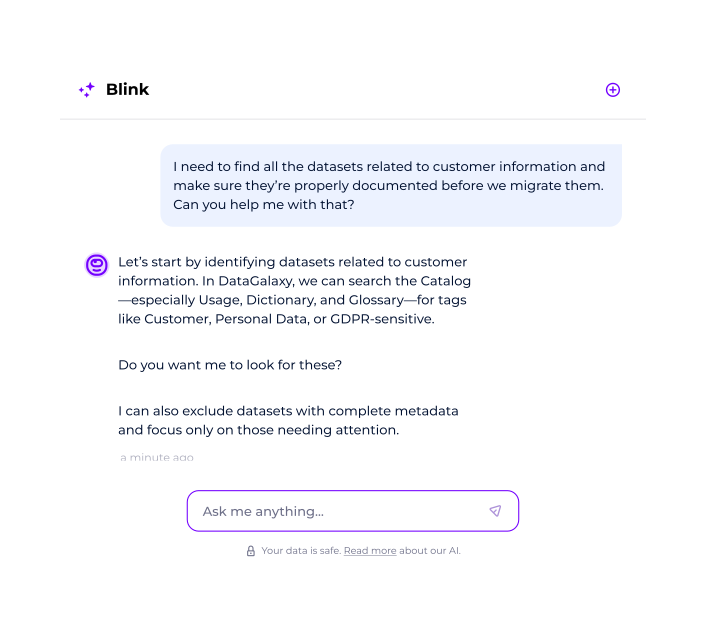
Blink helps every user explore, understand, and use data in their daily work. No tickets, no filters, no delays. Ask anything in your native language and get trusted, contextual answers and recommendations.
A successful data literacy program is about more than just training. It’s about enabling confident, independent, and informed data use across your entire organization.
By starting at the ground level and focusing on practical, tailored, and engaging learning, organizations can unlock the full value of their data and build a truly data-literate culture from the ground up.
FAQ
What is data governance?–
Data governance ensures data is accurate, secure, and responsibly used by defining rules, roles, and processes. It includes setting policies, assigning ownership, and establishing standards for managing data throughout its lifecycle.
What is data intelligence?–
Data intelligence transforms raw data into meaningful insights by analyzing how it flows and where it adds value. It uncovers patterns and connections, helping teams make confident, strategic decisions that drive real business outcomes.
What is data lineage?–
Data lineage traces data’s journey—its origin, movement, and transformations—across systems. It helps track errors, ensure accuracy, and support compliance by providing transparency. This boosts trust, speeds up troubleshooting, and strengthens governance.
What is data mesh?–
Data mesh decentralizes data ownership to domain teams, letting them manage and serve data as products. It fosters collaboration and accountability, supported by shared standards, self-serve tools, and governance to ensure data is interoperable and trustworthy across the organization.
What is data mesh architecture?–
Data mesh architecture treats data as a product, giving ownership to domain teams. It replaces centralized control with shared standards and empowers experts to manage and share data, making it more scalable, discoverable, and useful across the organization.
About the author: Jessica Sandifer
Tech writer
With a passion for turning data complexity into clarity, Jessica Sandifer is an experienced content manager who crafts stories that resonate across technical and business audiences. At DataGalaxy, she creates content and product marketing messages that demystify data governance and make AI-readiness actionable.
More than a buzzword, data culture is the shared mindset and operating system that determines whether your organization treats data as a strategic asset or an untapped byproduct. As data & AI products become central to how companies create value, the need for a mature, governed, and collaborative data culture has never been greater. Summary […]
Did you know that Gartner estimates that by 2026, 90% of current analytics content consumers will become content creators enabled by AI? Leading analytics, research, and expert guidance firm, Gartner, recently shared their thoughts on the future of the data and analytics industry, including understanding how to work with emerging AI tools while ensuring high-quality data […]
There’s a growing disconnect in many organizations: Governance is talked about as indispensable, yet it’s often treated as a checkbox. Leaders are eager to adopt data and AI strategies, invest in platforms, and hire data governance officers—but often, implementation lags. In this post, we explore Gartner’s finding that while nearly 89% of data and analytics […]
Most data catalogs stop at organization. The Marketplace goes further, turning certified data assets into visible, reusable products directly linked to the use cases they support. This is not just about access. It’s about alignment. Keep reading to learn how to make your data reusable, discoverable, and aligned with real business goals. Why does the […]
Data is more than a byproduct of operations. It is now the currency of competitiveness and a catalyst for innovation. The challenge, however, is not in collecting data but in cultivating the data maturity to manage, interpret, and transform it into actionable intelligence. A data maturity model is a strategic framework to assess an organization’s […]
AI innovation must be matched by equally powerful governance frameworks. However, across many industries, governance is frequently perceived as a limitation rather than a catalyst for positive business outcomes. Artificial intelligence isn’t just advancing. It’s multiplying in enterprise applications. In this article, we’ll explore two of the hottest trends in Gartner’s 2025 Hype Cycle: AI […]