From AI‑powered personalization to mission‑critical analytics, every decision relies on data that is timely, consistent, and trustworthy.
From early niche adoption to mainstream business necessity, the data observability market has transformed into one of the fastest‑growing sectors in the data and analytics landscape. In 2025, organizations face unprecedented pressure to ensure the reliability, accuracy, and transparency of their data pipelines.
This article explores data observability, why it’s essential, the trends shaping its future, and the key players leading the market. Keep reading to learn more.
What is data observability?
Data observability is the ability to fully understand and monitor the health, quality, lineage, freshness, schema, and volume of data as it flows through your data stack.
It extends application observability into the data layer, bringing together signals like schema drift, distribution shifts, SLA freshness gaps, volume anomalies, and lineage tracking to help teams detect and resolve issues proactively.
Observability also operates on three pillars: Logs, metrics, and traces. These are adapted to data workflows to offer end‑to‑end visibility and context into data incidents.
Modern data observability tools collect metrics on:
Freshness
Is the data up to date?
Schema
Unplanned type or organization changes
Distribution & volume
Unexpected changes in value ranges or row counts
Schema
Unplanned type or organization changes
Why do I need data observability?
Trust & reliability
Data issues like schema drift, missing rows, or skewed distributions can silently undermine dashboards, ML models, analytics pipelines, and decisions.
Observability tools help catch these issues before they impact business outcomes.
Faster detection & resolution
Data observability can provide automated anomaly detection, dynamic thresholds, and trace-based impact analysis to accelerate issue triage and root cause resolution for data teams.
The 3 KPIs for driving real data governance value
KPIs only matter if you track them.
Move from governance in theory to governance that delivers.
GDPR, HIPAA, and other international regulations often require transparent lineage tracking and data usage controls. Data observability helps preserve compliance and traceability of your data assets.
Collaboration & alignment
Linking data alerts to cataloged assets, owners, definitions, and business context enables cross-functional alignment between data engineers, analysts, stewards, and business users.
AI & ML readiness
Reliable AI systems require clean, high‐trust data inputs. Observability improves data integrity, reduces model risk, and enhances transparency in data pipelines feeding models.
Future trends in data observability (2025 & beyond)
Increasingly, tools will learn baseline behavior and forecast anomalies before they occur, reducing noise and catching drift earlier.
2. Deeper integration with governance & catalogs
In 2025, best‐of‐breed partnerships (like DataGalaxy + Bigeye) are connecting observability signals seamlessly into governance workflows, lineage views, and shared metadata to close the loop between monitoring and remediation.
3. Column‑level & field‑level observability
Moving beyond table-level alerts, platforms are adding fine‑grained lineage and monitoring that help root‑cause anomalies at the column/attribute level.
4. Observability embedded into governance
Rather than siloed systems, the future is about governance platforms that natively ingest observability signals and expose them within catalog, policy, and collaboration workflows.
5. Metadata‑driven automation & AI augmentation
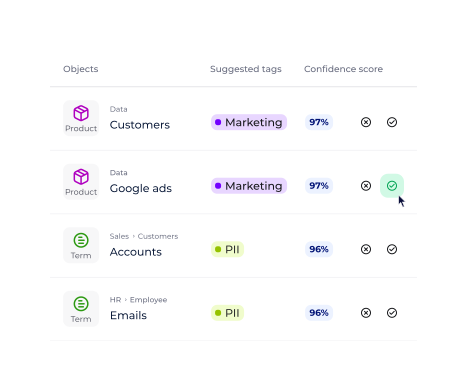
Smart assistants, AI stewards, and automated suggestions are becoming standard. Platforms like DataGalaxy use AI to auto‑tag assets, enrich glossaries, suggest owners, and integrate observability insights into workflows.
5 key players in the data observability market (2025)
Below is an overview of five leading data observability solutions in today’s data observability market, including their various strengths and weaknesses:
1. Bigeye
Strengths
Rich library of 100+ pre‑built monitors for freshness, distribution, schema, volume, and more
Predictive anomaly detection with dynamic baseline thresholds
Root-cause analysis linking anomalies to lineage or upstream events
Weaknesses
Primarily focused on engineering workflows; less tailored to business/analytic stakeholders
2. Sifflet
Strengths
AI-driven monitoring suite spanning storage, transformation, and consumption layers
Native connectors and collaboration features (assigning issues, commenting, Slack/Jira integration)
Weaknesses
A collaboration-first interface may come at the cost of deeper technical configuration options
Designing data & AI products that deliver business value
To truly derive value from AI, it’s not enough to just have the technology.
One of the early pioneers in data observability, with robust enterprise usage
Field‑level lineage and incident impact analysis tied to dashboards and downstream assets
Supports data contracts between producers/consumers
Weaknesses
Can be complex to configure and operate at scale
4. IBM
Strengths
Simplified procurement, consistent user interface, and tight integration within the vendor stack
Comprehensive feature coverage spanning governance, observability, lineage, and policy management
Weaknesses
May not offer best‑of‑breed depth per module (e.g. observability or governance individually)
User experience and innovation speed can lag compared to that of specialized players
Higher cost and vendor lock‑in risk
5. DataGalaxy
As a modern data & AI governance platform, DataGalaxy goes beyond cataloging to deeply embed data observability into governance, collaboration, and AI readiness workflows, making it the ultimate solution for data‑driven organizations.
DataGalaxy’s strengths
Active metadata & real‑time observability
Built‐in support for live lineage, schema/distribution monitoring, freshness SLAs, and volume tracking tied directly into cataloged datasets and business terms.
Unified platform for governance & observability
DataGalaxy integrates observability signals (through connectors like Bigeye) with collaborative governance features such as ownership, policy management, and issue workflows, creating a single source of truth for trusted data.
Column‑level lineage & root cause context
Detailed lineage down to the column level accelerates troubleshooting and impact assessment across dashboards and analytical pipelines.
AI‑powered discovery & smart suggestions
Tools like Blink auto-suggest glossary definitions, PII tags, classifications, and observability triggers, reducing manual effort and improving metadata quality.
Collaboration & governance built in
Tasks, comments, Slack/MS Teams/Jira integration, automated cataloging, and campaign workflows unite business and technical teams around observability insights.
70+ connectors and open API
Real‑time sync with Snowflake, Databricks, BigQuery, dbt, Sifflet, Bigeye, and more—ensuring observability and governance across your entire stack.
Proven customer impact
Organizations like Society Insurance have streamlined data quality detection and governance by integrating DataGalaxy with observability tools, proactively surfacing issues, and improving resolution times.
Weaknesses
Rapid feature innovation means teams should plan for continuous enablement and training to leverage their capabilities fully.
Because it fosters collaboration across business and technical users, it may require change‑management efforts to adopt standardized workflows organization‑wide.
Why is DataGalaxy the ultimate data observability solution?
DataGalaxy stands apart in the data observability market by bridging the gap between detection and action. Rather than treating observability as a siloed monitoring tool, it embeds observability within context:
Alerts are directly tied to business terms, definitions, and owners
Lineage views show exactly where data flow issues occur and who owns affected assets
The platform scales across data teams, product teams, analysts, and executives, all working from the same trusted knowledge hub
In short, DataGalaxy transforms observability from a technical afterthought into a strategic asset, ensuring data reliability at scale and fueling AI‑ready data ecosystems.
Blink, your AI Copilot
Ask questions. Get answers. Drive action.
Blink helps every user explore, understand, and use data in their daily work. No tickets, no filters, no delays. Ask anything in your native language and get trusted, contextual answers and recommendations.
The data observability market outlook: 2025 & beyond
The data observability market in 2025 is characterized by rapid maturation, growing sophistication, and a deeper coherence with data governance.
As complexity in modern data pipelines rises with real‑time streams, machine learning, multicloud environments, and AI models, the need for joined-up observability and governance has never been greater.
Key trends shaping the future data observability market:
Convergence: Platforms like DataGalaxy with observability experts like Bigeye exemplify a best‑of‑breed integrated stack. Market demand is converging toward governance‑native observability solutions.
Shift-left observability: Tools are embedding observability earlier in development and data product workflows, reducing silent failures and improving shift‑left quality controls.
AI & metadata synergy: Expect expanded use of smart agents, automated tagging, ownership suggestions, compliance monitoring, and anomaly prediction.
Expansion into AI governance: Observability will increasingly monitor not just data, but the health of AI pipelines, including their bias signals, feature drift, model input quality, and lineage across data‑model‑dashboard chains
Conclusion
For modern data professionals, pairing proactive observability with collaborative governance is no longer optional.
The data observability market in 2025 includes a mix of specialized monitoring platforms and broader governance providers, each with different strengths and trade‑offs.
However, as organizations choose integration, collaboration, and AI readiness over reactive monitoring, DataGalaxy emerges as the ultimate solution. It’s a governance‑native platform that fully embeds observability, metadata, policy, lineage, and collaboration in one unified, user‑centric ecosystem.
FAQ
Do I need a data catalog?–
If your teams are struggling to find data, understand its meaning, or trust its source — then yes. A data catalog helps you centralize, document, and connect data assets across your ecosystem. It’s the foundation of any data-driven organization.
? Want to go deeper? Check out: https://www.datagalaxy.com/en/blog/what-is-a-data-catalog/
Can you govern AI without governing your data?–
No — AI is only as good as the data it learns from. Poor data governance leads to biased models, opaque decisions, and compliance risks. Responsible AI starts with trustworthy, well-governed data.
How does a data catalog integrate with my existing tools?–
Modern catalogs integrate with your full data ecosystem — from Snowflake to Power BI. DataGalaxy includes prebuilt connectors, APIs, and automation tools that make syncing metadata seamless and scalable.
? See supported integrations
What is DataGalaxy?–
DataGalaxy is a modern data & AI governance platform that centralizes metadata, data lineage, and business definitions to create a shared understanding of data across the organization. Designed for collaboration, we empower teams to find, trust, and use data confidently. Learn how DataGalaxy accelerates data-driven decision-making at www.datagalaxy.com.
What makes DataGalaxy different?–
DataGalaxy stands out with our user-friendly, collaborative data governance platform that empowers everyone—from data stewards to business users—to understand, trust, and use data confidently. Unlike complex legacy tools, DataGalaxy offers intuitive metadata management, real-time lineage, and a business glossary in one centralized hub. Discover how we drive agile, value-first data strategies at www.datagalaxy.com.
At a glance
Data observability ensures the reliability, accuracy, and transparency of data pipelines by monitoring freshness, schema, lineage, and anomalies to detect and resolve issues proactively.
In 2025, the market is shifting toward AI-driven anomaly detection, deeper integration with governance, and column-level observability, with platforms like DataGalaxy leading through unified governance-native observability.
Embedding observability within governance workflows transforms it from a reactive monitoring function into a strategic asset that fuels trust, AI readiness, and business‑aligned decision‑making.
About the author: Jessica Sandifer
Tech writer
With a passion for turning data complexity into clarity, Jessica Sandifer is an experienced content manager who crafts stories that resonate across technical and business audiences. At DataGalaxy, she creates content and product marketing messages that demystify data governance and make AI-readiness actionable.
More than a buzzword, data culture is the shared mindset and operating system that determines whether your organization treats data as a strategic asset or an untapped byproduct. As data & AI products become central to how companies create value, the need for a mature, governed, and collaborative data culture has never been greater. Summary […]
Did you know that Gartner estimates that by 2026, 90% of current analytics content consumers will become content creators enabled by AI? Leading analytics, research, and expert guidance firm, Gartner, recently shared their thoughts on the future of the data and analytics industry, including understanding how to work with emerging AI tools while ensuring high-quality data […]
There’s a growing disconnect in many organizations: Governance is talked about as indispensable, yet it’s often treated as a checkbox. Leaders are eager to adopt data and AI strategies, invest in platforms, and hire data governance officers—but often, implementation lags. In this post, we explore Gartner’s finding that while nearly 89% of data and analytics […]
Most data catalogs stop at organization. The Marketplace goes further, turning certified data assets into visible, reusable products directly linked to the use cases they support. This is not just about access. It’s about alignment. Keep reading to learn how to make your data reusable, discoverable, and aligned with real business goals. Why does the […]
Data is more than a byproduct of operations. It is now the currency of competitiveness and a catalyst for innovation. The challenge, however, is not in collecting data but in cultivating the data maturity to manage, interpret, and transform it into actionable intelligence. A data maturity model is a strategic framework to assess an organization’s […]
AI innovation must be matched by equally powerful governance frameworks. However, across many industries, governance is frequently perceived as a limitation rather than a catalyst for positive business outcomes. Artificial intelligence isn’t just advancing. It’s multiplying in enterprise applications. In this article, we’ll explore two of the hottest trends in Gartner’s 2025 Hype Cycle: AI […]