Data is now the most valuable strategic asset an enterprise can possess.
However, its true value is realized only when it is governed with discipline and vision.
Far more than a technical exercise, data governance is a critical enabler of trust, compliance, and innovation. It empowers organizations to transform raw information into reliable insights that drive sustainable competitive advantage.
Keep reading to learn more about understanding data governance and best tips on overcoming common data governance challenges.
What is data governance?
Data governance is the process of managing the availability, usability, integrity, and security of the data in enterprise systems.
Simply put, data governance covers all the rules and processes that ensure the organizational data’s structure, protection, and management.
Data is more effective with proper data governance. Data management is indispensable for analytics, enabling your company to make better, more informed decisions.
Additionally, good data governance ensures that the data you and your teams use is correct, consistent, and accessible to the right people in the company.
Data governance enables you to:
Gather data from across the enterprise to get a global view
Identify data sources and processes
Verify data quality
Educate the company on the need to use data correctly
Ease data integration
Ensure compliance with data protection laws and regulations
Allow the business teams to analyze and present the data
Without effective data governance, companies run the risk of data consistency issues, which in turn result in unreliable enterprise and business intelligence reporting.
Designing data & AI products that deliver business value
To truly derive value from AI, it’s not enough to just have the technology.
- Clear strategy
- Reasonable rules for managing data
- Focus on building useful data products
Read the free white paper
Do my teams need a data governance strategy?
If you are concerned about any of the following issues, then implementing a data governance strategy can help your business:
Analyze your data in greater detail
Keep up with security regulations requires strict control of your data
Recognize and mitigate security problems
Remove duplicates, incorrect, and obsolete data
Manage several databases
Implementing organizational data governance in 3 easy steps
#1: Inventory and map the company’s data
The first step to establishing data governance is knowing where the company’s data is stored and identifying it. Next, you can look at its lifecycle within the enterprise:
- What is the use of the data?
- How is it transformed?
- By whom?
A data catalog is essential to get an overview of all data.
Since it brings together all the company’s data, you can map it more efficiently and establish a common overview.
#2: Create a more data-driven organization
The implementation of a data governance plan varies depending on a project’s criticality and the company’s size.
In all cases, it is essential to determine the roles and responsibilities of each person in relation to the data.
Start by appointing data owners: Those who manage the data in their respective business areas.
It may also be helpful to appoint one or more Data Governance Managers to orchestrate all actions.
#3: Promote and encourage a data culture
Once you have all the tools necessary to manage data, it is important to encourage other business teams to utilize data in their decision-making.
It can often be challenging to promote an overarching data culture and a data-driven approach among your teams. To achieve this, it is useful to:
- Schedule various training sessions for all users
- Facilitate the exchange of information and dissemination of best practices through recurring meetings, an idea box on your intranet, or a data newsletter.
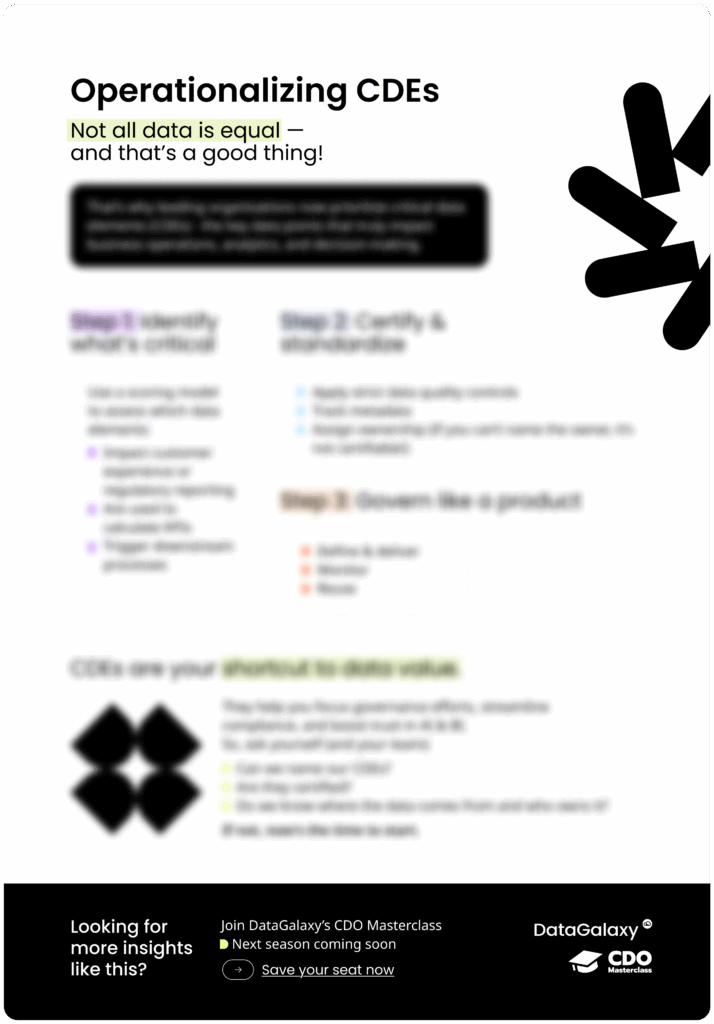
Operationalizing
CDEs
Do you know how to make critical data elements (CDEs) work for your teams?
Get your go-to guide to identifying and governing critical
data elements to accelerate data value.
Download the free guide
Best practices for implementing data governance
Establish clear rules
When implementing your data governance strategy, it is likely to run into some resistance along the way, as data governance can restrict how data is handled within the organization.
A vital step to ensuring your governance project’s success is establishing clear and comprehensive guidelines.
These rules can be outlined by a data governance committee established within your organization.
Provide training
All teams in the company must have the tools to use data effectively.
When it comes to data, consistency is vital.
Consider carrying out a workshop or training session so that everyone can be on the same page about your data governance objectives.
Communicate clearly & often
Consistent communication throughout all stages of the project is key.
Ensure that all project roles and ownership are clearly defined.
Choose the right data catalog
Choosing the right data catalog is perhaps one of the most important factors for your project.
Data catalogs are the golden tool for your governance project as they gather all of your organization’s data in one place, making it accessible to all.
How do I manage organizational change?
When building your governance strategy, it’s important to involve all teams as early as possible.
This can help identify data-related issues by asking the various business units. You can then involve them and convince them to participate in the data governance project.
The future of good data governance
Good data governance will protect your company from serious data issues by ensuring all data in your enterprise is tracked, cataloged, and protected.
Without such a plan, it will be more difficult for your business to manage the volume and quality of information that is currently being generated.
In the end, your governance project is more than just about ensuring data is reliable: It’s about ensuring that your company has access to all the information it needs to effectively make informed decisions.
FAQ
-
What is data governance?
–
-
Data governance ensures data is accurate, secure, and responsibly used by defining rules, roles, and processes. It includes setting policies, assigning ownership, and establishing standards for managing data throughout its lifecycle.
-
Why is data governance important?
–
-
Data governance brings clarity and consistency, ensuring everyone uses and understands data the same way. It’s not just about control—it fosters collaboration, trust, and smarter decisions, turning data into a strategic asset that fuels innovation and growth.
-
How do I implement data governance?
–
-
To implement data governance, start by defining clear goals and scope. Assign roles like data owners and stewards, and create policies for access, privacy, and quality. Use tools like data catalogs and metadata platforms to automate enforcement, track lineage, and ensure visibility and control across your data assets.
-
How do I start a data governance program?
–
-
To launch a data governance program, identify key stakeholders, set clear goals, and define ownership and policies. Align business and IT to ensure data quality, compliance, and value. Research best practices and frameworks to build a strong, effective governance structure.
-
How is value governance different than data governance?
–
-
Value governance focuses on maximizing business outcomes from data initiatives, ensuring investments align with strategic goals and deliver ROI. Data governance, on the other hand, centers on managing data quality, security, and compliance. While data governance builds trusted data foundations, value governance ensures those efforts translate into measurable business impact.
With a passion for turning data complexity into clarity, Jessica Sandifer is an experienced content manager who crafts stories that resonate across technical and business audiences. At DataGalaxy, she creates content and product marketing messages that demystify data governance and make AI-readiness actionable.