As the digital revolution continues to accelerate, the importance of data stewardship within data governance strategies is becoming increasingly apparent.
Organizations worldwide are recognizing the intrinsic value of their data assets. Data stewardship is emerging as a pivotal role in managing and enhancing this value. Yet, the role of a data steward is often overlooked or underappreciated.
Data stewards are unsung heroes who ensure data quality, security, and adherence to governance policies. Their role also extends into areas directly impacting an organization’s decision-making and business intelligence.
The multifaceted role of data stewards
Some may view the data steward’s role as relatively static, focused on data quality and policy adherence tasks. However, their responsibilities extend far beyond these standard duties, and should not be confused with data owner responsibilities, which operate at a more strategic level. Data stewards are primarily responsible for defining data and identifying assets within their data domains. Accurately defining data elements prevents conflicts and ensures clarity in data management. This task is not a one-time event but an ongoing process as data elements evolve and increase. As organizations grow, they collect new data types, find new uses for existing data, and adapt to changing data standards and regulations.
In response to these changes, data stewards must consistently review and update data definitions and identify new data assets. A well-maintained data dictionary is a foundational resource for this work, providing centralized definitions of data attributes, types, and relationships that keep the entire organization aligned. This process helps ensure the organization’s data’s clarity, accuracy, and usefulness.
Monitoring, enforcing, and facilitating data quality and governance
Among their many responsibilities, data stewards:
- Create processes & procedures that monitor and enforce data governance policies
- Establish guidelines for data handling, quality assessments, and data security
- Track quality, resolve data-related issues, and enforce compliance with regulatory requirements
Create processes & procedures that monitor and enforce data governance policies
Establish guidelines for data handling, quality assessments, and data security
Track quality, resolve data-related issues, and enforce compliance with regulatory requirements
Their role is pivotal in maintaining the integrity and reliability of an organization’s data.
Moreover, data stewards provide vital support to the user community. They collect, collate, and evaluate data-related issues and problems. They also serve as a liaison between users and data management teams, facilitating effective communication and problem resolution.
The domain-specific expertise of data stewards
Lastly, data stewards often bring subject-area expertise to their roles. Assignments based on subject areas or line-of-business responsibilities generally mean data stewards possess domain-specific knowledge. They are the go-to individuals for data-related queries and guidance within their designated areas. As guardians of an organization’s data, stewards are responsible for the management and fitness of the data, ensuring its quality, security, and compliance with regulatory standards. Understanding the distinction between data owner vs data steward is essential here: while data owners hold strategic authority over datasets, data stewards handle the day-to-day operational work of maintaining data quality and accuracy. A data steward’s role is comprehensive and varied, combining technical skills with strategic vision. As data governance champions, they are fundamental in driving their organizations toward a data-driven future.
Essential practices for effective data stewardship
Understanding the role of a data steward is one thing, but how do they effectively fulfill their responsibilities? What practices should they adopt to provide maximum value to their organizations?
Here are a few best practices for data stewards to consider:
- Data stewards should regularly monitor and review data quality metrics to ensure they meet organizational standards. This is where data quality monitoring through observability practices becomes a powerful complement to governance policies, enabling teams to detect freshness issues, accuracy gaps, and completeness failures in real time.
- Ensure privacy & security: As protectors of data, stewards must maintain an awareness of the latest data protection laws and ensure their organization’s compliance. This responsibility includes implementing and monitoring privacy and security measures, such as data anonymization, access controls, and data breach response plans.
- Promote compliance with data governance policies: Data stewards must continually implement adherence to governance policies, monitor their application, and rectify deviations. They should also take the lead in educating fellow staff members regarding these policies and their importance.
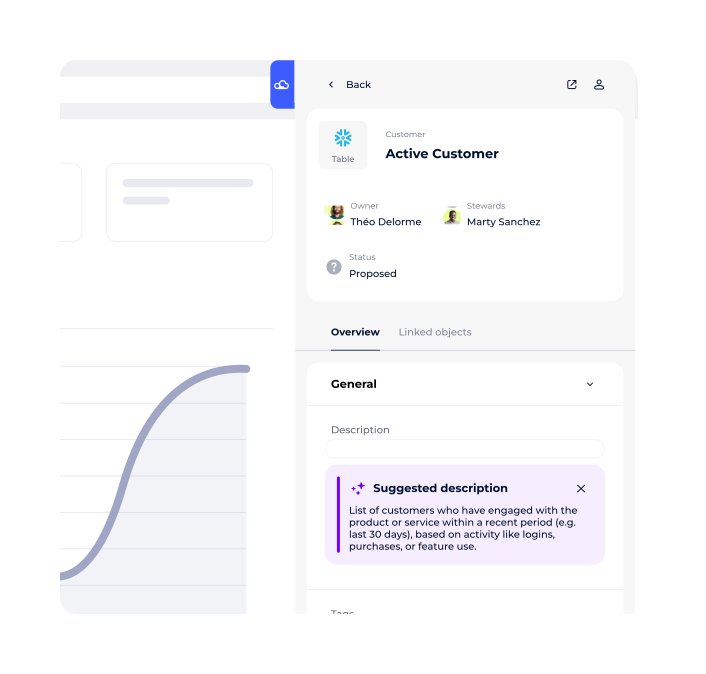
Smart browser extensions
Our browser extension doesn’t just supply knowledge – It also gives users an easy way to capture knowledge and share it with their team members.
Maintain high data quality
Data stewards ensure their organization’s data accuracy, consistency, and reliability.
This includes proactive measures like setting up validation rules and reactive measures such as rectifying identified issues.
Data stewards should regularly monitor and review data quality metrics to ensure they meet organizational standards
Ensure privacy & security
As protectors of data, stewards must maintain an awareness of the latest data protection laws and ensure their organization’s compliance.
This responsibility includes implementing and monitoring privacy and security measures, such as data anonymization, access controls, and data breach response plans.
Promote compliance with data governance policies
Data stewards must continually implement adherence to governance policies, monitor their application, and rectify deviations.
They should also take the lead in educating fellow staff members regarding these policies and their importance.
While these well-established practices remain critical, newer approaches, such as developing and applying a data catalog, are gaining significance.
A comprehensive data catalog aids data stewards in managing and organizing data assets. It also promotes transparency by providing a clear understanding of the data’s origins, transformations, and uses. In addition, a data catalog can serve as a vital tool for communication and collaboration among data stakeholders.
Another growing trend is the adoption of data governance frameworks such as data mesh. These distribute ownership and stewardship responsibilities across domain-oriented teams.
Data stewards play a crucial role in these frameworks, ensuring their assigned domains adhere to overarching data governance policies and standards.
Lastly, data stewards should strive for continuous learning and skill development. The world of data management is dynamic, with new technologies and methodologies continually emerging. Data stewards must continuously update and develop their skills to remain practical and relevant.
Case study: The role of data stewards in Blueprint 2.0
Effective data governance and decision-making are crucial for promoting success and organizational improvement. The following case study underscores the value of data stewardship and highlights the role in Baltimore, Maryland’s blueprint for revitalizing education.
As the state seeks to “Transform Maryland’s early childhood, primary, and secondary education systems to the levels of high-performing systems around the world,” the inclusion of Data Stewards in the program highlights their importance in driving data-driven decision-making.
Leveraging technology
BCPS, the 25th largest school district in the United States, implemented a data governance program as part of its Blueprint 2.0 strategic plan. The program aimed to leverage technology and data to improve teaching and learning, promote equity, and enhance organizational effectiveness.
To achieve these goals, BCPS developed BCPS One, a centralized system that included data dashboards for schools and administrators to access relevant and actionable data.
The role of data stewards
Data stewards play a crucial role in BCPS’s data governance program. They oversee data quality, usage, and reliability within their subject areas.
Each steward is assigned to a specific responsibility area, such as student information systems, assessment, special education, or finance. They ensure that the data within their domain are accurately collected, stored, and reported.
The duties of data stewards include:
- Defining data collection, reporting, and quality assurance processes within their subject areas
- Establishing access rights and security levels for data elements to ensure data privacy and confidentiality
- Collaborating with stakeholders to determine data quality metrics and performance standards
- Providing training and support to data owners and users to ensure compliance with governance policies and procedures
- Overseeing the appropriate use of data and leveraging them to drive informed decision-making
- Collaborating with other departments and offices to ensure data standardization and consistency across the organization
- Identifying and addressing risks and vulnerabilities related to data security and compliance
Designing data & AI products that deliver business value
To truly derive value from AI, it’s not enough to just have the technology.
Data professionals today also need a clear strategy, reasonable rules for managing data, and a focus on building useful data products.

The impact of data stewards
Data stewards in BCPS’s data governance program directly impact many vital components of their data governance initiative, including:
- Data integrity & quality: Data stewards ensured that data collected and reported within their subject areas were accurate, reliable, and aligned with established quality standards. They conducted data profiling and validation checks to maintain data integrity.
- Accessible & actionable data: Data stewards played a vital role in organizing and presenting data through dashboards. They collaborated with the Office of Equity and Cultural Proficiency to disaggregate data and highlight disparities, enabling educators to take targeted actions to address achievement gaps and promote equity.
- Decision-making: By providing a consistent and reliable data source, data stewards empowered principals, assistant principals, and other stakeholders to make informed decisions. They facilitated data analysis workshops, promoted data literacy, and supported school progress planning through conversations and interventions.
- Streamlined data requests: The presence of data stewards reduced the volume of ad hoc requests from schools and central office staff. With a centralized governance system, stakeholders could access refreshed data, decreasing the need for redundant data collection and reporting.
The experience of BCPS demonstrates that stewards play a pivotal role in ensuring data integrity, accessibility, and usability. Their responsibilities encompass data quality assurance, standardization, security, and stakeholder collaboration.
By leveraging their expertise, data stewards facilitate data-driven conversations, support equity initiatives, and empower educators to make informed decisions to improve student outcomes and promote organizational effectiveness.
The role of the data steward, while often underappreciated, is pivotal to effective governance. Their responsibilities encompass defining data elements, creating robust processes, ensuring adherence to standards, and acting as an interface between users and data management teams.
The future of stewardship holds exciting possibilities and challenges as the landscape evolves. Trends such as automation, privacy regulations, governance frameworks, integration practices, and collaboration will shape the role of data stewards.
To ensure effective governance, it will be critical to stay ahead of the curve with the right tools and commit to continuous learning to navigate these changes.
Conclusion
The role of data stewards will continue to evolve, gaining increased significance in data privacy, automation, and cross-functional collaboration. As AI becomes central to organizational strategy, stewards are increasingly called upon to support a broader AI governance framework, ensuring that the data feeding AI models is trustworthy, well-documented, and ethically managed. By understanding and embracing these changes, organizations can ensure that their governance strategies remain robust, adaptable, and primed to deliver maximum value in the years ahead.
FAQ
-
How does a data catalog help with AI risk management?
-
A modern data catalog helps identify and track sensitive data, document lineage, and ensure data quality — all of which reduce AI-related risks. It also improves traceability across AI pipelines and enables proactive monitoring.
-
How does DataGalaxy help with regulatory compliance?
-
The platform includes role-based access (RBAC), SSO, audit trails, and admin control over every object and user permission.
-
How is a data catalog different from a data glossary?
-
A business glossary defines terms and ensures shared understanding. A data catalog documents the technical assets (tables, fields, reports) and connects them to the glossary. Both are essential — and should be linked.
? Want to go deeper? Check out:
https://www.datagalaxy.com/en/blog/data-catalog-vs-glossary-dictionary -
If data is everyone’s job, why does it still feel like no one knows where to start?
-
Most teams still rely on a few experts to translate the data jungle. As a result, adoption lags, reporting is inconsistent, and decisions get bottlenecked.
DataGalaxy boosts data literacy by making business terms, definitions, and trusted data assets easy to explore for every user — not just the experts.
👉 – Empower teams with a shared vocabulary through a centralized business glossary
👉 – Make trusted data assets easily discoverable via natural language search
👉 – Provide guided lineage and visual context to foster real understanding
👉 Facing this challenge? Explore the solution
👉 Want to see it live? Book a tailored demo -
Struggling to deliver transparent ESG reporting?
-
You can’t report what you can’t trace.
Whether it’s carbon data, supply chain transparency, or DEI metrics — ESG initiatives require governance-grade metadata and traceability.
DataGalaxy helps organizations map where ESG-related data lives, how it moves, and who owns it, enabling transparent, reliable, and auditable reporting.
👉 – Trace ESG-related KPIs back to source systems and owners
👉 – Ensure consistency across teams with shared definitions and policies
👉 – Easily surface data used in ESG dashboards, external audits, and regulatory reports
👉 Facing this challenge? Explore the solution
👉 Want to see it live? Book a tailored demo