Data quality and data governance go hand-in-hand, and it’s virtually impossible to have one without the other.
So, how does data governance impact data quality, and vice versa? Let’s take a look.
TL;DR
Data governance and data quality are two sides of the same coin.
Governance defines who is responsible for data, how it is managed, and under which rules, while data quality measures how trustworthy and usable that data actually is.
Without governance, data quality initiatives fail to scale; without quality, governance loses credibility.
Modern organizations must combine both, supported by the right tools, roles, and AI-enabled automation, to build trusted data products and power analytics and AI with confidence.
What is data governance?
Data governance is the organizational framework that defines how data is owned, managed, accessed, secured, and used across an enterprise.
It establishes decision rights, accountability, and policies to ensure data creates value while remaining compliant and secure.
A comprehensive data governance framework typically includes:
- Clear roles and responsibilities (Data Owners, Data Stewards, Data Consumers)
- Policies and standards for data usage, privacy, and security
- Processes for data lifecycle management
- Decision-making bodies such as data councils or governance committees
From a business perspective, data governance ensures that data is treated as a strategic asset, not just a technical byproduct of IT systems.
What is data quality?
Data quality refers to the condition of data based on its ability to meet the expectations of its users and intended use cases.
High-quality data accurately represents reality, is up to date, and can be trusted for operational, analytical, and AI-driven decisions.
Data quality management focuses on defining, measuring, and improving data through rules, controls, and continuous monitoring.
It ensures that business teams can rely on data without second-guessing its accuracy or relevance.
Why data governance & data quality are inseparable
It is virtually impossible to maintain data quality at scale without governance.
At the same time, governance frameworks without quality controls quickly become theoretical and disconnected from business reality.
- Data governance sets the rules
- Data quality measures the results
Together, they form the foundation of trusted data, analytics, and AI.
Common data quality challenges in modern organizations
Despite growing investments in data platforms, organizations continue to struggle with data quality issues.
Common root causes include:
1. Exponential Data Growth
Cloud platforms, SaaS tools, IoT devices, and AI models generate massive volumes of data, cloud data warehouses like the Snowflake data platform alone can process billions of records that must remain consistently governed and quality-controlled.
As data ecosystems expand, manual monitoring becomes unsustainable without governance and automation, making data observability a critical complement to ensure data pipelines remain reliable and compliant in real time.
2. Data Silos and Inconsistent Updates
When the same data exists across multiple systems, updates are often applied unevenly.
This leads to conflicting reports, duplicated records, and eroding trust.
3. Lack of Clear Ownership
Without designated Data Owners and Data Stewards, no one feels accountable for fixing issues.
Over time, errors accumulate and become normalized.
4. Regulatory and Compliance Pressure
Regulations such as GDPR, CCPA, and emerging AI governance frameworks significantly raise the cost of poor-quality data.
Inaccurate or undocumented data increases legal, financial, and reputational risk.
The role of data governance in improving data quality
Data governance provides the operating model that enables sustainable data quality improvement.
It ensures that quality is not a one-time cleanup project but an ongoing business capability.
Governance Enables Measurement
Governance frameworks define data quality KPIs, thresholds, and escalation paths. This allows organizations to:
- Identify issues early
- Prioritize remediation
- Track improvements over time
Core data quality dimensions (Indicators)
Modern data governance programs rely on standardized quality dimensions to assess data fitness. The most widely used dimensions include:
Completeness
All required data fields are populated and available.
Accuracy
Data correctly reflects real-world entities, events, or values.
Consistency
Data does not conflict across systems, datasets, or formats.
Validity
Data conforms to predefined formats, business rules, and standards.
Uniqueness (Unicity)
Each real-world entity is represented once, without duplicates.
Integrity
Relationships between datasets are preserved and reliable.
These dimensions create a shared language between business and technical teams when discussing data quality, a foundation that becomes even more powerful when formalized in a data dictionary that documents definitions, formats, and ownership for every critical data asset.
Making data governance work in practice
Involve Business Teams in Defining Data Quality Rules
Data quality rules must reflect how data is actually used in the business. Examples include:
- Email address formats
- Mandatory fields for customer onboarding
- Acceptable value ranges for financial data
When business teams define these rules themselves, adoption and compliance increase dramatically. Governance teams act as facilitators—not gatekeepers.
Don’t Ignore the Human Factor
Not all quality issues are detectable through automated rules. Experienced users often intuitively know when data “doesn’t feel right.”
Leading organizations complement technical metrics with:
- Confidence scores
- User feedback
- Usage indicators
This human-centered approach explains why certain datasets are avoided—even when they appear technically valid.
Leverage Technology, AI, and Automation
Modern data governance platforms use AI and machine learning to scale quality management by:
- Detecting anomalies and inconsistencies
- Recommending corrective actions
- Prioritizing issues based on business impact
- Adapting rules based on real usage patterns
Human expertise remains critical, but AI dramatically reduces manual effort and improves responsiveness.
Governance, Data Quality, and Regulatory Compliance
Regulatory compliance is one of the strongest drivers of data governance maturity, and organizations looking to benchmark their progress will find that a structured data maturity model helps pinpoint exactly where governance and quality capabilities need to be strengthened.
Frameworks like GDPR, CCPA, and upcoming AI regulations require organizations to demonstrate:
- Data lineage and transparency
- Clear ownership and accountability
- Accurate, documented data usage
Strong governance combined with measurable data quality reduces audit risk and builds trust with regulators and customers alike.
Overcoming common data governance challenges
Resistance to Change
Employees may perceive governance as bureaucracy. Clear communication and business alignment are essential.
Lack of Executive Sponsorship
Successful programs require visible support from leadership, often led by a Chief Data Officer (CDO).
Complex Data Architectures
Hybrid, cloud, and legacy systems require centralized visibility—not centralized control.
Organizations that succeed focus on culture, enablement, and tooling, rather than control alone.
DataGalaxy as a best solution for data governance & data quality
DataGalaxy is a leading Data & AI Product Governance Platform designed to bridge the gap between business, data, and technology.
With DataGalaxy, organizations can:
- Define clear data ownership and stewardship
- Document data products, rules, and quality dimensions
- Engage business users through intuitive interfaces
- Leverage AI to scale governance and quality initiatives
- Align governance with real business usage
Unlike traditional metadata tools, DataGalaxy focuses on adoption, collaboration, and value creation, making governance and data quality actionable—not theoretical.
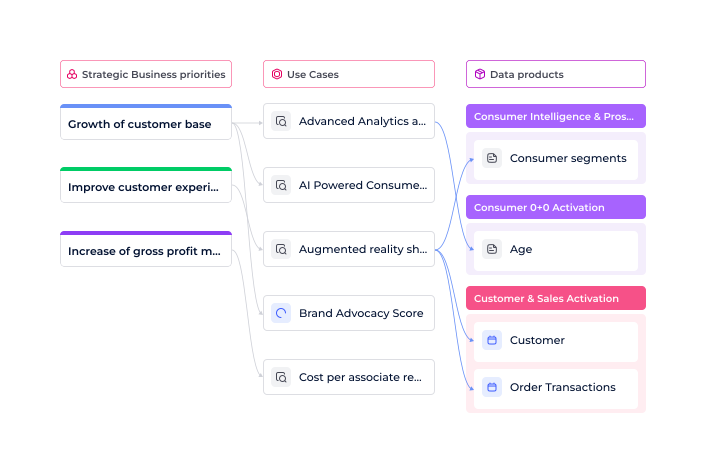
Drive alignment and value through a governed portfolio
DataGalaxy Portfolio connects strategy, planning, and execution in one place so teams can clearly see priorities, progress, and expected outcomes.
It helps organizations manage resources more effectively, avoid duplication, and ensure that every use case supports business objectives. See the DataGalaxy Portfolio
The future of data governance & data quality
As organizations shift toward data products, AI-driven decision-making, and self-service analytics, governance and quality become even more critical.
Key trends include:
- Governance by design for AI and analytics
- Automation powered by machine learning
- Product-oriented data ownership
- Increased focus on data trust and literacy
Companies that invest now will be better positioned to innovate responsibly.
Clearly, data governance is a critical piece of any data quality initiative, and the two concepts work together to drive success.
To achieve your company’s data quality goals on an ongoing basis, you’ll need to ensure that these policies are regularly reviewed, updated, and enforced to ensure they’re as effective as possible.
In doing so, you’ll be well on your way to ensuring strong data quality across the entire organization—and having the business insights that matter when making key decisions.
Without an adequatedata governance policy, data quality is difficult to achieve and even more difficult to maintain.
Therefore, all the company’s businesses and strategic decision-makers must work together to establish and follow data quality rules.
Key takeaways
- Data governance and data quality are inseparable
- Governance creates accountability; quality builds trust
- Business involvement is essential for sustainable success
- AI accelerates, but does not replace, human expertise
- DataGalaxy enables scalable, business-driven governance and quality
FAQ
-
How do you improve data quality?
-
Improving data quality starts with clear standards for accuracy, completeness, consistency, and timeliness. It involves profiling, fixing anomalies, and setting up controls to prevent future issues. Ongoing collaboration across teams ensures reliable data at scale.
-
What is data quality management?
-
Data quality management ensures data is accurate, complete, consistent, and reliable across its lifecycle. It includes profiling, cleansing, validation, and monitoring to prevent errors and maintain trust. This enables smarter decisions and reduces risk.
-
How does the integration support data quality management?
-
The integration leverages Snowflake’s Data Metric Functions and DataGalaxy’s semantic layer to monitor, surface, and manage data quality issues. This enables teams to quickly detect anomalies, ensure data reliability, and deliver AI-ready datasets with full business context.
-
Why is data governance important?
-
Data governance brings clarity and consistency, ensuring everyone uses and understands data the same way. It’s not just about control—it fosters collaboration, trust, and smarter decisions, turning data into a strategic asset that fuels innovation and growth.
-
What’s the difference between data governance and data management?
-
Data management is the operational handling of data (storage, processing, integration), while governance defines *how* and *why* it should be managed — including standards, responsibilities, and policies. Governance is the strategy layer.
? Want to go deeper? Check out:
https://www.datagalaxy.com/en/blog/data-governance-and-data-mesh/