Are you looking for a faster way to understand, trust, and use your data?
Every organization aspires to make data truly self-service. However, without the right context, clarity, or confidence, users often fall back on old habits. These can include asking a colleague for help, copying an outdated report, or rebuilding a project from scratch.
Blink changes that.
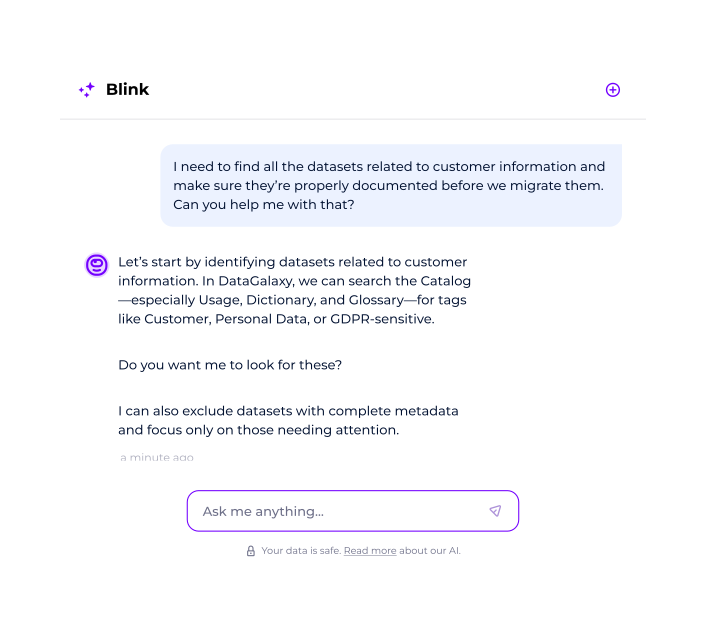
By acting as your AI copilot inside DataGalaxy, Blink turns the knowledge already captured in your platform into something actionable.
Blink allows every user to find, understand, and use the data they need through natural language without technical filters or specialized syntax.
It answers real questions across the entire platform, from business terms and KPIs to dashboards, fields, domains, and more.
Instead of functioning as a simple search bar, it provides intelligent access designed to drive adoption, scale data literacy, and unlock the value of the documentation and governance you have already invested in.
Keep reading to learn more about this revolutionary AI assistant.
Ask real questions, get actionable answers
Blink is built to understand plain language.
Users don’t need to learn a query language or adjust filters. Instead, they can simply ask what they want to know.
Examples include:
Where is the “revenue by region” dataset?
Is this model certified?
Who owns the “active customer” KPI?
Can you help with my SQL query?
What does “customer churn” actually mean?
How do I start documenting a new domain?
Blink responds with clear answers backed by the context available directly in your platform.
It draws from your governance model, metadata, and documentation to provide authoritative and trusted responses that adapt to the user’s role and permissions.
From metadata to answers
Blink connects users with information across the entire platform.
This includes tables and columns, KPIs and indicators, dashboards and models, business terms and glossary entries, domains and data products, use cases and objectives, as well as ownership, stewardship, certification status, governance rules, and access policies.
Every answer is filtered according to what the user is allowed to see, which means the experience reinforces trusted sources, certified assets, and the governance controls already in place.
Operationalizing
CDEs
Do you know how to make critical data elements (CDEs) work for your teams?
Get your go-to guide to identifying and governing critical data elements to accelerate data value.
Instead of metadata sitting passively in a catalog, it becomes an interactive, living resource that actively supports decision-making.
Increase adoption & data literacy
When users are able to ask direct questions and receive clear, trusted answers, they are far more likely to rely on the platform and the data within it.
It also accelerates onboarding, helping new users become productive quickly while empowering business teams to explore data on their own.
Documentation, instead of being static and underused, becomes interactive and useful. This shift encourages adoption, builds confidence, and increases the return on governance investments by making the platform an everyday part of how teams work with data.
Built for global teams & secure environments
Blink supports multilingual queries that ensure that global teams across regions and languages can interact with data in a way that feels natural.
It runs entirely inside your environment with no external APIs, no model exposure, and no metadata leaving your platform, so security and control remain intact.
Out of the box, it respects visibility and role-based access, keeping governance at the center while providing immediate value.
From platform to answers instantly
Blink is not only about saving time; it is about creating trust, enabling true self-service, and helping every team make smarter decisions with the data already available.
When knowledge becomes accessible in this way, the entire platform becomes more usable, more transparent, and more effective in supporting the business.
Now available in DataGalaxy
Blink is live and ready to use!
Explore your catalog, ask real questions, and see how your teams can move faster and with greater confidence.
Blink, your AI Copilot
Ask questions. Get answers. Drive action.
Blink helps every user explore, understand, and use data in their daily work. No tickets, no filters, no delays. Ask anything in your native language and get trusted, contextual answers and recommendations.
Can DataGalaxy adapt to my organization’s data landscape?–
Yes. DataGalaxy is built to support hybrid, multi-cloud, and evolving ecosystems. Whether you’re wrangling spreadsheets, Snowflake, or SaaS tools, the platform connects and documents everything — while staying flexible enough to reflect your teams’ real-life workflows, business terms, and governance needs.
Can I compare DataGalaxy to other data catalog tools?–
Yes. We provide detailed comparisons vs. Alation, Collibra, Atlan, and others — or you can request a personalized assessment.
Can I migrate from Atlan to DataGalaxy?–
Yes. Our team can support you in migrating metadata, glossary terms, and lineage. We’ve helped clients transition from legacy tools with minimal disruption.
Does this help with regulatory frameworks like the EU AI Act?–
Yes. DataGalaxy gives you visibility into data lineage, ownership, and usage policies — key pillars of AI compliance and model transparency.
How do I migrate from another data catalog like Atlan or Collibra?–
Switching platforms can feel complex, but it doesn’t have to be. DataGalaxy offers dedicated support, metadata import features, and automated connectors to help teams smoothly transition from tools like Atlan, Alation, Collibra, or Informatica.
With a passion for turning data complexity into clarity, Jessica Sandifer is an experienced content manager who crafts stories that resonate across technical and business audiences. At DataGalaxy, she creates content and product marketing messages that demystify data governance and make AI-readiness actionable.
If 2023 and 2024 were the years of AI experimentation, 2025 is the year of formal governance. New regulatory milestones, fresh guidance from standards bodies, and maturing internal controls have made AI governance best practices a board-level priority. In the EU, the Artificial Intelligence Act began phasing in requirements earlier this year and added additional […]
Artificial intelligence is no longer an experimental technology. It is a core driver of competitive advantage. Yet, without rigorous oversight, AI can introduce ethical risks, regulatory exposure, and operational failures that jeopardize an organization’s reputation and bottom line. Therefore, establishing a structured pathway to AI governance is now a strategic imperative. This article explores the […]
Artificial intelligence is rewriting the rules of modern business. However, without the right guardrails, it can create more problems than it solves. AI governance software gives data teams and business leaders the tools to monitor, manage, and keep their AI systems trustworthy and compliant. In 2025, there are more options than ever, making it tough […]
If you’re working with machine learning, one thing becomes clear fast: Your model is only as good as the data you feed it. While algorithms often steal the spotlight, it’s the behind-the-scenes work, like getting your data clean, consistent, and ready, that truly drives success. Most data scientists will tell you that data preparation takes […]
With great power comes even greater risk. AI is being adopted at a blistering scale and pace. However, the unintended downside is that it’s moving faster than policy, tooling, or training can keep up. It’s time for a dedicated AI governance framework. One that’s squarely rooted in your business realities, expands with your ambitions, and […]
What’s the difference between AI outcomes you can explain and those you can’t? Risk. From skewed insights to biased outputs, AI is a business liability when left unchecked. So, what does it take to keep AI on track? Rigorous monitoring and hands-on control. Let’s talk AI risk management: How to scrutinize AI in production, where […]