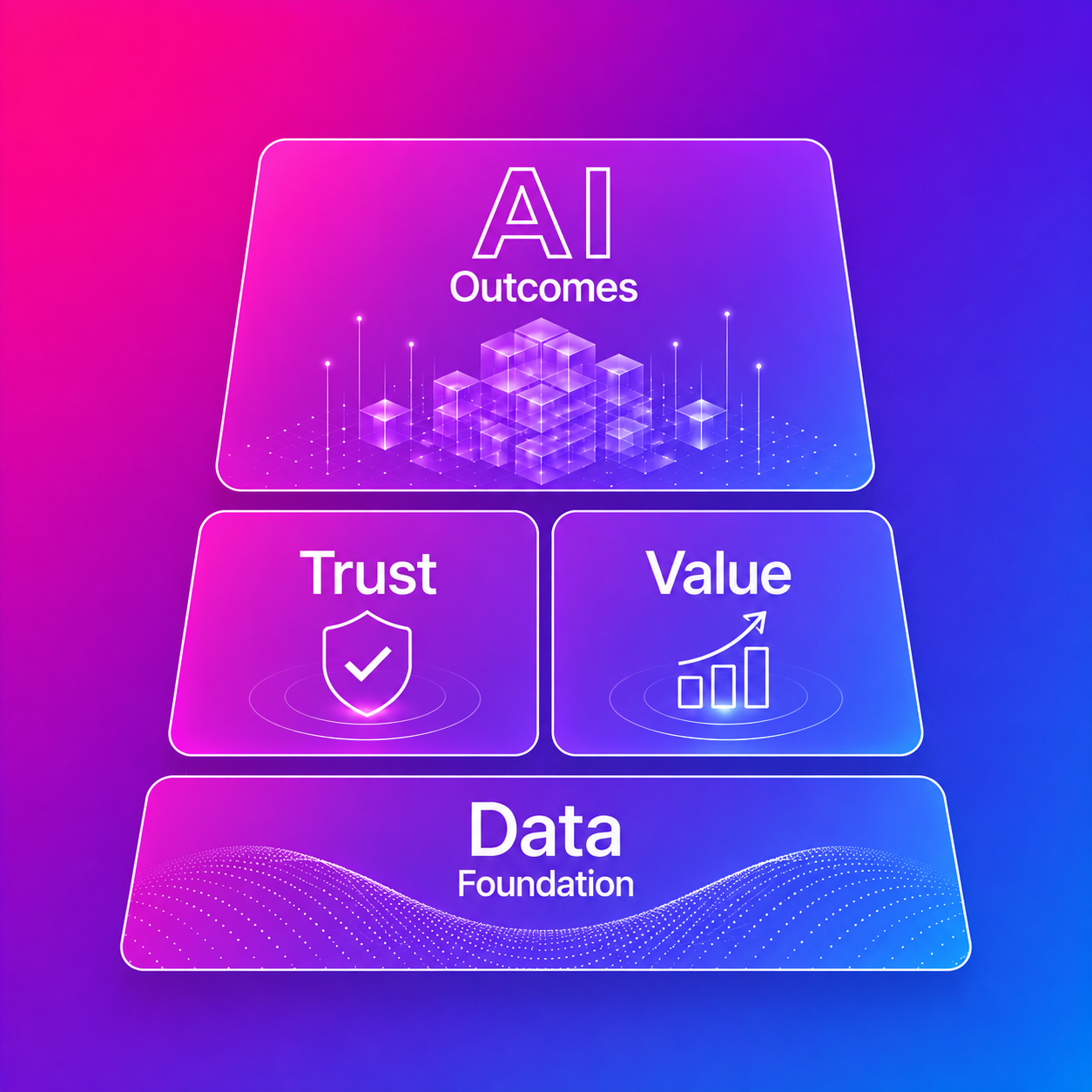
Artificial intelligence is no longer an experimental technology. It is a core driver of competitive advantage.
Yet, without rigorous oversight, AI can introduce ethical risks, regulatory exposure, and operational failures that jeopardize an organization’s reputation and bottom line. Therefore, establishing a structured pathway to AI governance is now a strategic imperative.
This article explores the essence of AI governance and provides a clear five‑step pathway to an AI governance strategy. Keep reading for all the insights.
What is AI governance?
AI governance establishes the AI governance framework, the set of policies, practices, and regulations that guide the responsible development, deployment, and operation of AI systems.
This framework ensures organizations remain aligned with ethical standards, focusing on transparency, fairness, accountability, privacy, and security.
AI governance encompasses every stage of the AI lifecycle, from design and training to validation, deployment, monitoring, and decommissioning. It involves both technical measures, like model documentation, explainability, and performance monitoring, and organizational steps, such as role assignment, audit procedures, and stakeholder alignment.
Why now?
Laws like the EU AI Act are coming into force, while Gartner and similar analysts are calling AI governance “make‑or‑break” for market credibility. The cost of neglect is high and can include brand reputation damage, systemic bias, and compliance fines that loom without proper governance.
AI governance vs. data governance
While AI governance builds on the foundations of data governance, there are a few key distinctions:
- Scope
Data governance focuses on data management, including aspects like data quality, classification, lineage, and ownership. AI governance expands to algorithmic behavior, model validation, decision explainability, and post‑deployment monitoring.
- Complex lifecycle
AI models are dynamic and prone to drift and unexpected bias, necessitating continuous monitoring. Data governance typically involves more static controls.
- Technical requirements
AI requires model interpretability, algorithmic risk assessments, and infrastructure for retraining.
Designing data & AI products that deliver business value
To truly derive value from AI, it’s not enough to just have the technology.
Data professionals today also need a clear strategy, reasonable rules for managing data, and a focus on building useful data products.

- Regulatory depth
AI governance must meet the evolving standards and rules outlined in the EU AI Act, which extend beyond privacy to encompass fairness, transparency, and accountability obligations.
In short, data governance ensures trustworthy data; AI governance ensures trustworthy, ethical AI systems that leverage that data safely.
5 main principles of AI governance
Experts consistently emphasize these five core pillars of AI governance, despite it being an ever-growing field:

Transparency
Ensure that AI decisions are explainable and systems are transparent and traceable. This includes documentation on how and why models operate.

Fairness
Data experts should proactively mitigate data and model biases to ensure equitable outcomes for all affected groups.

Accountability
Assign clear ownership and lifecycle responsibilities for AI systems.
Privacy & security
It’s essential that AI governance help protect personal data, prevent breaches, and comply with regulations.
Robust risk management
Regularly identify, assess, and monitor AI-related risks, including those from changing datasets.
A pathway to AI governance: 5 practical steps
Here is a structured five-step process to help organizations embark on a pathway to AI governance.
Step 1: Define your objectives & governance scope
Map out your AI use cases
These can be customer service chatbots, loan decision engines, or predictive maintenance.
Align your governance strategy with your business goals
For example, your team can aim to ensure algorithmic fairness in customer credit scoring.
Conduct a readiness assessment
This can include reviewing your existing data policies, AI maturity, and stakeholder preparedness. Identify gaps across people, processes, and technology.
Step 2: Establish policies & roles
- Create clear AI policies around ethical use, fairness, privacy, and transparency that reference recognized principles
- Assign roles, including:
- AI governance council (C-suite, legal, ethics, data science) to make strategic decisions
- AI product owner/steward to oversee development and performance
- Ethics/compliance officer to ensure compliance with regulations
- Operational committees to create processes for ongoing review
Step 3: Catalog AI assets to ensure data readiness
Step 4: Embed AI risk controls in the lifecycle
Pre-deployment
Enforce model guardrails, including bias tests, explainability checks, and privacy compliance.
Deployment
Document model performance while maintaining version history.
Post-deployment
Set up continuous monitoring, including data drift alerts, outcome audits, and stakeholder feedback.
Identify risks
This can include operational, legal, and ethical risks, and maintain a mitigation log with assigned ownership.
Step 5: Educate, report & iterate
Conduct training
across roles like data teams, business users, and executives on AI transparency, ethics, detection of drift, and reporting protocols.
Define measurable KPIs
These can include the number of bias incidents, model audits, time to detect drift, and stakeholder perception scores.
Review & improve quarterly
As lessons are learned, update policies, retrain models, and revise governance processes.
How does this path provide real value?
- Implements global ethics in practice
Moves beyond statements to enforceable checks and balances.
- Reduces risk of reputational damage
Research shows organisations with governance frameworks retain trust, while others trigger crises.
- Ensures regulatory readiness
Complies with frameworks from GDPR to the coming EU AI Act.

The 3 KPIs for driving real data governance value
KPIs only matter if you track them. Move from governance in theory to governance that delivers.
- Drives scalable trust
Supports hundreds of models across decentralized teams without sacrificing accountability
DataGalaxy: A best‑in‑class partner on your journey
1. Unified data & AI asset repository
DataGalaxy’s platform catalogs AI products alongside data assets to capture metadata, lineage, business context, ownership, and lifecycle status in one hub.
2. Policy definition & monitoring
With built-in support for defining policies and monitoring compliance (such as bias thresholds or drift alerts), DataGalaxy directly operationalizes AI governance requirements.
3. Value‑driven governance
DataGalaxy connects AI strategy to business impact—enabling teams to track real KPIs and demonstrate ROI.
4. Collaboration & role clarity
DataGalaxy allows stewards to assign AI product owners, stewards, and stakeholders, operate within federated domains, and facilitate cross‑team workflows.
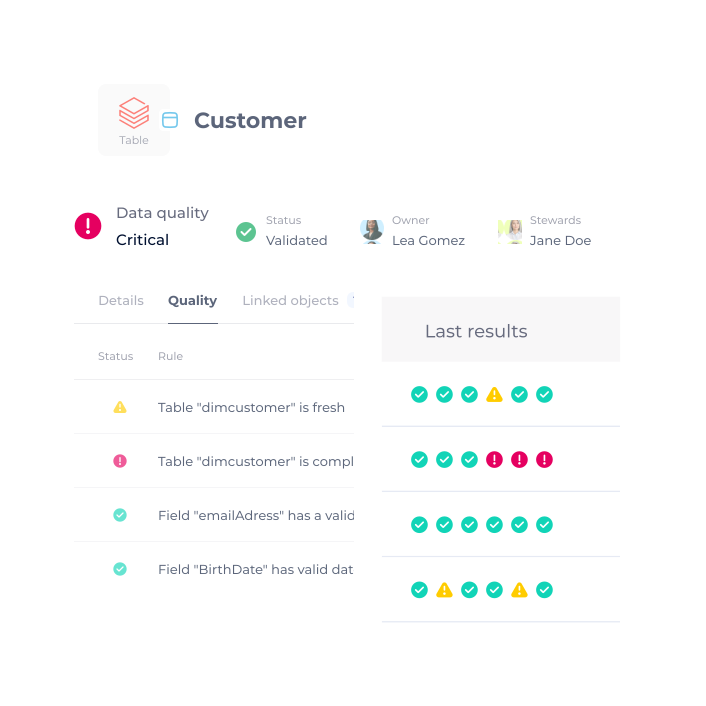
Spot issues before they spread
Track, assess, and act on data quality directly inside DataGalaxy’s quality monitoring. Define what “good” looks like, assign responsibilities, and monitor issues in context, where governance already happens.
5. Security‑first mindset with explainable models
DataGalaxy has secure, internally hosted AI capabilities to ensure governance for both the data and AI layers.
The AI governance road ahead
The moment for action is now.
Trustworthy AI isn’t just ethical – it’s a competitive differentiator. Institutions that prioritize a robust pathway to AI governance will mitigate reputational and compliance risks while unlocking sustainable, scalable value.
When you and your teams are ready to implement AI governance in your organization, DataGalaxy offers a fully integrated platform that aligns data governance and AI governance, emphasizing transparency, accountability, collaboration, and value monitoring.
With a track record that includes over 200 global organizations, rapid growth, and recognition by Gartner and Forrester, DataGalaxy is the ideal partner to operationalize your AI governance strategy.
Start your pathway to AI governance today to begin governing AI not as a compliance burden, but as a value driver.
FAQ
-
How can organizations implement AI governance?
-
Organizations implement AI governance by developing comprehensive frameworks that encompass policies, ethical guidelines, and compliance strategies. This includes establishing AI ethics committees, conducting regular audits, ensuring data quality, and aligning AI initiatives with legal and societal standards. Such measures help manage risks and ensure that AI systems operate in a manner consistent with organizational values and public expectations.
-
Can you govern AI without governing your data?
-
No — AI is only as good as the data it learns from. Poor data governance leads to biased models, opaque decisions, and compliance risks. Responsible AI starts with trustworthy, well-governed data.
-
How is AI governance different from data governance?
-
While data governance focuses on managing data quality, access, and compliance, AI governance extends those principles to models and algorithms. It includes monitoring for bias, ensuring explainability, and managing the lifecycle of machine learning models.
-
Do I need a data catalog?
-
If your teams are struggling to find data, understand its meaning, or trust its source — then yes. A data catalog helps you centralize, document, and connect data assets across your ecosystem. It’s the foundation of any data-driven organization.
? Want to go deeper? Check out:
https://www.datagalaxy.com/en/blog/what-is-a-data-catalog/ -
How is a data catalog different from a data glossary?
-
A business glossary defines terms and ensures shared understanding. A data catalog documents the technical assets (tables, fields, reports) and connects them to the glossary. Both are essential — and should be linked.
? Want to go deeper? Check out:
https://www.datagalaxy.com/en/blog/data-catalog-vs-glossary-dictionary
At a glance
- AI governance protects and scales value: It embeds ethics, transparency, fairness, and accountability into every stage of the AI lifecycle.
- Different from data governance: AI governance extends beyond data quality to cover model behavior, bias monitoring, explainability, and ongoing risk control.
- A structured pathway works best: Defining scope, setting policies, cataloging assets, embedding risk controls, and continuous education enable safe, compliant, and high‑impact AI at scale.