The evolving ESG compliance landscape & the role of data strategy in compliance
Environmental, social, and governance (ESG) compliance has morphed from a voluntary, self-reporting checklist of corporate responsibility into an increasingly regulated business activity.
As a result, sustainable business models have become a strategic imperative driven by the expectations of investors, consumers, and society.
ESG regulations and standards now originate from multiple federal and global entities. The U.S., France, the EU, and other national entities have introduced an almost competitive array of rules and standards for companies to navigate.
Unsurprisingly, companies are turning to robust data governance and management to steer through the increasing complexities of ESG compliance.
Let’s examine how shifting regulatory standards could will influence the ESG compliance strategies of forward-thinking companies.
TL;DR summary
Environmental, Social, and Governance (ESG) compliance has evolved from a voluntary initiative into a highly regulated business requirement across Europe, the U.S., and global markets.
As frameworks like the EU’s CSRD and the SEC’s climate disclosure rules take effect, organizations must master ESG data quality, traceability, and reporting accuracy.
This article explores today’s ESG regulatory environment, the rising importance of data governance, and how platforms like DataGalaxy accelerate sustainable, compliant growth. The key to ESG success now lies in harmonizing cross-functional stakeholders, managing massive ESG datasets, and embedding sustainability into the corporate culture.
What is ESG reporting?
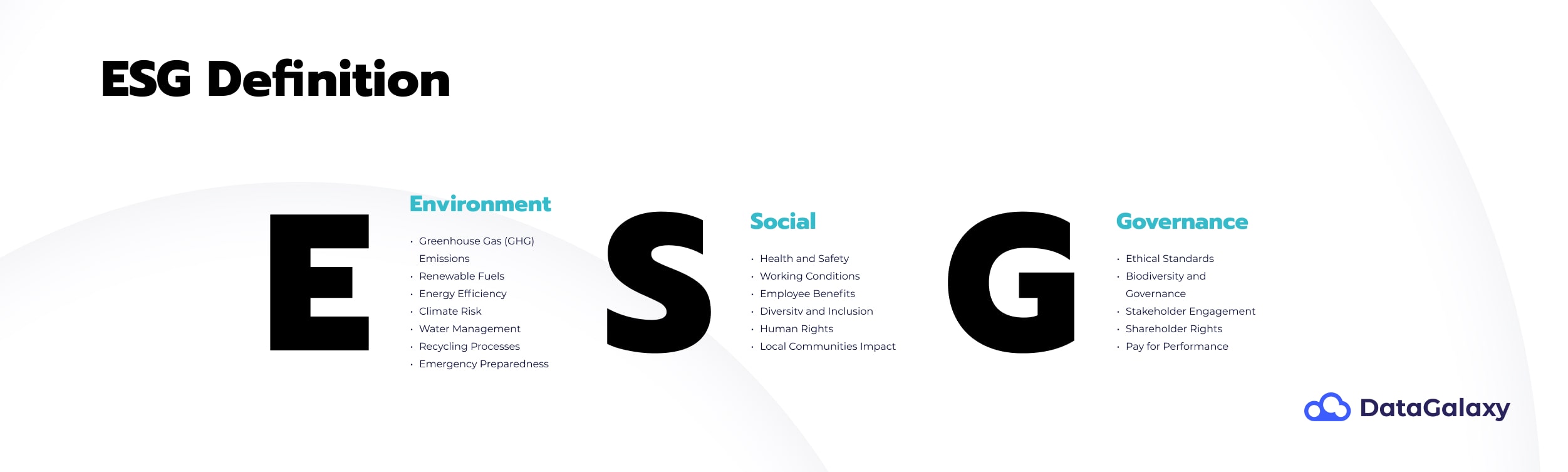
Environmental, Social, and Governance (ESG) compliance refers to an organization’s ability to measure, manage, and report on its performance across three critical areas: environmental stewardship, social responsibility, and corporate governance.
Once considered a voluntary set of best practices, ESG compliance has evolved into a formal regulatory requirement in many regions as governments, investors, and consumers demand greater transparency about how companies impact the world around them.
At its core, ESG compliance ensures that organizations operate ethically, sustainably, and in alignment with global expectations for climate responsibility, human rights, and organizational integrity.

Today, ESG compliance is shaped by a growing network of global regulations and frameworks, including the European Union’s Corporate Sustainability Reporting Directive (CSRD), the U.S. Securities and Exchange Commission’s (SEC) climate disclosure rules, the Global Reporting Initiative (GRI), and the International Sustainability Standards Board (ISSB) standards.
These frameworks require organizations to produce standardized, verifiable disclosures supported by high-quality data—meaning ESG compliance has become both a strategic priority and a data management challenge.
Companies must establish clear ownership of ESG data, implement governance policies, and maintain transparent, traceable reporting processes.
Why ESG compliance has transformed into a strategic imperative
ESG requirements have undergone a dramatic evolution. What started as a voluntary, values-based reporting initiative has become a mandatory, high-stakes business obligation. This change is driven by:
- Intensifying climate impacts and global warming evidence
- Investor and consumer demand for sustainable operations
- Regulatory pressure driven by governments and global entities
- The rise of sustainability as a competitive advantage
Today, organizations must deliver accurate, auditable, and timely ESG disclosures—a far more complex task than traditional corporate reporting.
As companies adapt, data strategy, governance, and AI-powered tools are becoming the engine of modern ESG compliance.
A complex & rapidly expanding ESG regulatory environment
Evolving US ESG regulations
In the United States, ESG policies form a patchwork across federal and state bodies:
- Federal initiatives:
- Nasdaq Board Diversity Rule
- SASB Standards (now maintained by ISSB)
- State-level divergence (as of 2023):
- 20 states with anti-ESG rules
- 8 states with pro-ESG laws
- 3 states mandating ESG disclosure
This fragmented landscape creates operational challenges, especially for companies operating nationally or globally.
EU’s Corporate Sustainability Reporting Directive (CSRD)
The CSRD, taking effect from 2024 onward, is now the most far-reaching ESG reporting framework globally. It requires disclosure across:
- Environmental criteria: climate change, pollution, circularity, biodiversity
- Social criteria: human rights, working conditions, diversity
- Governance criteria: controls, ethics, sustainability oversight
Applies to:
- All large EU companies
- Public-interest entities
- Non-EU companies with significant EU activity
The CSRD aligns with major global frameworks:
- European Climate Law
- Paris Agreement
- ESRS (European Sustainability Reporting Standards)
SEC Climate Disclosure Rules & scope 1–3 reporting
The U.S. SEC is moving toward mandatory climate disclosures that require:
- Scope 1: Direct emissions from owned assets
- Scope 2: Indirect emissions from purchased energy
- Scope 3: All other indirect emissions across the value chain
For many organizations, Scope 3 accounts for 70–90% of their footprint—making accurate, governed data essential.
CDO Masterclass: Upgrade your data leadership in just 3 days
Join DataGalaxy’s CDO Masterclass to gain actionable strategies, learn from global leaders like Airbus and LVMH, and earn an industry-recognized certification.
Save your seat!The rising importance of key ESG dimensions
Climate change & emissions management
ESG reporting requires organizations to map and govern emissions data across:
- Supply chains
- Logistics networks
- Vendor ecosystems
- Facilities and energy systems
This demands mature data governance, lineage, traceability, and automated reporting—areas where DataGalaxy’s platform provides critical capabilities.
Diversity, equity & inclusion (DEI)
DEI has expanded beyond workforce composition and now includes:
- Inclusive leadership practices
- Supplier diversity
- Pay equity disclosure
- Accessibility initiatives
Governance & data oversight as ESG foundations
With ESG data spanning hundreds of systems and stakeholders, companies now need:
- Clear data ownership & stewardship
- Standardized ESG data definitions
- Automated lineage and traceability
- Real-time data quality monitoring
- Compliance-ready workflows and documentation
This is where Data & AI Product Governance Platforms like DataGalaxy become indispensable.

Total visibility. Zero guesswork.
Column-level lineage is automatically mapped across tools, making root cause and impact analysis easy. Understand dependencies, spot anomalies faster, and keep changes under control, without the technical headache.
Discover DataGalaxy for ESGESG stakeholder dynamics & the expanding role of the Chief Sustainability Officer
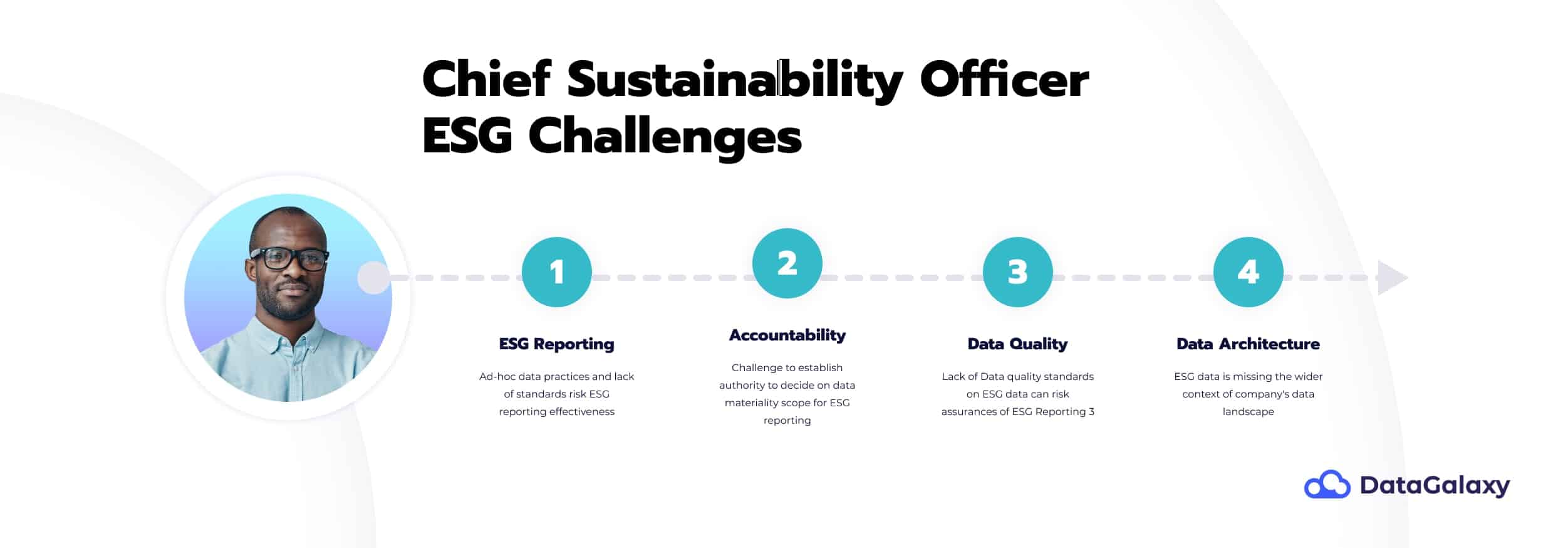
As ESG reporting becomes mandatory, organizations are formalizing sustainability functions and appointing Chief Sustainability Officers (CSOs).
Their responsibilities now include:
- Coordinating ESG strategy across operations, HR, finance, and procurement
- Establishing auditable reporting processes
- Supporting investor relations and regulatory communication
- Ensuring data integrity across Scope 1–3 emissions
The CSO–CDO partnership: A new power duo
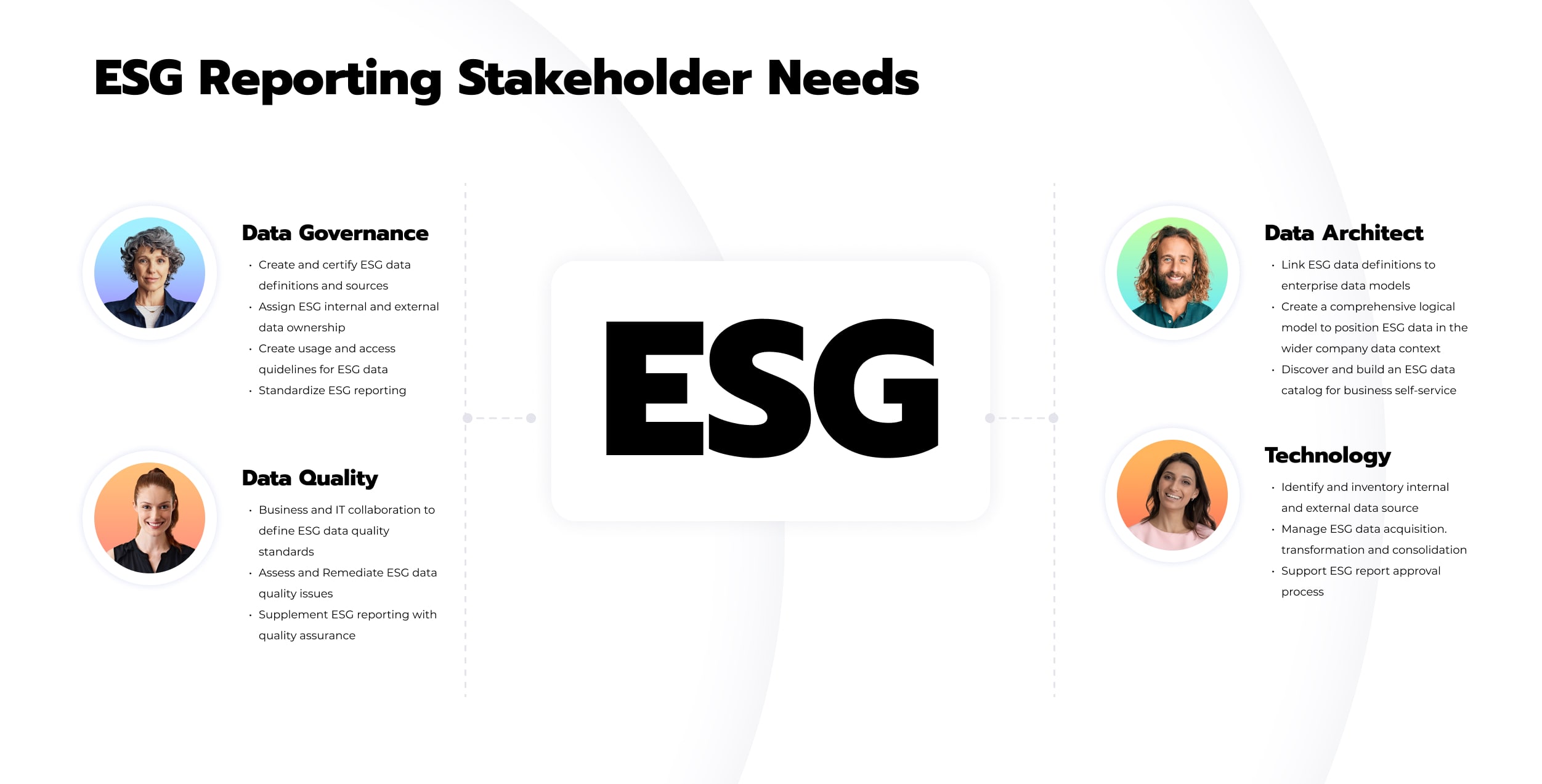
CSOs increasingly partner with Chief Data Officers (CDOs) to ensure high-quality ESG data.
Together they define:
- ESG critical data elements
- Ownership and stewardship roles
- Source-to-target data flows
- Quality rules and controls
- Metadata standardization
- AI-assisted reporting processes
This cross-functional synergy requires a centralized ESG data platform that provides shared context, governance, and visibility.

Why data platforms & data catalogs are now mission-critical
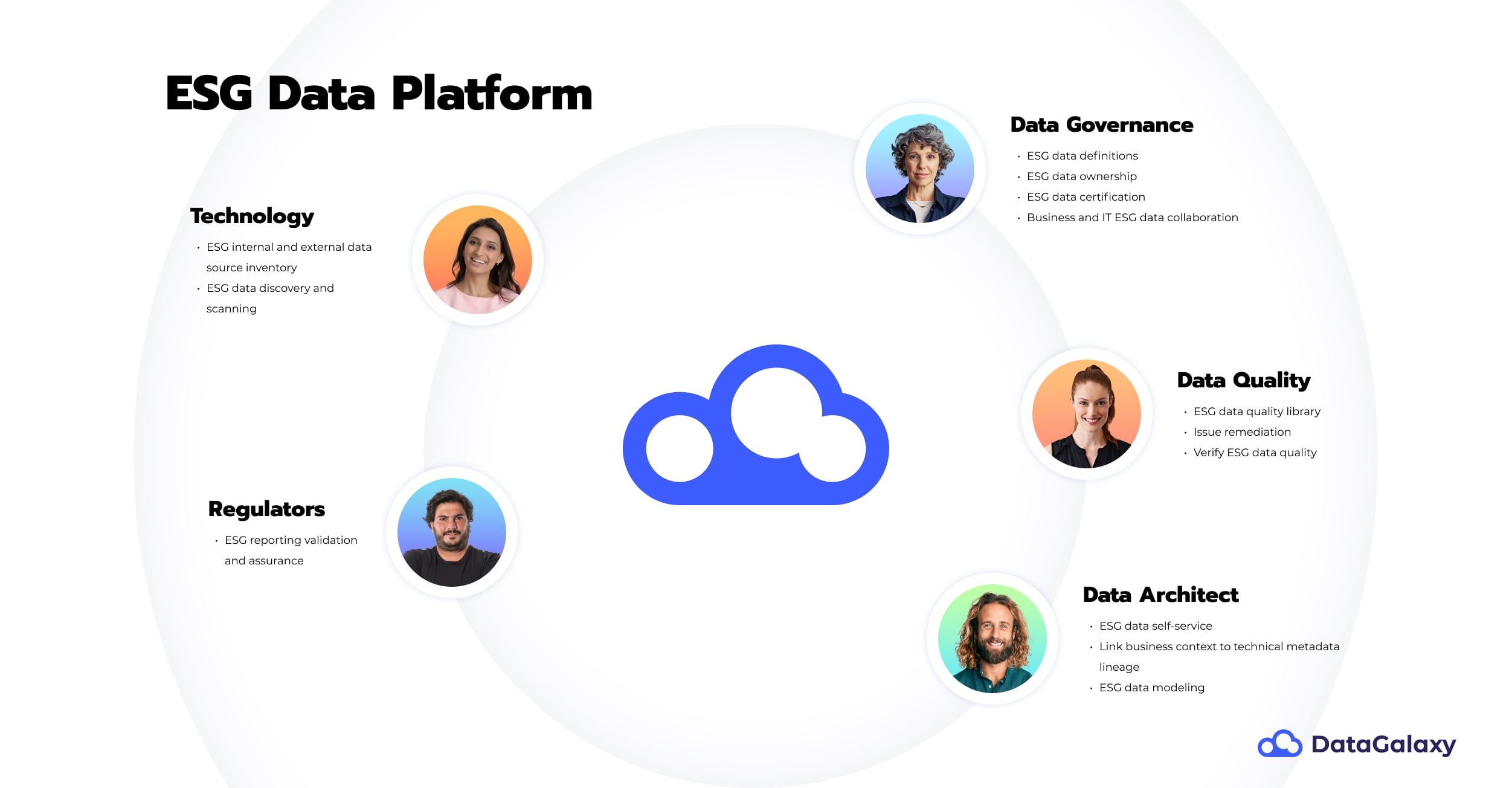
The volume and complexity of ESG data require advanced data governance technology. Solutions like DataGalaxy’s ESG Data Platform enable organizations to:
1. Improve ESG data quality & accessibility
- Unify sources across the enterprise
- Provide a governed, verified ESG data layer
- Enable stakeholder self-service
2. Strengthen governance & standardization
- Built-in controls enforce consistent data definitions
- Automated lineage captures the full ESG reporting lifecycle
- Role-based access ensures secure handling of sensitive data
3. Streamline ESG reporting
- Metadata automation
- Validation and quality scoring
- Template-based disclosures aligned with CSRD, SEC, ESRS, GRI
4. Improve decision-making & strategy
Organizations gain visibility into:
- Emission hotspots
- Supplier risks
- Compliance gaps
- Sustainability opportunities
5. Reduce risk & strengthen brand trust
Accurate, auditable ESG reporting protects organizations from:
- Regulatory penalties
- Investor scrutiny
- Reputation damage
Operationalizing
CDEs
Do you know how to make critical data elements (CDEs) work for your teams?
Get your go-to guide to identifying and governing critical
data elements to accelerate data value.

Challenges & opportunities in today’s ESG landscape
Key challenges
- Rapid regulatory changes
- Managing massive volumes of ESG data
- Aligning internal stakeholders across functions
- Making ESG part of daily operations, not an annual reporting exercise
Opportunities for growth
- Greater investor confidence
- Access to ESG-focused capital
- Competitive differentiation
- Innovation in sustainable products and services
- Stronger brand reputation and customer loyalty
DataGalaxy: Your ideal platform for ESG monitoring & compliance
Unlike traditional sustainability tools, DataGalaxy is built as a Data & AI Product Governance Platform, meaning it applies product-level rigor to the way ESG metrics are defined, managed, and monitored.
This approach gives organizations the structure and transparency needed to meet global standards such as CSRD, ESRS, GRI, ISSB, and the SEC’s climate disclosure rules.
What makes DataGalaxy the ideal ESG compliance partner
DataGalaxy empowers ESG teams, data teams, and executives by providing:
- End-to-end data lineage mapping to track ESG data from origin to final report, ensuring full traceability
- Role-based governance and ownership so each ESG metric has clear accountability
- Automated data discovery and classification, accelerating readiness for CSRD, ESRS, and SEC audits
- Real-time data quality monitoring, with alerts for inconsistencies, missing values, or compliance risks
- Cross-functional collaboration tools that bring together ESG, compliance, sustainability, data governance, and IT teams
- AI-driven insights and metadata enrichment to streamline reporting and enhance decision-making
A platform designed for scalable, reliable ESG programs
With DataGalaxy, organizations gain a living, governed ESG ecosystem—not a static reporting tool. Teams can continuously monitor performance, assess risk, and ensure that every ESG disclosure is supported by complete, accurate, and auditable data.
Whether reporting Scope 1–3 emissions, diversity metrics, or governance controls, DataGalaxy ensures consistency and compliance at scale.
By turning ESG data into a governed enterprise asset, DataGalaxy helps organizations go beyond regulatory compliance to build long-term sustainability maturity—anchored in transparency, accountability, and trusted data.
Strategies for successful ESG compliance
To thrive in the new ESG landscape, leaders should:
- Establish a comprehensive ESG framework with clear KPIs & governance
- Leverage modern ESG data platforms like DataGalaxy
- Ensure data quality and traceability through automated controls
- Provide ongoing training to build a sustainability-driven culture
- Monitor regulatory updates across CSRD, SEC, ISSB, and ESRS
- Engage stakeholders across the business early and often
- Integrate ESG into strategy, not just annual reporting cycles
- Conduct routine internal audits to maintain compliance readiness
ESG compliance has shifted from optional to critical and mandatory. With the introduction of CSRD, evolving SEC rules, and global expectations for sustainability transparency, organizations must transform how they manage ESG data.
Platforms like DataGalaxy equip organizations to navigate this complexity with:
- Superior data governance
- Traceability across Scope 1–3
- Automation in reporting
- Cross-functional collaboration
True ESG leadership isn’t just regulatory—it’s strategic. Companies that embed sustainability into their culture, powered by strong data foundations, will gain resilience, trust, and long-term competitive advantage.
FAQ
- Struggling to deliver transparent ESG reporting?
-
You can’t report what you can’t trace.
Whether it’s carbon data, supply chain transparency, or DEI metrics — ESG initiatives require governance-grade metadata and traceability.
DataGalaxy helps organizations map where ESG-related data lives, how it moves, and who owns it, enabling transparent, reliable, and auditable reporting.
– Trace ESG-related KPIs back to source systems and owners
– Ensure consistency across teams with shared definitions and policies
– Easily surface data used in ESG dashboards, external audits, and regulatory reportsFacing this challenge? Explore the solution
Want to see it live? Book a tailored demo
- How can I ensure compliance with data regulations like GDPR, HIPAA, or ESG?
-
When regulations tighten, your metadata better be ready.
Think GDPR, ESG, HIPAA, BCBS 239 — every compliance standard demands clarity on where sensitive data lives, how it flows, and who’s responsible for it.
DataGalaxy gives governance teams the metadata backbone to support audits, regulatory reporting, and privacy-by-design at scale.
– Map sensitive data and tag it with classifications like PII
– Track lineage and movement of regulated assets
– Enforce policy through ownership, documentation, and rulesFacing this challenge? Explore the solution
Want to see it live? Book a tailored demo
- Who needs a data catalog?
-
Data catalogs serve everyone — from analysts and stewards to engineers and executives. If you work with data, need to trust it, or rely on reports, a catalog helps.
👉 Want to go deeper? Check out:
https://www.datagalaxy.com/en/blog/what-is-a-data-catalog/ - Why do modern data catalogs include lineage and governance?
-
Because documentation alone isn’t enough. Data lineage shows how assets flow and transform. Governance ensures trust, access control, and compliance. Together, they turn a static catalog into an intelligent, collaborative platform.
- What should I look for in a data catalog tool?
-
Key factors include metadata discovery, lineage visibility, collaboration support, governance workflows, and ease of adoption across teams.
Key takeaways
- ESG is now a regulated global requirement—not a voluntary practice.
- CSRD and SEC rules are reshaping how organizations collect and manage data.
- Scope 3 reporting is the most complex and requires advanced data governance.
- The CSO and CDO partnership is essential for ESG success.
- DataGalaxy enables scalable, accurate, and compliant ESG reporting.