Data governance isn’t new. But in an AI-fueled, risk-heavy, insight-obsessed world, it’s never mattered more.
Today, data isn’t just a byproduct of doing business: it is the business. It powers AI models, shapes customer experiences, drives strategy, and fuels growth.
But without a dynamic data governance program? Good luck.
Inconsistent formats. Unknown sources. Conflicting definitions. They might look like technical issues, but they’re symptoms of something more profound – a lack of structure, ownership, and clarity.
From basic fundamentals to business impact, let’s break down exactly why data governance is important and why it matters more now than ever.
Why is data governance important?
Simply put, data governance is the framework that keeps your data trustworthy, secure, and ready for whatever comes next.
It helps answer critical questions: Who owns this data? Who can use it? And under what rules?
Good governance doesn’t just protect data—it activates it. Your teams can trust what they see, move faster, and make decisions that stand up to scrutiny.
Let’s drill down on the basics that breathe life into a governance framework.
The essential elements of data governance
Great governance relies on a few core components to bring order, context, and accountability to your data ecosystem.
Here’s what they are, what they do, and why they matter:
Data ownership
Assigning direct ownership to individual datasets creates lasting accountability for accuracy, freshness, and access, understanding data owner responsibilities is what makes this structure stick. Data stewards support that ownership by maintaining quality, resolving problems, and upholding standards.
Without clear ownership, accountability fades, and trust goes with it.
Policies
Policies define the rules of engagement. They cover everything from data classification and retention to acceptable use and access control.
Strong policies shape behavior. When written clearly, they make it easier for everyone to handle data responsibly.
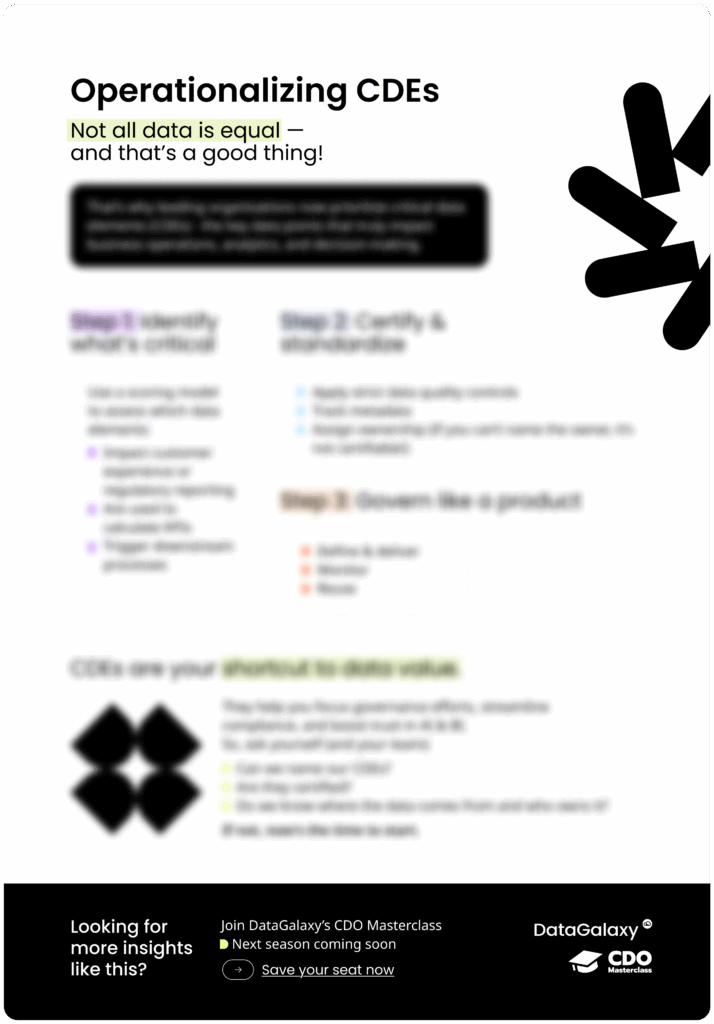
Operationalizing
CDEs
Do you know how to make critical data elements (CDEs) work for your teams?
Get your go-to guide to identifying and governing critical
data elements to accelerate data value.
Data quality
Governance without quality is an empty promise. Clear standards for accuracy, completeness, and consistency ensure that insights are sound and decisions are defensible.
With monitoring and validation built in, including data observability practices, you can catch problems before they spread downstream.
Access control
Role-based permissions, approval workflows, and audit trails protect sensitive information while keeping teams productive.
The right people. The right data. At the right time. That’s the goal.
Metadata management
Metadata transforms raw data into something usable. It tells you where the data came from, what it means, and how it flows through your ecosystem, a structured data dictionary is what makes this context accessible at scale. Metadata offers vital context that powers data discovery, compliance, and AI transparency.
So why is data governance important, and why do these components matter so much right now? Let’s talk about it.
Why does data governance matter so much?
Data governance powers every high-stakes initiative your teams touch: Scaling operations, deploying AI, and managing compliance. Without it? Friction, guesswork, and unnecessary risk.
Data governance builds trust
When everyone, from engineers to executives, knows where data comes from, how it’s managed, and what it means, confidence is built into every outcome.
Governance eliminates ambiguity and turns hesitation into action.
Data governance improves data quality
Quality doesn’t happen by accident. Data governance sets standards, assigns accountability via ownership, and monitors processes to keep data clean, complete, and ready for use.
No more crossed fingers and guesswork.
Data governance lowers risk
From GDPR to HIPAA, the rules are only getting stricter. Governance gives you visibility into sensitive data, audit traceability, and safeguards to prevent slip-ups.
It’s your best defense against regulatory pain and reputational fallout.
Data governance improves efficiency
Shared definitions. Clear responsibilities. Strong lineage.
Governance eliminates time spent hunting for data, fixing errors, or second-guessing its accuracy.
People spend less time troubleshooting and more time delivering results.
That’s why data governance is important, but what happens when it’s missing or weak?
Let’s break that down next.
Designing data & AI products that deliver business value
To truly derive value from AI, it’s not enough to just have the technology.
- Clear strategy
- Reasonable rules for managing data
- Focus on building useful data products

What happens when data governance fails
The consequences can be costly when governance is missing, misaligned, or just outright ignored.
Here’s what happens when things fall through the cracks:
Slower growth & wasted potential
When data is inconsistent or unclear, teams waste time second-guessing dashboards, rebuilding reports, or making cautious, low-confidence decisions.
- Sales teams target the wrong leads
- Marketing misreads campaign performance
- Product teams overlook key user behaviors
- In retail, poor governance can mean inaccurate inventory data feeding demand forecasts, leading to overstock, missed sales, or empty shelves
- In SaaS, it might mean churn risk models are built on outdated usage data, leaving renewal teams in the dark
Momentum stalls, opportunities slip through the cracks, and growth suffers.
Compliance failures & legal exposure
Data privacy laws aren’t slowing down – from GDPR to the EU AI Act, the rules are growing stricter, and the consequences more severe.
- In healthcare, weak data lineage can mean AI models train on outdated or incomplete patient records, risking both compliance and clinical outcomes
- In finance, poorly governed customer data can trigger violations of AML and KYC laws
When sensitive data becomes exposed or misused, companies pay the price through more invasive audits, fines, and public scrutiny.
Broken trust or broken brands
Governance lapses might look like technical slip-ups from the inside: a misconfigured policy, a misaligned algorithm, a mismatched record across systems. But from the outside? They feel like betrayal.
In an era where trust drives loyalty, even small mistakes can leave enduring scars.
Blink, your AI Copilot
Ask questions. Get answers. Drive action.
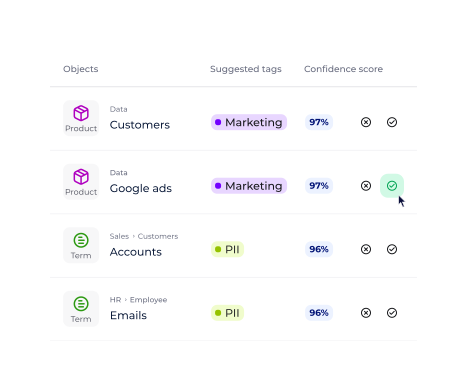
Blink helps every user explore, understand, and use data in their daily work. No tickets, no filters, no delays. Ask anything in your native language and get trusted, contextual answers and recommendations.
Security gaps that can invite trouble
You can’t protect your sensitive data if you don’t know where it lives, who owns it, or how it’s accessed.
Weak governance leaves gaps that can be exploited by bad actors. Strong frameworks are your best defense against internal mishandling and external threats.
Weak data governance creates risk at every level of your business. But the good news is that it’s never too late to course-correct, using a data maturity model to assess where you stand today and map a clear path forward.
Data governance for today’s AI world
Data governance isn’t new, but its importance is renewed and amplified in an era where AI fuels decision-making, privacy laws are tightening, and your business leaders demand answers at lightning speed.
In this world, data governance becomes the edge. It sharpens decisions, reduces risk, and gives your teams the clarity and control they need to move fast and build responsibly.
It’s not a roadblock – it’s a blueprint.
FAQ
-
How do I know if my data is “governed”?
-
If your data assets are documented, owned, classified, and regularly validated — and if people across your org trust and use that data consistently — you’re well on your way.
? Want to go deeper? Check out:
https://www.datagalaxy.com/en/blog/choosing-the-right-data-governance-tool/ -
How is AI governance different from data governance?
-
While data governance focuses on managing data quality, access, and compliance, AI governance extends those principles to models and algorithms. It includes monitoring for bias, ensuring explainability, and managing the lifecycle of machine learning models.
-
Can you govern AI without governing your data?
-
No — AI is only as good as the data it learns from. Poor data governance leads to biased models, opaque decisions, and compliance risks. Responsible AI starts with trustworthy, well-governed data.
-
How does DataGalaxy help with regulatory compliance?
-
The platform includes role-based access (RBAC), SSO, audit trails, and admin control over every object and user permission.
-
Can I compare DataGalaxy to other data catalog tools?
-
Yes. We provide detailed comparisons vs. Alation, Collibra, Atlan, and others — or you can request a personalized assessment.
At a glance
- Data governance is the framework that keeps data trustworthy, secure, and high-quality, enabling faster decisions, stronger compliance, and AI-ready foundations.
- Without it, organizations face risks like poor data quality, compliance failures, security gaps, and broken trust that slow growth and damage reputation.
- Strong governance transforms data into a strategic asset, powering efficiency, protecting sensitive information, and ensuring AI delivers accurate, ethical outcomes.