
As AI adoption accelerated across Sage, the challenge was no longer simply how to experiment with AI. It was how to scale AI initiatives responsibly, consistently, and with clear accountability.
Sage needed a governance model that could support innovation without creating another layer of complexity. One that could connect every AI initiative to the data it relies on, the people accountable for it, the risks involved, the decisions made, and the value it is expected to deliver.
With DataGalaxy, Sage extended its existing data governance foundation into a continuous AI governance model, creating a shared framework to evaluate, approve, deliver, and monitor AI initiatives throughout their lifecycle.
The challenge
Scaling AI meant scaling governance too
As the number of AI initiatives grew, Sage needed a consistent way to determine which projects should move forward, which teams needed to review them, and what conditions had to be met before deployment.
A traditional approval process was not enough. Governance needed to continue beyond the initial review and remain connected to each AI initiative as it evolved.
Sage needed to answer critical questions such as:
- What business outcome is this AI initiative designed to support?
- Which data products does it depend on?
- Who is accountable for the initiative?
- Which security, privacy, ethics, and compliance reviews are required?
- Why was an initiative approved, rejected, or approved under specific conditions?
- Is it continuing to deliver value after deployment?
- How does its risk evolve over time?
The objective was clear: give teams the guardrails they needed to innovate confidently, without turning governance into a bottleneck.
The approach
Bringing AI governance into the same operating model
Rather than creating a separate governance system for AI, Sage extended the operating model it had already built for data products.
Because DataGalaxy already contained ownership, lineage, governance information, and business context for Sage’s data products, AI initiatives could be governed in connection with the data ecosystem they depended on.
Each AI initiative can be linked to its underlying data products, governance rationale, ownership, approvals, and expected value. This gives teams a shared view of not only what the AI initiative is, but also why it exists, what supports it, and who is responsible for it.
A continuous AI governance lifecycle
From AI request to ongoing monitoring
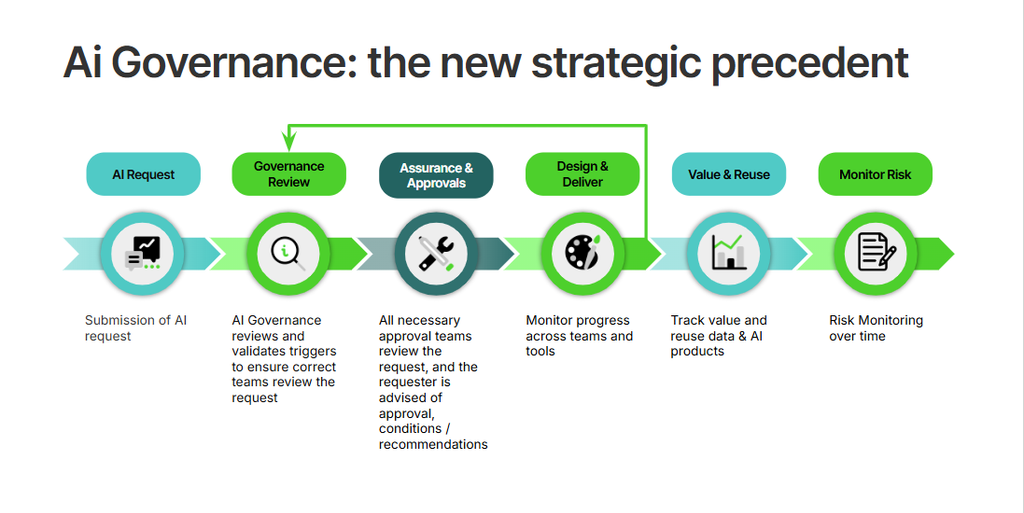
Sage built AI governance as a continuous process rather than a one-time compliance checkpoint.
1. AI request
Every new AI initiative enters a common governance process, creating visibility from the moment it is proposed.
2. Governance review
The initiative is assessed to determine which governance requirements and review teams need to be involved.
3. Assurance and approvals
Relevant teams evaluate the initiative and provide approval, conditions, or recommendations. The rationale behind those decisions is captured, creating clear accountability.
4. Design and deliver
Approved initiatives move into delivery using the same structured operating model already established for data products.
5. Value and reuse
Progress and business value are monitored over time, while teams can identify opportunities to reuse existing data and AI products rather than rebuilding from scratch.
6. Monitor risk
Governance continues after deployment. Risk is monitored throughout the lifecycle so changes can be detected and addressed over time.
How Sage Scaled AI Governance Across 100+ Use Cases
Turn AI governance principles into action. Get the complete guide to structuring trusted data, clear ownership, and the right context for responsible AI at scale.
AI Governance: The Complete Guide
Connecting AI governance to data context
AI cannot be governed in isolation
One of the key principles behind Sage’s approach is that AI governance starts with understanding the data behind AI.
Within DataGalaxy, AI initiatives can be connected to the governed data products they rely on, along with their lineage, ownership, business definitions, and governance information.
This creates a shared context across AI, data, governance, and business teams.
Instead of maintaining a standalone inventory of AI initiatives, Sage can understand the full chain:
Business objective → AI initiative → data products → ownership → governance decisions → risk → value
That context makes governance actionable. Teams can understand not only that an AI initiative exists, but whether the data supporting it is trusted, who is accountable, why decisions were made, and what value the initiative is delivering.
The impact
A governance model built to scale with AI
By extending its existing governance model to AI, Sage created a shared framework for managing both data and AI initiatives.
100+ AI use cases
Implemented under Sage’s extended governance model.
500+ data and AI use cases
Prioritized through a single governance pipeline.
One governance foundation
Connecting AI initiatives with data products, ownership, governance context, risk, and business value.
The result is an approach to AI governance that does more than control risk. It gives teams a structured path for moving the right AI initiatives forward while maintaining visibility and accountability throughout their lifecycle.
Key takeaway
AI governance works best when it is connected to context
Sage’s approach shows that effective AI governance is not simply about maintaining an AI inventory or adding another approval step.
It is about connecting AI initiatives to the data, people, decisions, risks, and business outcomes behind them.
By building AI governance on top of a trusted data foundation, Sage can scale AI innovation while keeping accountability and risk visible from idea to impact.
Suggested closing message:
Govern AI in context. Connect every initiative to the trusted data, ownership, decisions, risks, and business outcomes behind it.
How Sage Scaled AI Governance Across 100+ Use Cases
Turn AI governance principles into action. Get the complete guide to structuring trusted data, clear ownership, and the right context for responsible AI at scale.
AI Governance: The Complete Guide