AI innovation must be matched by equally powerful governance frameworks. However, across many industries, governance is frequently perceived as a limitation rather than a catalyst for positive business outcomes.
Artificial intelligence isn’t just advancing. It’s multiplying in enterprise applications.
In this article, we’ll explore two of the hottest trends in Gartner’s 2025 Hype Cycle: AI governance and augmented stewardship.
We’ll define what these concepts mean in practice, outline the opportunities and challenges they present, and show how DataGalaxy enables businesses to simplify governance, scale responsibly with AI, and empower both technical and non-technical stakeholders.
Gartner’s 2025 Hype Cycle for Data & Analytics Governance
According to the Gartner Chief Data and Analytics Officer (CDAO) Agenda Survey for 2024, 89% of respondents consider effective data and analytics governance essential for fostering business and technology innovation.
Gartner’s 2025 Hype Cycle for Data & Analytics Governance report evaluates the progress of D&A governance innovations across all use cases. The report also includes additional research that helps form a holistic view of D&A.
Download your free copy of the Gartner 2025 Hype Cycle for Data & Analytics Governance today!
AI governance & augmented stewardship: Gartner Hype Cycle leaders
In Gartner’s 2025 Gartner Hype Cycle for Data & Analytics Governance, AI governance and data observability emerge as the most influential innovations reshaping governance today.
Designing data & AI products that deliver business value
To truly derive value from AI, it’s not enough to just have the technology.
- Clear strategy
- Reasonable rules for managing data
- Focus on building useful data products

These trends underscore the need for governance platforms that can handle not only traditional data assets but also intelligent systems and lineage.
By leaning into AI governance and augmented stewardship, organizations can unlock trust, scale compliance, and engage non‑technical teams in governance, all while accelerating strategic AI value.
What is AI governance?
AI governance spans more than boxes on a checklist. It includes:
Policy enforcement and rule definition tailored to AI systems
Monitoring for bias, drift, and model fairness
Model lineage and observability, ensuring transparency from data input to algorithmic output
Operational oversight to assess AI decisions with data quality and compliance
The importance of AI governance
What is augmented stewardship?
Augmented stewardship leverages metadata, knowledge graphs, and generative AI to make governance accessible.
Rather than having governance confined to specialists, tools like AI copilots, glossary auto-generation, and lineage visualizations empower everyday users to understand and engage with governance actively. This participatory model works best when roles are clearly defined, knowing the difference between data owner vs. data steward ensures accountability flows to the right people.
Understanding the importance of augmented stewardship
- Bridges the technical divide: Non‑technical stakeholders can participate in governance without needing deep tech skills
- Enables participatory governance: Rather than gatekeeping, governance becomes collaborative with ownership and context
DataGalaxy’s augmented stewardship
DataGalaxy fuses technology and human insight to embody augmented stewardship:
Blink, DataGalaxy’s AI copilot
Helps users explore metadata, definitions, and lineage using natural language queries
Automated glossary generation
Reduces manual documentation burden
Smart suggestions (PII tagging, classifications)
Simplify stewardship at scale
DataGalaxy: Leading the way in AI governance
DataGalaxy isn’t just another data catalog. It’s a value governance platform enabling responsible AI and democratized governance.
1. Managing AI-ready data & automating governance
- Unified metadata and governance hub: Merges technical lineage, business context, ownership, and policies
- Policy definition, enforcement, and monitoring: Native within the platform to transform governance from static to actionable
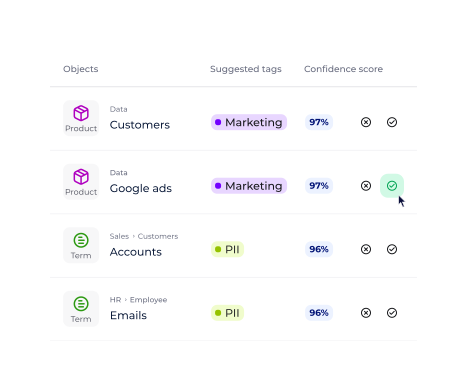
Blink, your AI Copilot
Ask questions. Get answers. Drive action.
Blink helps every user explore, understand, and use data in their daily work. No tickets, no filters, no delays. Ask anything in your native language and get trusted, contextual answers and recommendations.
2. Collaborative features for business + IT alignment
- Multi‑role collaboration: C‑suite, business stewards, IT, and compliance teams work in the same hub
- Governance campaigns: Teams can launch targeted projects like data ownership validation or quality improvements, with included tasks, timelines, and feedback loops
3. Self-service, scalability & simplicity
- Smart search and data product marketplace: Teams can discover and request data that’s certified and described in business terms
- AI copilot: Provides contextual guidance where decisions are made, reducing the learning curve
- Built‑in connectivity with 70+ data and BI tools: Ensures seamless adoption without disrupting existing stacks
How do I prepare for AI governance & stewardship today?
1. Data literacy & standardization
Equip teams with a common language through your glossaries, metadata definitions, and shared vocabulary.
You can also foster comfort exploring data governance tools. DataGalaxy’s business glossary tools and AI‑enriched definitions help build a culture of literacy on a user-friendly platform. Part of that literacy means understanding data owner responsibilities, who is accountable for data quality, access, and compliance at the dataset level.
2. Adopt metadata management & governance platforms
Move from spreadsheets and scripts to a unified platform that documents lineage, ownership, policies, and quality, keeping everything traceable and trusted. Knowing where your organization stands is the first step, a data maturity model helps you chart that progression and prioritize the right governance investments.
The 3 KPIs for driving real data governance value
KPIs only matter if you track them.
Move from governance in theory to governance that delivers.
3. Don’t be afraid to experiment
AI features like smart tagging, classifications, and search can help with human stewardship efforts, accelerate adoption, and show early ROI.
AI governance and augmented stewardship aren’t emerging trends. They are what’s happening now in big data.
Ready to see what’s next?
These innovations form the backbone of responsible, scalable AI adoption, enabling higher trust, agility, and participation across teams.
DataGalaxy is ready to help organizations unlock this value.
With capabilities to manage AI-ready data, automate governance, democratize collaboration, and connect strategy to data products, it delivers the tools you need today to thrive tomorrow.
Download Gartner’s Hype Cycle for Data & Analytics Governance 2025 to explore where AI governance, augmented stewardship, and observability intersect to reshape governance!
FAQ
-
Can you govern AI without governing your data?
-
No — AI is only as good as the data it learns from. Poor data governance leads to biased models, opaque decisions, and compliance risks. Responsible AI starts with trustworthy, well-governed data.
-
Does this help with regulatory frameworks like the EU AI Act?
-
Yes. DataGalaxy gives you visibility into data lineage, ownership, and usage policies — key pillars of AI compliance and model transparency.
-
How does a data catalog work?
-
It connects to your data sources and tools, ingests metadata automatically, and creates a centralized, searchable inventory of your assets. Advanced catalogs like DataGalaxy also provide lineage, collaboration, and governance capabilities.
? Want to go deeper? Check out:
https://www.datagalaxy.com/en/blog/utilizing-the-semantic-layer/ -
How can organizations implement AI governance?
-
Organizations implement AI governance by developing comprehensive frameworks that encompass policies, ethical guidelines, and compliance strategies. This includes establishing AI ethics committees, conducting regular audits, ensuring data quality, and aligning AI initiatives with legal and societal standards. Such measures help manage risks and ensure that AI systems operate in a manner consistent with organizational values and public expectations.
-
Is DataGalaxy a full alternative to Informatica?
-
Yes. DataGalaxy offers the full range of data catalog, governance, lineage, glossary, and collaboration capabilities — with a stronger focus on usability and cross-team adoption.
At a glance
- AI governance and augmented stewardship are now core drivers of responsible AI, ensuring fairness, transparency, and collaboration across both technical and non-technical teams.
- These approaches combat bias, meet rising regulatory demands, and simplify governance by making it participatory, accessible, and powered by metadata and AI copilots.
- DataGalaxy leads this shift with AI-ready governance, collaborative features, and automation that help organizations scale trust, compliance, and business value.