Secure your BCBS 239 compliance

The challenge: the urgency of financial transparency
-
The real-time challenge during market stress: In volatile markets, aggregating exposure data can no longer take days. Regulators now expect immediate response capabilities and rapid stress-testing evidence.
-
A direct impact on capital requirements: When a bank cannot prove the exact source of a figure in a regulatory report, authorities such as the ECB or the Fed may impose conservative capital add-ons, directly affecting profitability.
-
The gap created by siloed infrastructure: Connecting legacy mainframes, market databases, and predictive models without central visibility creates critical breaks in the audit trail.

Benefits for your organization
Immediate reduction in audit costs
Simplify ACPR, ECB, and regulatory controls by providing ready-to-use traceability evidence instead of spending months on manual documentation work.
Regulatory capital optimization
By reducing uncertainty around data quality, you help limit conservative capital buffers imposed by regulators and improve the allocation of your own funds.
Faster strategic risk steering
Turn a regulatory constraint into a decision-making asset. Leaders can rely on certified data to react faster to market movements and risk exposure changes.
Stronger operational efficiency
Remove time-consuming manual documentation tasks. Data Stewards and risk analysts can focus on active risk monitoring instead of hunting for data.
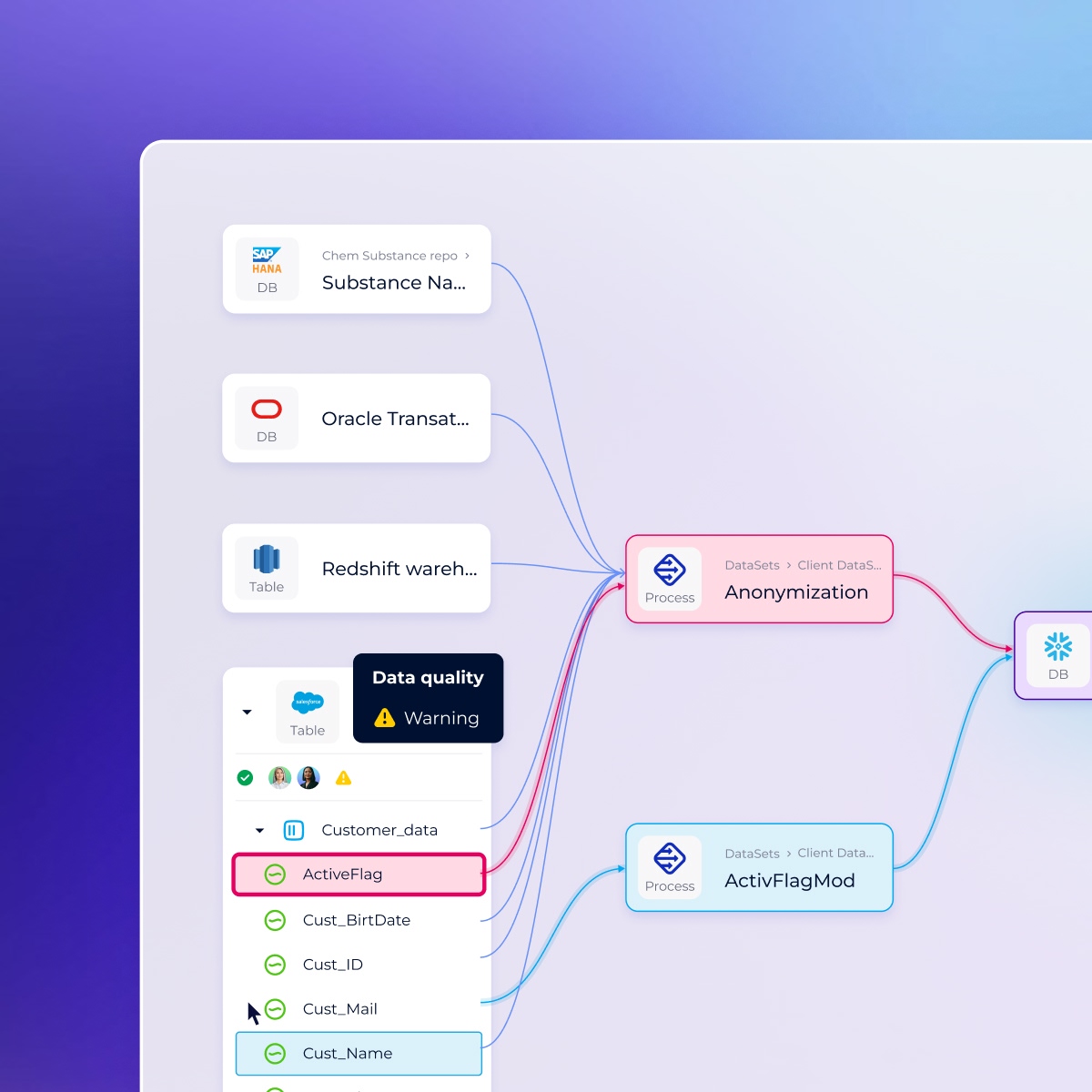
End-to-end lineage for risk aggregation
The platform automatically maps financial data flows and intermediate transformations. This visibility helps validate the robustness of your consolidation processes and instantly trace any anomaly detected in stress-testing reports back to its source.
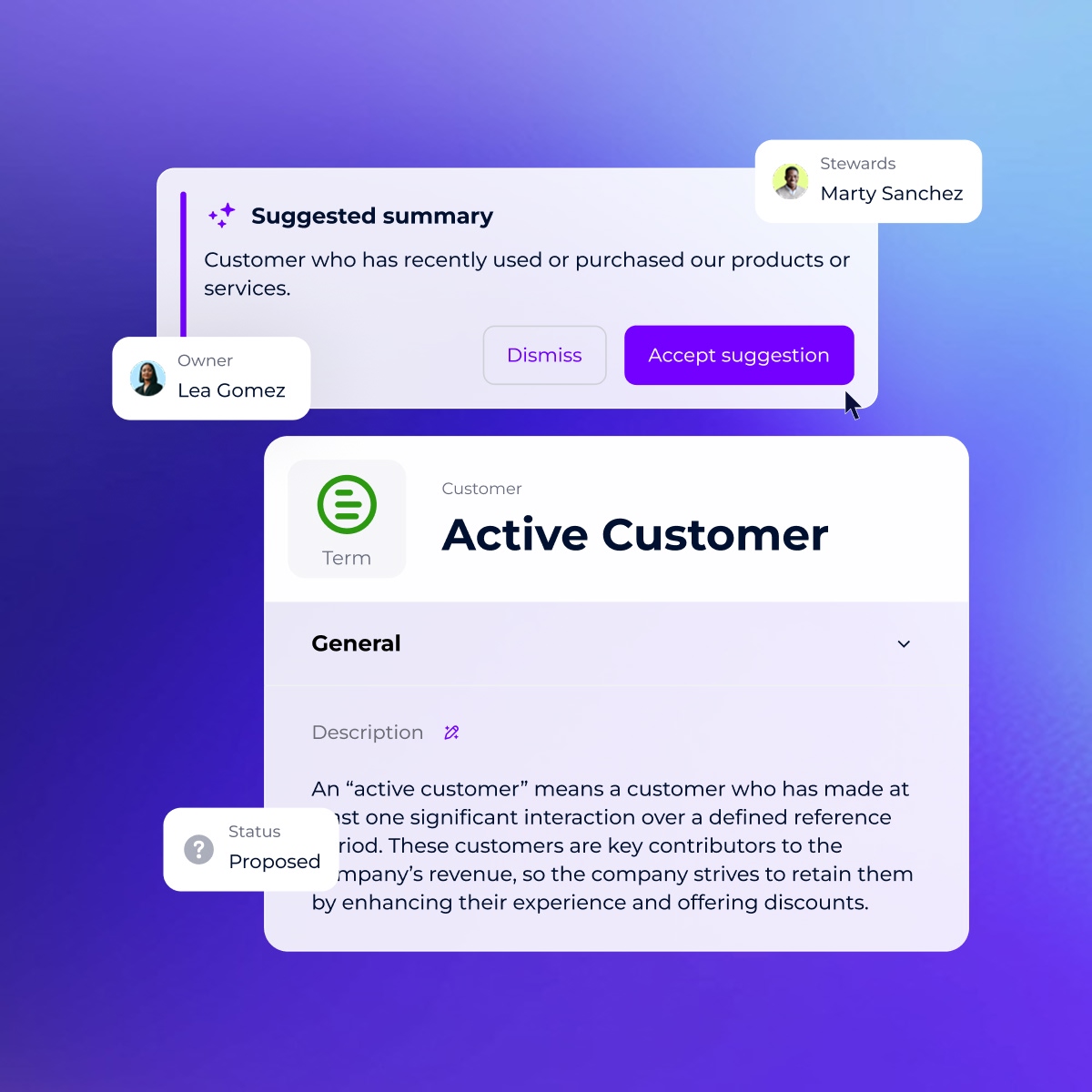
A single dictionary for risk concepts
Align risk, finance, and IT teams around one shared language. By centralizing calculation definitions and linking them directly to technical tables, your organization reduces interpretation gaps and ensures consistent regulatory reporting.
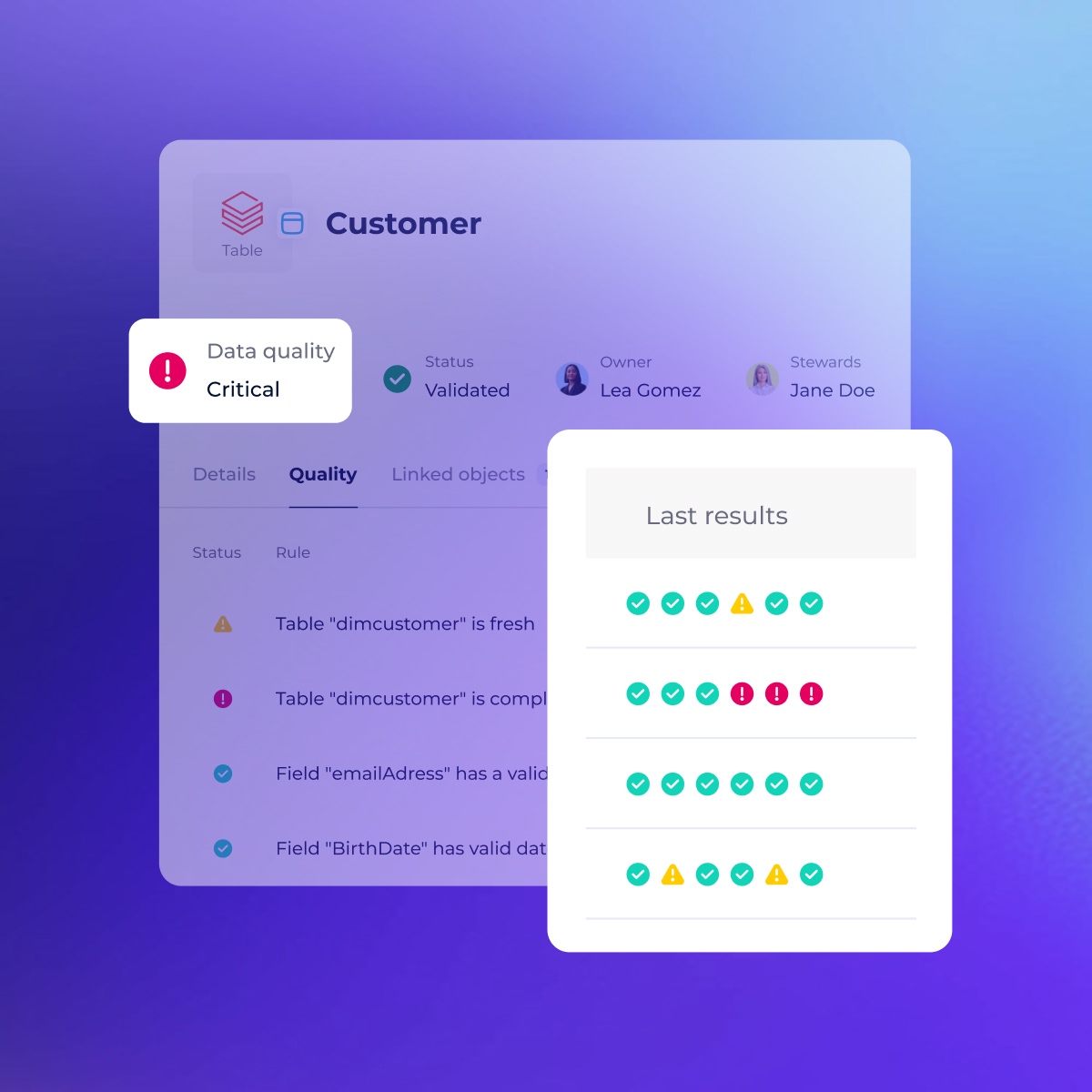
Embedded compliance controls and quality scores
Attach health indicators such as accuracy, freshness, and completeness directly to your data products. Control teams can visually identify weaknesses in the data supply chain before reports are submitted to authorities.
GDPR: what you do not trace can cost you
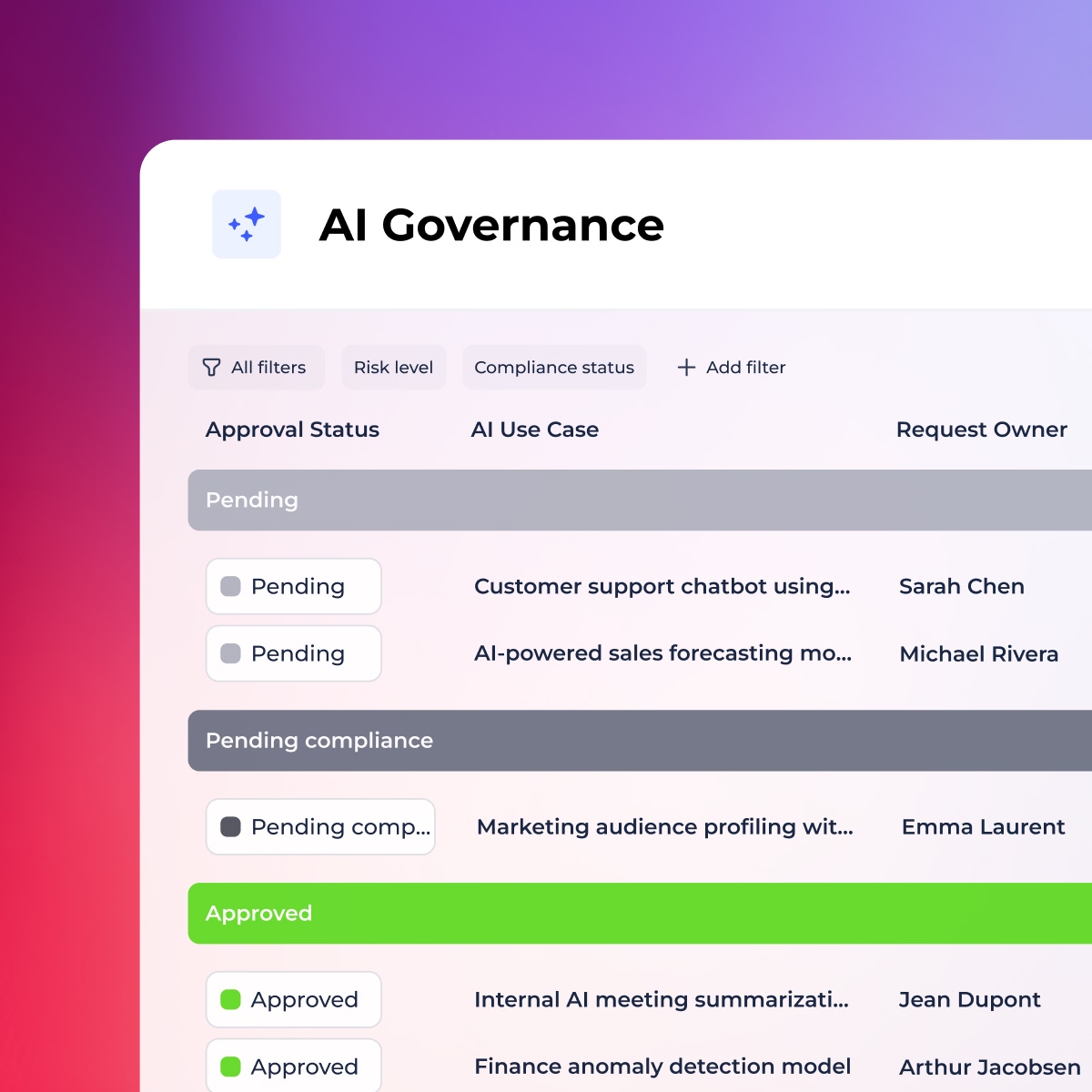
Watch our GDPR webinarFull transparency across actuarial and AI models
Document the origin, usage, and training criteria of machine learning and credit scoring models. Meet strict audit expectations around automated decision traceability and algorithmic risk control.

Request a demo
FAQs
- What is BCBS 239?
-
BCBS 239 is a set of principles issued by the Basel Committee on Banking Supervision to strengthen banks’ risk data aggregation and risk reporting capabilities. The principles address governance, data architecture, accuracy, integrity, completeness, timeliness, adaptability, reporting, and supervisory review. They were initially directed at systemically important banks, although supervisors may apply similar expectations more broadly.
- Is a data catalog enough to achieve BCBS 239 compliance?
-
A data catalog alone is not enough. BCBS 239 requires strong governance, suitable architecture, reliable aggregation processes, effective reporting practices, validation, and management oversight. DataGalaxy supports these efforts by centralizing metadata, lineage, definitions, ownership, policies, and quality context. Banks must combine these capabilities with appropriate technology, controls, operating models, and supervisory remediation processes.
- How does data lineage help meet BCBS 239 requirements?
-
Data lineage shows how risk data moves from operational systems through transformations and aggregation processes into management or regulatory reports. It allows teams to trace reported figures back to their source, investigate anomalies, and assess the impact of changes. These capabilities support BCBS 239 expectations around accurate, reliable, and documented risk data aggregation, particularly across complex banking architectures.
- How does DataGalaxy support BCBS 239 compliance?
-
DataGalaxy provides a shared metadata foundation for documenting risk data, definitions, ownership, policies, quality information, and technical dependencies. Banks can use the platform to connect risk concepts with their source systems, transformations, calculations, and reports. This improves transparency across risk, finance, business, and IT teams and helps produce traceability evidence for internal validation, audits, and supervisory reviews.
- How can a business glossary support BCBS 239?
-
A business glossary creates shared definitions for risk measures, entities, products, exposures, and reporting concepts. DataGalaxy connects these definitions to physical data fields, calculations, owners, and reports. This helps reduce interpretation gaps between risk, finance, business, and IT teams. It also supports the BCBS 239 expectation that banks establish integrated taxonomies, metadata, identifiers, and clear ownership responsibilities.