About the author: Ellen Du
Digital Marketing Manager
Ask three leaders which AI project delivers most and you get three answers, with no numbers behind any of them. An AI use case prioritization framework replaces those opinions with one method: score every project on the same criteria, stop risky ones at a gate, and rank the rest on a matrix.
An AI use case prioritization framework is one shared way to score every AI project on business value, strategic alignment and feasibility, gate it on risk, and rank it on an impact-versus-complexity matrix. It sends funding to the projects most likely to pay off, and it shows why.
What sets it apart from a simple scoring sheet is risk: it works as a gate, not a score, so a project that scores well can still be stopped. The matrix then turns the scores into a ranking that leadership can defend, because every project was judged the same way.
Most organizations don’t lack AI ideas. They lack a way to choose between them. Prioritization tends to break down in four places:
Opinion beats evidence. The project with the loudest sponsor gets funded, not the one with the strongest case.
Value claims can’t be compared. Each team measures impact its own way, so one project’s “big win” can’t be weighed against another’s.
Risk shows up after funding. Privacy, ethics or regulatory problems surface once the budget is spent and the team is staffed.
Teams take on more than they can deliver. Too many projects start at once, and most stall as pilots.
Left alone, AI portfolio management drifts into a ghost portfolio: projects nobody can fully account for, still consuming budget, with no record of what they were meant to deliver.
Good candidates come from three places: business pain points, intake requests from teams, and existing initiatives that AI could improve. Whatever the source, write each one up the same way. Scoring only works when every candidate is described in the same terms.
Map business pain points across departments: how often the problem occurs, what it costs and who it affects.
Collect intake requests from business leaders who already see where AI could remove friction.
Review existing initiatives that could benefit from AI without starting from zero.
Check the data each one depends on: does it exist, can the team access it, and is it documented?
Write a one-page brief per candidate: the problem, the expected impact, the data it depends on and the sponsor.
Three to five well-documented candidates are enough to start. A long list of vague ideas is harder to rank than a short list of clear ones.
Steps one to three are each scored from 1 to 5, step four is a gate, and step five turns the result into a ranking. Agree on what a 1 and a 5 look like before anyone scores, so two people scoring the same project land in the same place.
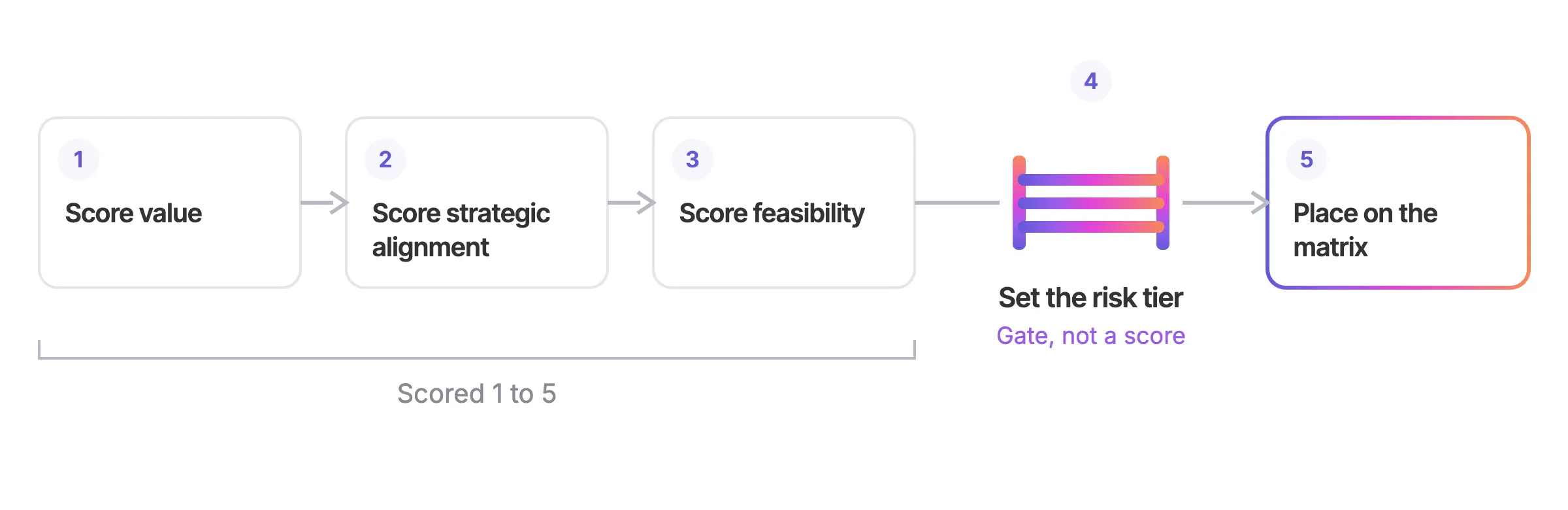
| Criterion | What a 1 looks like | What a 5 looks like |
|---|---|---|
| Business value | No clear financial or operational gain, or value only years away | A measurable gain in cost, revenue or efficiency, visible within a few months |
| Strategic alignment | Not tied to any stated business objective; no committed sponsor | Directly supports a top business objective, reusable across domains, with a committed sponsor |
| Feasibility | Data missing or undocumented, heavy effort, skills or technology not in place | Data available and documented, modest effort, skills and technology already in place |
Score financial impact, operational impact and time to value. A project that improves a metric the business already tracks, within months, scores higher than one that needs years before it shows results.
Ask each sponsor to name the metric the project will move and how they will measure it. A claim like “better customer experience” earns a low score until it is tied to something measurable, such as handling time, error rate or cost per transaction. That one question filters out many inflated claims before scoring starts.
Score fit with a top business objective, reuse across domains and sponsor commitment. A use case that serves one of the company’s stated priorities and can be reused by other teams earns a higher score. A named sponsor who will defend the budget matters as much as the idea itself.
Alignment also protects the roadmap later. When budgets tighten, projects tied to a stated business objective keep their funding; side projects are the first to go. Scoring alignment up front tells you which projects will survive that conversation.
Score data readiness, effort, and the skills and technology the project needs. On this scale, 5 means easy. Data readiness is the usual surprise: score it against the actual datasets, glossary terms and policies the use case depends on, not a guess. A project built on undocumented data costs more and takes longer than its sponsors expect.
Effort and skills deserve the same honesty. A use case that needs a new platform, a team the company hasn’t hired yet, or months of integration work should score low here, however attractive its value score. Score what the team can deliver with what it has today.
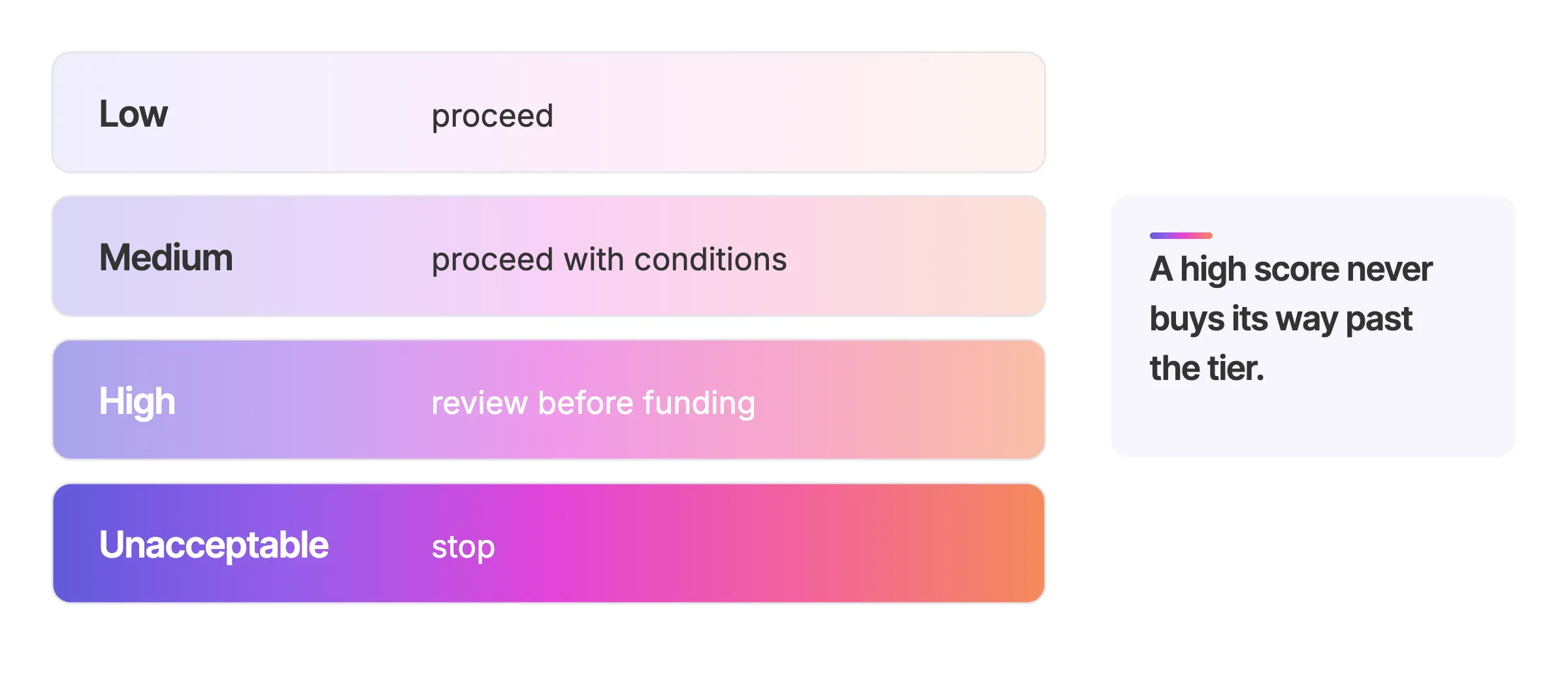
Risk doesn’t go into the score. It decides whether the project can go ahead at all. Three inputs set one tier for each project: its category under the EU AI Act, privacy and ethics concerns, and delivery risk.
Low: proceed.
Medium: proceed with conditions, such as extra testing or human review.
High: review before funding.
Unacceptable: stop.
The EU AI Act shapes this step directly. Practices it prohibits, listed in Article 5, belong in the Unacceptable tier. Uses it classes as high-risk, set out in Article 6 and Annex III, start at High and need review before any funding. A high score never buys its way past the tier.
Plot each project that passes the gate by impact (from steps one and two) against complexity (from step three). Each quadrant calls for a different decision:
Must-have: high impact, low complexity. Fund these first.
Strategic investment: high impact, high complexity. Plan and fund them deliberately, often in stages.
Quick win: lower impact, low complexity. Do them when capacity allows; they build momentum.
Discard: low impact, high complexity. Drop them and free the budget for better candidates.
The matrix is not permanent. Scores change as data gets documented, sponsors change or regulations evolve, so re-plot every project at each review. A strategic investment today can become a must-have once its data is ready.
Here is the AI use case prioritization framework applied to four fictional projects. The companies and projects are illustrative, not customer data.
Invoice anomaly detection: must-have. Clear financial value, built on finance data the team already has, low delivery risk. Fund it first.
GenAI customer service assistant: strategic investment, High risk tier. Strong value and alignment. The EU AI Act doesn’t class a customer service assistant as high-risk (it mainly has to tell users they are talking to an AI), but accuracy, customer-facing use and privacy put it in the High tier. It goes to review before funding, then a short discovery phase to test the assumptions.
Churn model refresh: quick win. Modest impact, but the model and data pipelines already exist. Easy to deliver when capacity frees up.
HR self-service dashboard: discard. Low impact and difficult integrations. Dropping it frees budget for the projects above.
Notice what the risk gate did. On scores alone, the GenAI assistant might have ranked first: high value, high visibility, an enthusiastic sponsor. The gate doesn’t kill it, but it stops the project from being funded before anyone has checked what it does with customer data and how it handles wrong answers.
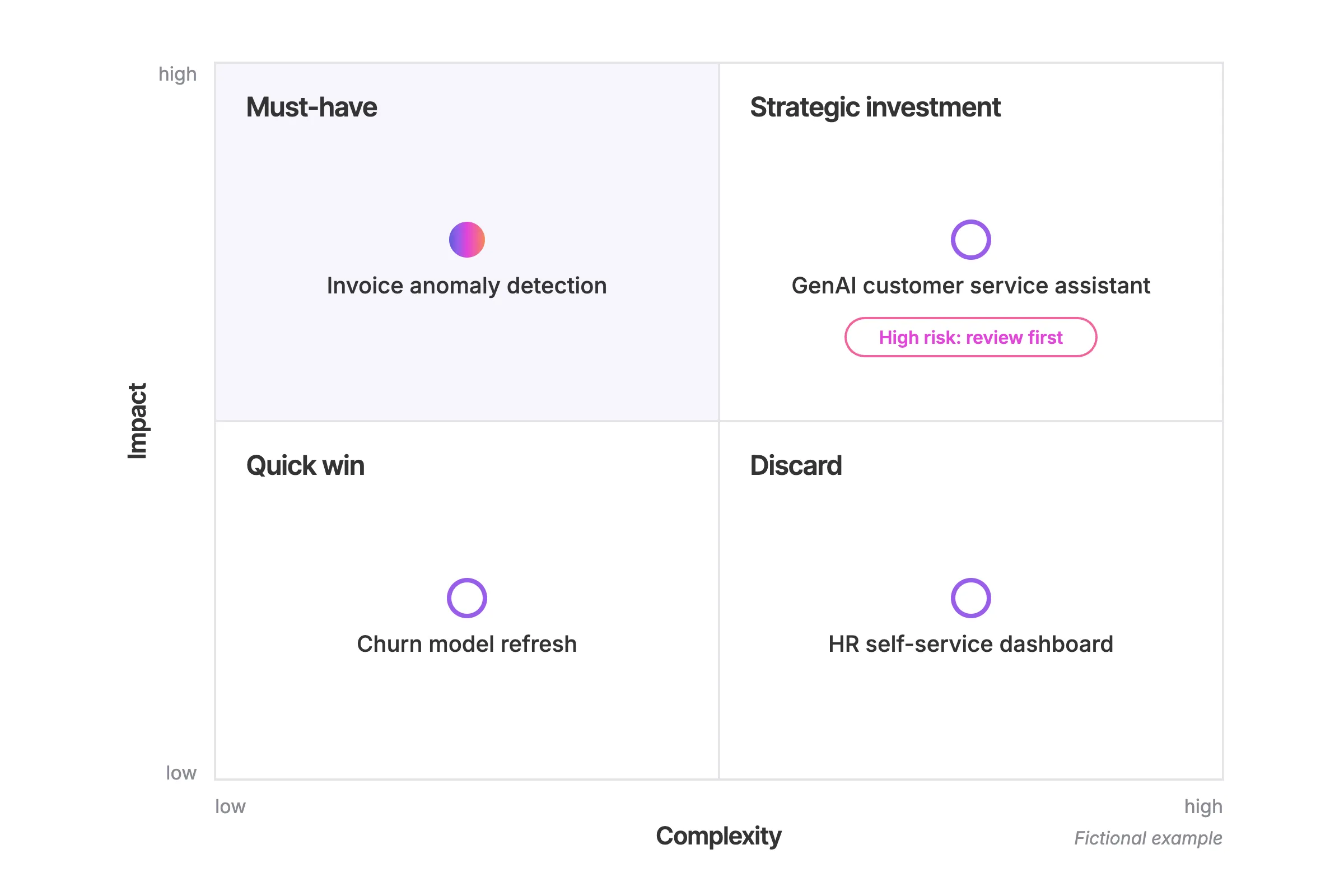
Laid out this way, the trade-offs are visible at a glance, and every decision has a reason a sponsor can read. Want to do this with your own pipeline? Rank your own AI projects in a 45 minute workshop.
A ranking only matters once it decides what gets funded. Sort the projects that passed the gate into three horizons:
Now: the must-haves, plus quick wins the team can deliver alongside them.
Next: strategic investments, once their discovery work or risk review is done.
Later: everything else that passed the gate, kept on the list until capacity frees up.
Then fund in rank order until capacity runs out, and stop there. Spreading budget across every approved idea is how pilots stall. Capacity here means people and data work, not only budget: a project that needs the same data engineers as two others has to wait its turn. Keeping visibility across your AI portfolio also shows dependencies between projects, such as a data investment in one horizon that unlocks several use cases in the next.
Share the whole ranking, not just the winners. Sponsors whose projects didn’t make the cut should see where they landed and what would move them up: better-documented data, a clearer metric or a lower risk tier. That keeps the next round of candidates stronger, stops the same unfunded ideas from coming back unchanged, and turns the AI use case prioritization framework into a standing process rather than a one-off exercise.
A spreadsheet ranking holds for a quarter. Then nobody maintains it, and it can’t show what any project delivered. Priorities only stay credible if each project is tracked after launch against what it promised.
AI Use Cases Portfolio links each use case to the datasets, glossary terms and policies it depends on in the DataGalaxy Catalog, so the ranking stays tied to real data and gaps show up early. It also follows milestones, adoption, costs and realized value over time, so you can see whether each project delivers what it promised. AI Value Tracking keeps assessing costs, performance, quality, risks and business outcomes after delivery, until the initiative is retired, so you can stop projects that no longer deliver.
Large organizations already work this way. Roche runs 300+ data and AI initiatives with value tracking. Sage prioritized 500+ data and AI use cases through a single governance pipeline.
45 Minute Workshop
Rank your own AI projects in 45 minutes
Bring three to five AI project write-ups. Leave with a ranking matrix, a first roadmap and a register template for new AI use cases.
A small cross-functional group: a data or AI leader, business sponsors and a risk or legal representative. The data leader runs the process and keeps the scoring consistent. Business sponsors defend value. Risk sets the tier. No single function should rank projects alone, or the ranking reflects only its own concerns.
Re-rank every quarter, and whenever something material changes: a new regulation, a shift in strategy, or a project missing its milestones. A quarterly rhythm keeps stalled projects from holding budget. New candidates join at the next review, so the list stays current without constant reshuffling.
It is the front door for new AI ideas: a sponsor submits a short brief, the team scores it, risk sets its tier, and approved projects join the ranked list at the next review. It keeps the framework fed with comparable candidates. For the governance around it, see our key considerations for an AI governance framework.
Write every candidate up the same way. Agree on what a 1 and a 5 mean before scoring. Treat risk as a gate, not a score. Fund in rank order until capacity runs out. Track value after launch and re-rank quarterly, so the list reflects what projects actually deliver.
Digital Marketing Manager