
Joe Reis is a “recovering data scientist” and a business-minded data nerd who's worked in the data industry for 20 years, with responsibilities ranging from statistical modeling, forecasting, machine learning, data engineering, data architecture, and almost everything else in between.
AI and Traditional Data Practices in 2026: What Still Works, What Doesn’t, and What Leaders Are Doing About It
5 January 2026 │ 9 mins read │ AI Data Governance Data Quality by Joe Reis, Author, Data Engineer, Recovering Data Scientist

Summarize with AI
A conversation with Joe Reis, author and host of The Joe Reis Show, on why the unsexy fundamentals of data management have become the most strategic investment leaders can make in 2026.
For the past two years, every board meeting started with the same question: what’s our AI strategy. Decks were built. Pilots were funded. Vendors were selected. And in early 2026, the same boards are starting to ask a more uncomfortable one: what’s actually working.
The uncomfortable part isn’t that the answer is incomplete. It’s that the answer keeps coming back to things nobody wanted to hear two years ago.
The unsexy comeback of data governance
In 2023 and 2024, data leaders were under pressure to chase the shiniest AI experiments. ChatGPT had made generative AI feel like a magic wand, and every board wanted to transform its business with chatbots, copilots, and agents. Two years in, the picture looks very different.
According to Deloitte’s State of the CDO survey, 51% of Chief Data Officers now cite data governance as their top priority. Not AI. Not agents. Governance. The unsexiest topic in the industry is suddenly the one everyone is quietly rushing back to.
Why? Because the force of gravity always wins. When OpenAI recently tried to deploy shopping agents, they hit a wall that will sound painfully familiar to anyone who has worked in enterprise data: the underlying data was a mess. They ended up going back to basics: data modeling, classification, ownership… the very practices many believed AI would make obsolete.
As Joe Reis puts it: “Boring works. You don’t get extra points for complexity.”
Why agents need the work everyone tried to skip
There’s a recursive irony at the heart of the current AI wave. For a brief moment, the industry convinced itself that large language models would absorb the work of data management; that semantic layers, glossaries, and ontologies were relics about to be swept away by models smart enough to figure out context on their own.
The reverse is happening. Agents are only as good as the context they can access. And context in an enterprise means exactly what data management has always been about: clear definitions, trusted ownership, traceable lineage, and a shared vocabulary between business and data.
A great illustration comes from outside the enterprise world. Joe shared the story of his local climbing gym, where the CEO — a non-technical founder — discovered Claude Code and automated entire workflows in weeks. Tasks that used to take 30 hours, like reading PDFs and entering data into QuickBooks, now take five minutes. The key difference? “We didn’t have any real habits to break,” the CEO told him. No institutional inertia. No turf wars. No 15-year-old data warehouse nobody wants to touch.
That’s the unspoken tax on most enterprises: it’s not the technology that’s hard, it’s the accumulated complexity underneath.
The ownership problem nobody wants to solve
One theme kept coming up in the conversation: ownership. Despite years of industry analysts calling it out, most organizations still don’t know who owns their critical data. Data exists, but no one wants to be accountable for it. Without ownership, no governance framework survives contact with reality, and no AI agent can be trusted to act on data without a human on the hook for the outcome.
The organizations that get this right are the ones rethinking their operating model from day one. Chief Data Officers (increasingly rebranded as Chief Data and AI Officers) are spending their first 100 days not picking tools, but building structures: identifying data owners across business lines (claims, risk, finance, marketing), setting KPIs tied to business outcomes, and embedding AI into the operating model rather than bolting it on top.
This is where automation genuinely helps. Tasks like classification, tagging, and documentation, the mundane work that nobody wanted to do anyway, are exactly where AI shines. The role of the data steward shifts from manual labor to exception handling and validation, which is a much more strategic position.
From outputs to outcomes: the maturity signal of 2026
One of the strongest signals of maturity in 2026 is the shift from output-based to outcome-based data strategies. Leaders are no longer measured on how many data assets they’ve documented or how many dashboards they’ve shipped. They’re measured on whether their work moves the business needles of revenue, risk, cost, and/or customer experience.
This is why concepts like data products, data mesh, and federated governance are resonating now. They put accountability closer to the people who actually know the data, while keeping central guardrails in place. The old model — a small central team trying to document everything for the whole enterprise — has never really worked at scale.
It also explains why semantic layers, ontologies, and knowledge graphs are suddenly everywhere. For decades, the worlds of data engineering and knowledge management lived in parallel. AI is finally forcing them to collide. If you want an agent to answer a business question reliably, it needs more than rows and columns — it needs meaning, relationships, and context.
Non-invasive data governance: the mindset shift
One of the most quietly important shifts in the industry is the move toward what Robert S. Seiner calls non-invasive data governance. For years, governance programs were launched like police actions: here are the rules, here are the Ten Commandments, now follow them. And it was no wonder that adoption was poor and resentment was high.
The new school, championed by practitioners like Seiner and Winfried Etzel, treats governance as a mindset, not a department. Everyone in the organization, including AI agents, operates with some degree of auditability, ownership, and accountability. It’s less about control and more about enabling trust at scale.
This is especially relevant as AI pushes governance into new territory: how do you govern the output of a generative model? How do you manage drift in a synthetic dataset? How do you document an AI model the way you document a table? These are open questions, but the answer will not come from top-down mandates. It will come from federated, embedded governance practices that every team adopts as part of how they work.
What CDOs should do about it in 2026
For CDOs and data leaders looking at 2026, the playbook isn’t revolutionary, it’s disciplined.
Go back to the fundamentals: know your critical data, assign owners, build a trusted semantic layer, and treat metadata as a first-class citizen. Use AI to accelerate the boring work of classification and documentation, not to replace the thinking. Tie every initiative to a clear business outcome, and be willing to measure it.
And above all, build feedback loops. The clock speed of business is accelerating, and the organizations that will win are the ones that can iterate fast on what’s working. As Joe Reis put it near the end of the conversation: “Don’t just whiteboard ideas; go build them. Everyone has the same tools these days. The differentiator is who moves faster and better.”
The companies that treat data management as boring infrastructure will always be chasing the next hype cycle. The ones that treat it as a strategic foundation for AI will be the ones who actually industrialize it.
Watch the full conversation with Joe Reis on the webinar replay, and explore how DataGalaxy helps organizations build the metadata foundations their AI strategy actually needs.
Q&A
Why are traditional data practices making a comeback in 2026?
Because AI exposes the gaps that traditional practices were designed to close. Agents, copilots, and generative models are only as good as the context they have access to — and context in an enterprise means clear ownership, trusted definitions, traceable lineage, and a shared vocabulary. Two years of generative AI experiments revealed that organizations without these fundamentals could not industrialize their AI initiatives. According to Deloitte’s State of the CDO survey, 51 % of CDOs now cite data governance as their top priority — ahead of AI itself.
What is non-invasive data governance?
Non-invasive data governance, a concept championed by Robert S. Seiner, treats governance as a mindset and an enabling practice rather than a top-down police action. Instead of writing rules and forcing teams to comply, it embeds governance into how people already work — with ownership, auditability, and accountability built into existing workflows. This approach scales better than traditional governance programs because it generates adoption rather than resentment, and it extends naturally to AI agents that need the same accountability structures as humans.
Why do most AI initiatives still fail to industrialize?
Three main reasons. First, lack of ownership: most organizations cannot identify a single accountable owner for their critical data, which makes any AI initiative fragile. Second, accumulated complexity: enterprise data stacks have years of legacy decisions that AI cannot magically untangle, as OpenAI discovered when trying to deploy shopping agents. Third, output-focused thinking: many leaders still measure success by how many models or dashboards they shipped, rather than by the business outcomes those models actually moved.
What is the difference between outputs and outcomes in AI strategy?
Outputs are what your team produces: dashboards built, models deployed, datasets documented. Outcomes are what changes in the business as a result: revenue gained, risk reduced, costs saved, customer experience improved. The maturity shift in 2026 is that data leaders are increasingly measured on outcomes rather than outputs. This is why concepts like data products, data mesh, and federated governance are resonating now — they explicitly tie data work to business value rather than treating documentation as the deliverable.
How should CDOs prepare for AI in 2026?
By going back to the fundamentals — with discipline. Know your critical data, assign clear owners, build a trusted semantic layer, and treat metadata as a first-class citizen. Use AI to accelerate the boring work of classification and documentation rather than to replace strategic thinking. Tie every initiative to a measurable business outcome. And build fast feedback loops, because the clock speed of business is accelerating and the differentiator is no longer who has the best technology, but who can iterate fastest on what works.
Related posts

What is the best tool for a retail company trying to scale AI personalization when every team is working from a different version of the data?
Retail AI personalization fails when every team uses a different version of the data. Compare DataGalaxy, Databricks, Atlan and Collibra.

MCP and AI context: How MCP connects agents to enterprise knowledge
The Model Context Protocol, or MCP, is quickly becoming part of the enterprise AI conversation. Its appeal is easy to understand. Instead of building a different custom integration every time an AI assistant or agent needs to interact with an external system, MCP provides a standardized way for AI applications to connect to tools, data […]

How to evaluate context layer tools for enterprise AI
As enterprise AI moves from experimentation into real workflows, more technology vendors are talking about context layers. The challenge is that the term can describe very different approaches. One platform may specialize in semantic definitions. Another may focus on agent memory. A data catalog may expose governed metadata to AI, while a cloud data platform […]

Context layer vs. data catalog vs. semantic layer: What’s the difference?
As organizations connect AI assistants and agents to enterprise data, several familiar parts of the data stack are taking on new roles. Data catalogs organize and govern data knowledge. Semantic layers standardize business meaning. Governance systems define how information should be used. Now, the context layer is emerging as a way to make this knowledge […]

What is a context layer? A guide to context for enterprise AI
A context layer gives AI systems the business meaning, relationships, trust signals, and rules they need to understand and use enterprise data correctly. Giving an AI assistant or agent access to a database is relatively straightforward. Helping it understand what the data actually means inside your organization is much harder. A table might contain a […]
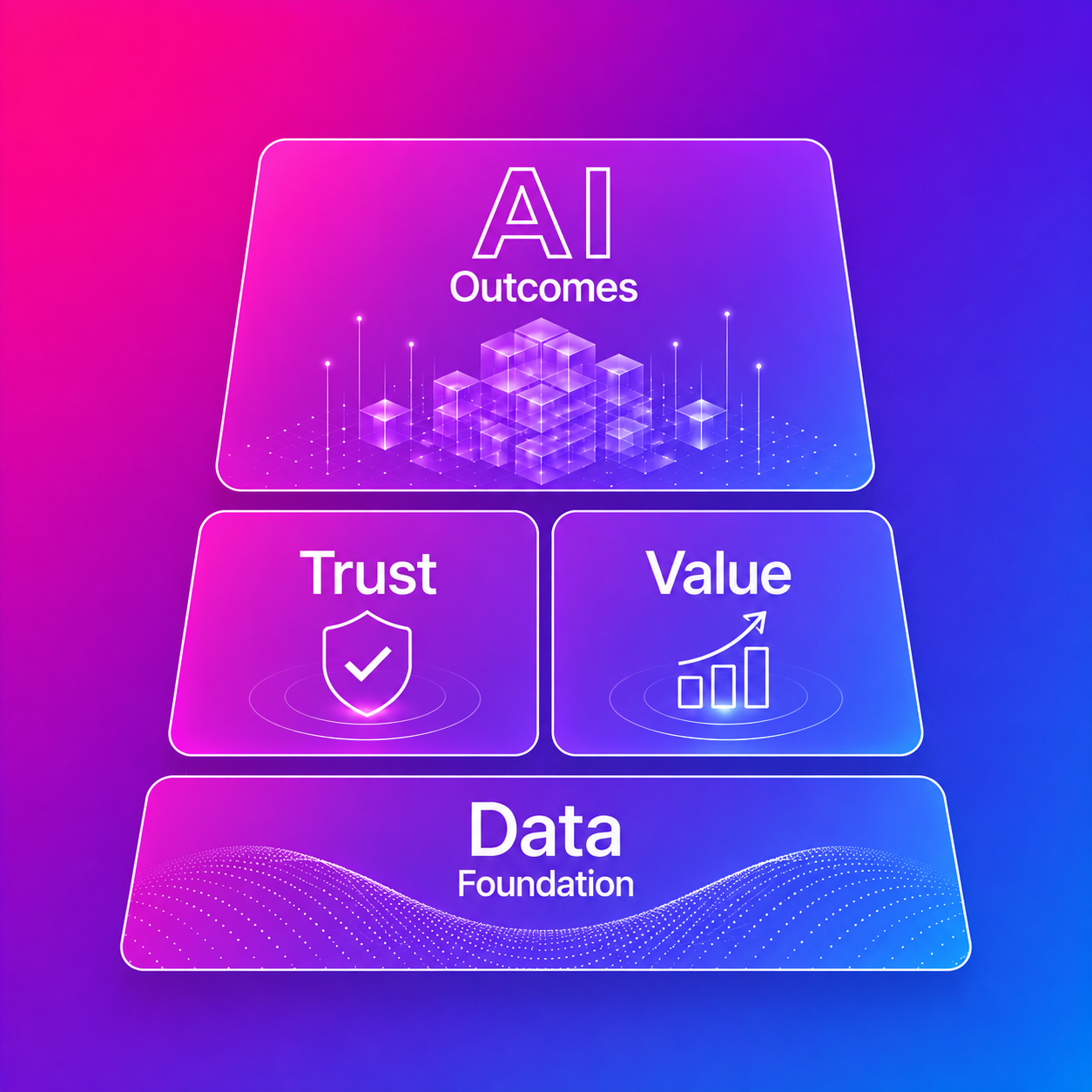
The missing layers: Why trust and value decide who wins at enterprise AI
Published in Business Reporter The most expensive line item in enterprise AI is no longer compute – it is the gap between what AI promised and what it is actually delivering. After two years ofpilots, boards have stopped asking what AI can do and started asking what itreturns. By 2027, Gartner forecasts that 80 per […]